Showing posts with label Chuck Hagel. Show all posts

Monday, December 1, 2014

Editorial: Shifting from Crisis to Crisis

Editorial


One reason it is hard to pin down what is going on in the U.S. is that there is such a frequent change of focus. One day we are talking about Fast and Furious, after that the IRS scandal, then Obamacare, then Cabinet Secretaries resigning, then unaccompanied alien minors, then executive orders, then Ferguson, then....


It is so hard to pinpoint targets that move so much. One solution is to pick ONE item and focus on working on that, and then, after it is dealt with, then move on to the next item of importance to you. This will work no matter how much the media and the president try to keep the continual change of topics!


Wednesday, August 13, 2014

Religious Freedom - Never Take It For Granted

An interesting article from http://www.ucg.org/ about the Islamic State. This follows this post about traditional values. For a free magazine subscription or to get the books recommended for free click HERE! or call 1-888-886- 8632.
I am leaving TWITTER SOON. Please continue to follow me here.


Religious Freedom - Never Take It For Granted


The Islamic Caliphate now called IS, is driving out Christians from Iraq. There is a sobering lesson here for all.


Media Download Options [ Download Media: right-click on link ]
filesVideo
MP4 Video
Video
MP4 Video - Low Quality
Audio
MP3 Audio - Religious Freedom - Never Take It For Granted


[Darris McNeely] The world is watching, horrified at events that are taking place in the Middle East and particularly in the nation of Iraq with the proclamation of an Islamic caliphate by a group that a few weeks ago we were calling – a group called Isis, signifying an Islamic state. Now, they're calling themselves just "I.S." for Islamic State – a group of terrorists who have taken over a very large portion of what has been modern day Iraq and the state of Syria as well. And they have proclaimed an Islamic caliphate and they are claiming themselves, with their leader, to be a legitimate, bona fide state now – a newly created state, in their mind at least, unrecognized by others there in the Middle East. And what they have been doing in recent weeks has astonished and stunned many, as they have bombed religious sites that date back more than 1500 to 1900 years. One of the latest things that they have done is begin to drive out people who are members of Christian groups, Christian sects, in Iraq, in a Muslim state, and forcing them to flee to other protected areas. There's one report of upwards of 50,000 people being trapped right now in a mountainous area as they have fled their home from this I.S. group, for their own safety. Essentially what they have been told is, you either convert to Islam or we will kill you. And many have chosen not to go that route to convert, and they have fled, and now they face a massive humanitarian crisis.
In looking at this, it is easy to realize and think it is just way off, it doesn't concern us, we have religious freedom, we have freedom to worship God as we choose in the United States and other western nations – which is true. But we should not fail to take note of what is taking place over there with a proclaimed state now persecuting a minority within their boundaries, and killing and uprooting it and creating these problems. Bible prophecy talks about an end time political power – not the one we're looking at right now in Iraq, a larger one, a more pervasive one yet to appear – who, it says in Revelation:13:7, "will make war with the saints." Revelation:13:7. Now that is to come. But what we're looking at right now at least is a forerunner, in a sense, of later events and something we should take note of – certainly just how precious our own personal freedoms are guaranteed by whatever state we live in, again in the western world. But also, pray "Thy kingdom come" and to help and to have a certain amount of sympathy for others who are trapped right now in a very, very precarious situation, contending for their own faith as it is.
The Bible portrays a greater time coming ahead for all of us, and it should give us all pause to consider the fragility of our present world, and certainly to pray "Thy kingdom come."
For BT Daily , I'm Darris McNeely. Join us next time.
Nobody has commented yet. Be the first to kick off the discussion!
Login/Register to post comments

Friday, June 6, 2014

70 Years After D-Day: From Power to Impotence

An interesting article from http://www.ucg.org/ about America and D-Day. This follows this post about China after Tiananmen square.  For a free magazine subscription or to get the book recommended for free click HERE! or call 1-888-886- 8632. You can follow me at blogspot here and at twitter here https://twitter.com/brianleesblog. Please consider following both in case one goes down!


70 Years After D-Day: From Power to Impotence


Seventy years ago, an American-led Allied invasion on the beaches of Normandy marked the beginning of the end of the grip of tyranny over Europe. In little more than a year, the United States would emerge as a superpower and world policeman. Contrast that to today, when that superpower is in retreat—its influence and power rapidly declining.
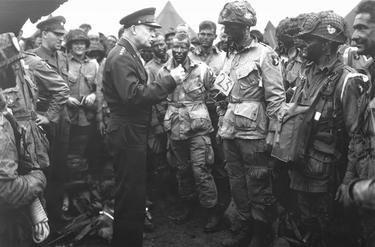

Dwight Eisenhower addresses U.S. paratroopers before they board their aircraft to participate in the D-Day Invasion.

Source: Digital Stock
In the early morning grayness of June 6, 1944, lookouts manning scores of German artillery emplacements above the Normandy beaches of northern France saw the unbelievable sight of nearly 6,000 Allied ships of all types and sizes steaming toward them. Shocked as they were, they knew what those thousands of ships meant: The long-expected Allied invasion of Adolf Hitler's fortress Europe had begun.
A short time later, at about 6:30 a.m., the drop-down doors of hundreds of landing craft opened out as ramps into the surf and more than 160,000 British, American, Canadian, French and Polish troops stormed ashore in what was the largest seaborne invasion in world history. Attacking on a 45-mile stretch of five beaches designated Utah, Omaha, Sword, Juno and Gold, the Allied troops faced obstacles unlike nearly any encountered by invading troops in the history of warfare.
They attacked what military experts agree were the most formidable defenses ever constructed in modern warfare. Hitler had placed Field Marshall Erwin Rommel, the famed "Desert Fox" of North Africa, in charge of the German defensive effort. His "Atlantic Wall," an elaborate array of concrete gun installations, bunkers and pillboxes, allowed considerable interlocking fire that could be devastating to any attackers. Fortunately for the Allies those defenses, despite four years of effort, were still incomplete.
The Allied troops waded ashore into withering German machine-gun fire. Those who made it to the beach ran a gauntlet of land mines and barbed wire. While on the beach their only cover was the steel landing obstacles that offered little protection from German gunners. On Omaha beach, soldiers of the U.S. 1st and 5th Ranger battalions soon became pinned down, huddled under the 100-foot-tall chalk cliffs at Point du Hoc. The U.S. First Army commander, General Omar Bradley, seriously considered pulling them off the beach, a move that would have crippled the attack.
In actuality, Operation Overlord, as the invasion landings were code-named, began just after midnight on June 6 when some 24,000 glider-borne troops from the U.S. 82nd and 101st Airborne Divisions parachuted behind the German front lines. Their mission: to protect the flanks of the invading troops, secure bridges and main roads, and prevent the Germans from bringing in reinforcements from the north.
The airborne landings were at best a mixed success. Many gliders missed their landing zones, some men parachuted into swamps and drowned, while others were shot as they slowly drifted to earth. But the partial success they achieved made the difference.
And in spite of all odds, the invasion succeeded. By nightfall the invading troops had secured small beachheads on all five beaches. These were the first of an oncoming wave of Allied troops over the next two weeks. The Allies advanced and didn't stop until they got to the heart of Germany.
American resolve on the world scene, as displayed at that time, is not so easily found today. Clearly something has changed!

Did God play a hand in those events?

June 6, 2014, marks the 70th anniversary of D-Day. Virtually all of the men who stormed ashore that awful day 70 years ago are dead, but a small handful, men in their late 80s and 90s, will visit those Normandy beaches for perhaps the final time to commemorate that important victory.
Despite the enormous cost of more than 9,000 Allied soldiers killed and wounded on that day, D-Day was a success. But many do not realize that it could easily have been a disaster. As supreme commander of Allied forces that day, U.S. Gen. Dwight Eisenhower knew as well as Rommel that if the invasion could be stopped at the beaches, it might be fatal to the Allied cause.
Over the decades, many have wondered if God had a hand in that historic day.
Let's look at the evidence. To begin with, Eisenhower and British General Bernard Montgomery, who commanded the land forces, successfully misled Hitler and the German High Command into believing that the invasion would take place across the narrow part of the English Channel at Pas de Calais. Over the previous year, they had planned and pulled off an elaborate ruse using fake guns, tanks, coded messages and other diversions to convince the German Fuehrer that a totally fictitious First U.S. Army Group was poised behind the cliffs of Dover for the attack.
When the landings took place, Hitler believed they were only a diversion from the main attack that he still believed would occur at Pas de Calais, 100 miles to the north of Normandy. Despite the urgent pleas of Rommel and General Gerd Von Rundstedt, the main German commanders, he refused to order the movement of troops to the south.
Could those thousands of extra troops have made the difference? Could they, as Hitler vowed, have thrown the Allied troops back into the sea?
Weeks after the landings it was revealed that a dispute between German commanders had kept most of the German panzer tank divisions away from the landing zones. By the spring of 1944 the Allies ruled the skies over France, and Rommel wanted most of the 10 panzer divisions near the beaches to minimize their exposure to Allied air attacks while in transit.
However, panzer commander General Leo von Gehr wanted the divisions kept closer to Paris. Hitler ordered what turned out to be a bad compromise: A few Panzer divisions would be at the beaches, but most would be kept inland.
Similarly, most of the Luftwaffe 's aircraft had been relocated far from the coast to defend Germany's heartland from American and British bomber attacks and weren't a factor when the invasion commenced.
Rommel had earlier told his aide: "The war will be won or lost on the beaches. We'll have only one chance to stop the enemy and that's while he's in the water . . . struggling to get ashore. Reserves will never get up to the point of attack and it's foolish even to consider them . . . the first twenty-four hours of the invasion will be decisive . . . for the Allies, as well as Germany, it will be the longest day" (quoted by Cornelius Ryan, The Longest Day: June 6, 1944, 1959, pp. 27-28).
Would the outcome have been different had those forces been deployed near the beaches?
Weather and the timing of the invasion were other crucial factors. Eisenhower and Montgomery knew the invasion had to take place in a narrow window of opportunity: A full or near-full moon was needed for glider pilots to see their landmarks, and successful beach landings required high spring tides to clear as many of the German defensive obstacles as possible.
That narrow window presented itself only from June 5 to 7. The Allied generals knew that missing that window would force them to put off the invasion for at least two weeks. Secrecy might have been lost, and German defenses would be even stronger.
Storms and high seas arrived with the first days of June. Eisenhower had planned the invasion to coincide with the full moon of June 5. But June 4 was an especially stormy day. Forced to delay the invasion, Eisenhower huddled with his staff. His chief meteorologist, J.M. Stagg, forecast a brief break in the weather for June 6. Though some of his officers disagreed, Eisenhower made the fateful decision: The attack would take place on June 6.
As it turned out, the bad weather unexpectedly weakened German defenses. Viewing the winds and stormy seas, the German commanders concluded that no one in his right mind would launch an invasion under such conditions. Senior officers ordered their troops to stand down, and many of them were away for the weekend. The Luftwaffe canceled normal reconnaissance flights, which would have given them advance warning of the invasion.
Even Rommel, the supreme German commander, overworked and exhausted from overseeing efforts to finish the formidable coastal defenses he anticipated being completed in a few weeks, decided to return to Germany for the weekend to visit his wife on her birthday—June 6. He also wanted to make a personal visit with Hitler to plead once more to have the German tank divisions repositioned to the coast rather than held in reserve far to the rear where they would be too far away to make a difference.

A "great crusade" hung in the balance

Much has been written about seemingly miraculous events that turned the tide of World War II. Historians have long referred to the Miracle of Dunkirk, where calm seas allowed an evacuation that saved more than 300,000 British troops from annihilation or capture in May 1940 while heavy fog grounded German planes.
Others have pointed to the extremely fortuitous instance of the British navy finding and sinking the dreaded German battleship Bismarck in May 1941.
Did God Himself intervene to clear the seas and skies enough on June 6 to permit the glider and seaborne landings, yet have this come amid terrible weather to make the German defenders think no attack would be forthcoming?
One has to pause and consider. Had D-Day been delayed, would Hitler have caught on to the deception? Would he have transferred thousands of troops, guns and tanks from Pas de Calais to Normandy? Would he have made good on his vow to drive the invaders back into the sea?
On the day of the invasion, Eisenhower sent a message to the airborne and seaborne troops: "You are about to embark upon the great crusade, towards which we have striven these many months. The eyes of the world are upon you. The hopes and prayers of liberty-loving people everywhere march with you . . . Let us all beseech the blessing of Almighty God upon this great and noble undertaking." He also carried in his pocket a second message—one to be read in case the invasion failed.
Years later, in referring to his agonizing decision to postpone the invasion from June 5 to June 6, Eisenhower said this: "If there were nothing else in my life to prove the existence of an Almighty and Merciful God, the events of the next twenty-four hours did it" (quoted by John McCollister, God and the Oval Office, 2005).

A superpower emerges victorious

Seven decades have passed since D-Day. With its success, which from a human perspective was by no means guaranteed, Hitler's Nazi grip on Europe was reduced to less than a year. By mid-May 1945, Berlin lay in ruins, Hitler was dead, and the war in Europe was over.
Many don't realize that your Bible had foretold the national power and prestige that America and Britain, historical allies, experienced over the course of the 19th and 20th centuries. Was there any prophetic significance to Anglo-American victory in World War II? Surprising at it may sound, ancient Israel was the forerunner of our modern
English-speaking nations of the United States and many of the British Commonwealth nations. (To learn more about this, read our free study aid, The United States and Britain in Bible Prophecy . )
Two parallel biblical passages, Leviticus 26 and Deuteronomy 28, prophesied blessings or curses that would come on Israel for either obedience or disobedience to the divine laws God put in place. For example, Deuteronomy:28:7 speaks of great military victories if the people would obey and honor their Creator: "The Lord will cause your enemies who rise up against you to be defeated before your face; they will come out against you one way and flee before you seven ways" (emphasis added throughout).
The United States emerged from World War II as the world's leading national power. Tyranny had been defeated, and the country even embarked on a massive and generous rebuilding plan to help its defeated former enemies get back on their feet.
America assumed the role of the world's policeman, and in the bipolar world of the Cold War era, the United States was the clear leader of the free world—pitted against its totalitarian rival, the Russian-led Soviet Union.

America quickly losing power and influence

Over the decades since, America has played its leading role with decreased effectiveness. Despite trillions of dollars spent and tens of thousands of lives lost, the result of U.S. conflicts in Korea, Vietnam, Iraq and Afghanistan has been stalemate or a negotiated peace that eventually turned to victory for America's enemies.
Past decades saw a willingness of the United States to go to the mat for its national interests. President John F. Kennedy faced down Soviet Premier Nikita Khrushchev in October 1962 during the Cuban missile crisis, ordering Soviet missiles to be taken out of Cuba. Yet only recently America has seen its power and ability to influence outcomes checkmated in Syria, in Iran, and most recently in Ukraine, where many in the province of Crimea pushed the secession of the province to be annexed by Russia (see " Ukraine: Feeble U.S. Stand Allows Russian Imperialism ").
What has changed from the earlier period of American resolve to the present?
In late February U.S. Defense Secretary Chuck Hagel submitted a proposed fiscal 2015 defense budget that would reduce U.S. military personnel to about 450,000, the smallest since 1945. It would also reduce the U.S. Navy to its smallest size in decades. Despite these proposed cuts, the U.S. military would yet remain the world's most powerful—though Russia and China, seeing American weakness and withdrawal, are vigorously updating and expanding their military capabilities.
Again we ask, what has changed?

A return to the Cold War?

The United States has had little power to influence the outcome of the situation in Crimea, which for all intents and purposes is now effectively part of Russia. Notice what God prophesied about the modern descendants of ancient Israel, who today include the major English-speaking nations: "I will break the pride of your power" (Leviticus:26:19). Though it still has the world's largest military, U.S. willingness and ability to use that military seems to be stymied around the world.
Recently suffering a humiliating withdrawal from Iraq and leaving that nation divided with parts of it taken over by radical Islamists, and now facing a similar withdrawal in Afghanistan, how is it that the world's greatest military power has essentially been fought to a draw by insurgents whose weaponry consists of AK-47s, rocket-propelled grenades and improvised roadside bombs?
America's sliding morals, national scandals and increasing disregard of God's law has brought consequences. Again, while Moses pointed out the blessings for obedience, he was also inspired to write about the consequences of disobedience:
"The Lord will cause you to be defeated before your enemies; you shall go out one way against them and flee seven ways before them; and you shall become troublesome to all the kingdoms of the earth" (Deuteronomy:28:25).
We are commanded to watch and give heed to what is taking place around us (Matthew:24:42). At this time we have no way of knowing in full where the Ukrainian crisis will lead. But the stark reality of international events of recent weeks is stirring millions in the Western world to a renewed concern that the Cold War of decades ago has returned. An NBC News/ Wall Street Journal poll during the week of March 10 revealed that 72 percent of Americans now view Russia as a threat, up from just 26 percent a few months ago.
As we reflect back on the amazing events of 70 years ago, we should ponder the years to come.
The God who created mankind has a plan for how these events will finally play out, and you need to learn more about that plan. And you need to know where the English-speaking peoples are identified in your Bible and what God has in store for them.


Wednesday, March 12, 2014

Thursday’s Important House Committee Hearing

A timely post about from www.hughhewitt.com about the House Appropriations Committee Defense Subcommittee meeting on Thursday. This follows this post about the Malaysian airplane that has been missing. This follows this post about pushing for Lois Lerner to go to jail! In the meantime, you can get more involved if you like here and read an interesting book HERE.
You can follow me at blogspot here and at twitter here https://twitter.com/brianleesblog. Please consider following both in case one goes down!

Thursday’s Hearing


 by Hugh Hewitt
When Chairman Randy Frelinghuysen of New Jersey open’s Thursday’s hearing of the Subcommittee on Defense of the House Committee on Appropriations, Vladimir Putin and Xi Jinping will very much be in the room.

The Russian president has invaded a neighboring country and seized a huge chunk of it –for the second time in six years.  The Chinese president is presiding over a massive arms build-up –a 12.2%  increase in the PRC’s already substantial public budget was announced las week– and the PRC is taking increasingly hostile actions in the South China Sea. (Robert Kaplan’s Asia’s Cauldron: The South China Sea and the End of a Stable Pacific which arrived this week could not be more timely.)
The combination of the Murray-Ryan budget accord of late last year and Secretary of Defense Chuck Hagel’s incoherent defense budget has left the Subcommittee a very difficult job: Reintroducing reality to the military budget. Todd Harrison, an analyst  Harrison at the Center for Strategic and Budgetary Assessments provides some background on the Subcommittee’s dilemma, but the short version is this: We don’t know what the Joint Chiefs say we need to protect America, our allies, and the international waters through which commerce flows and by which freedom expands.
For three years now, since the infamous Super Committee and the “sequestration machine” that followed in its failure, the Pentagon has not been funded according to its needs but according to a formula imposed because of the failure of the president to deal seriously with the domestic spending mess, primarily as it connects to entitlements.  The president got his tax hike in January of 2013, but he did nothing to bring long-term domestic spending under control.  So the sequester mechanism kicked in, wrecking havoc on our national security budget.
A handful of neo-isolationist Republicans have combined with a handful of strategically-placed deficit hawks to pretend that the cuts to the military have not been that horrible, and are in fact necessary.  ”Waste, fraud, and abuse” is their combined rallying cry, but they do not represent the country.  The country spoke –very loudly and very clearly– when the Congress attempted to cu the retirement pay COLA earned by the active duty or recently retired military with an aim or a record of at least 20 years of service.  The Congress’s decision to target that group woke the sleeping giant of support for a strong American military and the men and women who serve in it, and very few elected officials missed the message of what awaits representatives or senators who try to balance the budget on the backs of the military.
The repeal of the cut to the COLA of the career military should not be mistaken for a repudiation of the GOP’ drive to reform entitlements.  It wasn’t.  The repeal was, however, a giant flashing sign that entitlement reform is not an excuse to gut the military further and that in fact the Regean coalition was built on three legs, one of which is peace through the strength provided by the world’s most competent and well-equipped military.  Canards about our budget being bigger than the next ten combined do not answer the question of what America’s military needs to do its job?  That’s the answer that should drive the budget and nothing else.  If the military’s many jobs add up to a budget 20 times larger than the next ten nations combined, so be it.  That is how the peace is maintained and would-be adversaries kept far and firmly at bay.
A corner in this debate has been turned and the Murray-Ryan budget accord overtaken by events, both political and international, especially because of Putin’s adventurism and the PRC’s growing threat.
It is up to Chairman Frelinghuysen and his colleagues to get some mission statements out of Secretary Hagel –do we intend to deter China from seizing more space and islands, keep international waterways open, respond to aggression against a NATO member or an ally like Japan?– and then ask Chairman of the Joint Chiefs Martin Dempsey if the Pentagon has the resources it needs to accomplish all the missions the secretary agreed to?  Dempsey is a straight shooter, and the Service chiefs are becoming increasingly candid that they are beyond cutting into bone but are now carving out marrow.  The cutting has to end and in fact be reversed.
This will require the Committee on Appropriations to bust the caps imposed by Murray-Ryan, and to do so only for Defense and to do so openly and with an argument as to why each specific increase is being funded.  Deficit hawks will scream, but Speaker Boehner and Leader Cantor should put the bill on the floor and vote on it and then send it to the Senate and see which members of both bodies want to face voters in the fall having shrunk from the challenges of Putin and the PRC.
The Party of Reagan is regaining its voice and now it needs some Members of Congress to do the same.  Starting Thursday.

Wednesday, February 26, 2014

Obama's Steep Military Cuts to Pay for New Cars, Stereos for Illegal Aliens‏

A timely post about from https://prayfor.us about the Federal Budget which rewards illegal aliens and punishes soldiers and marines. This follows this post about moderate groups claiming to be conservative in Texas.  This follows this post about endorsements for TEXAS. This follows this post about Texas legislators who are graded "Worse than Wendy." This are GOP legislators!  In the meantime, you can get more involved if you like here and read an interesting book HERE.


Obama's Steep Military Cuts to Pay for New Cars, Stereos for Illegal Aliens


BLOGGER'S NOTE: START CONTACTINGE THE HOUSE BUDGET COMMITTEE  GOP MEMBERS HERE: http://budget.house.gov/about/budgetcommitteemembers.htm
 ‏


The latest attack on our military from Obama and the Democrats is absolutely sickening.
Obama is proposing a 1-percent across-the-board cut for all US military pay. He also wants to slash military benefits for medical care and to increase costs for families through a proposal to raise prices at military commissaries.
What is especially monstrous about these cuts is that Obama is increasing benefits for illegal aliens. The ones who are fraudulently collecting Social Security received a 1.5-percent increase in 2014!
We need to swamp Congress with FaxGrams immediately and tell them to reject Obama's military cuts!  This outrageous theft from our military has to stop!
Image of Charles Benninghoff, Founder
Charles Benninghoff, Founder
Obama's cuts would also completely eliminate renter's insurance for military families and reduce their housing allowances.
To see just how cold-hearted and unthinking Obama and the Democrats are to be proposing military cuts right now, we decided to compare the life of José, an illegal alien drug runner, with the life of John, a decorated combat veteran.  While these two names are fictional, the events recited actually happen, regrettably, day-after-day:
The Life of José
  • Upon successfully navigating our porous southern border with 35 pounds of methamphetamine strapped to his body with duct tape, José makes his way to your city.
  • José is immediately granted a driver's license, even though he flunked the test. This license allows him to sign up for an Individual Taxpayer ID Number (ITIN) and file for tax refunds.
  • José applies for and receives a low-skilled job, for which he is paid cash under-the-table. This deprives one local American of an available job. José will park on this job for years.
  • José applies for and receives housing assistance, energy assistance, food stamps, WIC, Medicare prescription drugs, unemployment and other benefits, because he has a driver's license and no official "job" as far as government agencies are concerned.
  • Even though José is a childless 23-year-old, at the end of the year he applies for Child Tax Credits for his 10 nieces and nephews in Mexico. He receives a $10,000 refund from the federal government.
  • José is eligible for more than $50,000 in benefits from the American taxpayer each year, which allows him to buy a new sports car so he can blast your eardrums out on the street with his favorite mariachi rap music.
The Life of John
  • John is a decorated combat vet who served two tours of duty in Iraq and two in Afghanistan with his unit.  
  • He was fired from his job after 15 years of service because he once whispered, in a private conversation, that he believes in traditional marriage between one man and one woman.
  • While trying to adjust to civilian life, John is declared 'mentally incompetent' by one of Obama's VA case workers, which allows the federal government to seize all John's privately-owned firearms.
  • John is unable to find a job in the disastrous Obama economy. Even the low-skilled jobs are taken by the hordes of illegal aliens brought here by Obama's policies (see José).
  • John ends up homeless.
  • His wife of 24 years divorces him and obtains custody over their three children.
  • When a social worker manages to track him down on the park bench where he now sleeps, John is informed that his benefits are being cut even further by Obama and the Democrats.
  • Now homeless, unemployed, living in poverty without family support, not eligible for hospital care since Obamacare has been enacted, John is considering ending it all, ending the tragedy that has become his life.
  • John prays daily for a solution to this mess his life has become.
What you don't hear on the nightly news is the fact that 22 veterans are committing suicide every single day in America -- more than 8,000 per year -- because the government and country that they fought and bled for is abandoning them.
Please don't let Obama spit on our military members like this! Click here to send a message to as many Senators and Representatives as you can RIGHT NOW and tell them to reject Obama's outrageous military cuts!
Obama is kicking military members and veterans to the curb once again while handing sacks of cash to every illegal alien that steals his or her way into the country.
How is it possible that we treat our veterans this way in America?
This is a massive-scale theft from the American taxpayers and a direct violation of hundreds of commands in Scripture to take care of our own poor and needy. Psalm 82:3 for example says, "Defend the poor and fatherless; do justice to the afflicted and needy."
Obama is paying off the illegal aliens and doing it by cutting pay and benefits for the military and veterans.  This has to stop!
Send your FaxGrams to Congress today and demand that they vote down Obama's military cuts!
Send Faxes Now Image
Sen. Kelly Ayotte (R-NH) summed this problem up brilliantly. She pointed out that Congress could balance their checkbook, pay our military and veterans and even extend unemployment benefits, if they would just cut off the spigot of public money that's going to illegal aliens.
And then forward this message to everyone you know, or send them this link:
Another way that you can help is by contacting your Senators and Representative at 202-224-3121. Tell them to reject Obama's military pay cuts!

Tuesday, February 25, 2014

Germany and Russia Shifting Balance of Power

An interesting article from http://www.ucg.org/ about Russia and Germany in their dual in places such as Ukraine. This follows this post about Mardi Gras. For a free magazine subscription or to get the book shown for free click HERE! or call 1-888-886- 8632.


Germany and Russia Shifting Balance of Power

Printer-friendly version


More than a century after his death, Otto von Bismarck's dream for Germany seems closer to being realized.

Otto von Bismarck, Germany's Iron Chancellor who presided over the unification of Germany and guided the new nation to great power status, was noted for his sometimes conflicting secret alliances that tried to secure Germany's future. Having secretly entered into a pact with the Austrian Empire in 1879, extended to include Italy seven years later, Bismarck then entered into a secret agreement with Russia, even though Russia and Austria were rivals in the Balkans.
Bismarck's great fear was of a Germany compelled to fight on two flanks, east and west. This is exactly what happened in both world wars with the result that Germany lost.
These two defeats contributed to a century of political upheaval in Germany.
In the 20th century there were six distinct Germanys, each in its own way different from the others. The Second Reich of Kaiser Wilhelm II (1888-1918), defeated in war, gave place to the Weimar Republic (1918-33). This was followed by Hitler's Third Reich (1933-45). Again defeated in war, the country came under Allied control for a brief period before the Federal Republic of (West) Germany was established in 1949, soon followed by the creation of the communist (East) German Democratic Republic. In 1990 these two were united, thereby establishing the sixth distinct German nation of the 20th century.
All six Germanys and previous ones were subject to what columnist Josef Joffe calls "the curse of geography." Geographical location has a profound effect upon national attitudes. The predominantly Anglo-Saxon countries are all protected by lengthy coastlines so that they do not have to greatly concern themselves with hostile neighbors. The result is a certain complacency, even naïveté, in their citizens, who often fail to understand the complexities of the outside world. Germany is in an entirely different situation, almost completely surrounded by other nations, all of which it has been in conflict with at one time or another.
The curse of geography
The curse of geography has been a major contributing factor to Germany's history.
Having learned many lessons from history, the first chancellor of the Federal Republic of Germany, Konrad Adenauer (1949-63), tried a different approach to diplomacy. Gradually a vision emerged of a new united Europe. Its nucleus was to be France and Germany, two nations that had been at war with each other three times in 75 years. These two nations were to be so closely bound to each other economically that they could never go to war again. The nations of Western Europe were able to rebuild while under the protection of the American nuclear umbrella during the Cold War. Closer economic ties between the various nations of the region would make it seemingly impossible for conflict to rear its ugly head again.
Having secured its western flank, in 1969 Germany started reaching out to the East. Chancellor Willy Brandt's Ostpolitik (Eastern Policy) was aimed at building closer ties to the communist countries of the East, with particular emphasis on East Germany and its master in Moscow. It was to be a further 20 years before the collapse of the communist East and the reunification of Germany. United Germany has recently moved its capital from Bonn back to Berlin, the former Imperial capital, now more appropriate for the nation that has become the dominant power in Europe.
There was a price for unification. Not only was there the economic cost of absorbing millions of poorer East Germans into the new Germany, there was also a cost that had to be paid for French support for reunification. Chancellor Helmut Kohl promised French President Francois Mitterand German support for a new European currency that would bind the two nations even closer together, thereby lessening French fears of reunification.
"…Like Bismarck, Kohl understood the precarious position of Germany-about to become the dominant power in Europe again…. Like Adenauer and Brandt, Kohl knew that Germany was too weak to stand alone but too strong to be left alone….
"Germany's Cold War chains were about to drop off, and so Kohl sought to reassure France and the rest of Europe by replacing the Cold War bonds with those forged by integration. The deutsche mark (Germany's own currency) was the very symbol of German primacy. What better way to soften its edge than to multinationalize the country's currency? By way of the euro, Germany proposed to tie itself down. To the French, invaded thrice by Germany in the space of a lifetime, the euro offered perfect compensation…. Kohl's gracious offer of the deutsche mark as the foundation for a European currency was a godsend for France" ( A Century's Journey edited by Robert Pastor, p. 129, chapter "Germany" by Josef Joffe, editorial page editor and columnist of the Suddeutshe Zeitung , 1999).
"Never sever the tie to St. Petersburg"
Because of Bismarck's pivotal role in the defeat of France in the war of 1870-71, Germany under the kaisers never really had a hope of an alliance with France. But Bismarck, a former ambassador to Russia, always believed that Germany should "never sever the tie to St. Petersburg," the former capital of Russia. A close relationship, even an alliance, with Russia would secure Germany's eastern flank.
After Bismarck, Wilhelm II desperately tried to reach out to Russia, but failed when Russia and France became allies in 1893. This was to prove fatal in World War I when Germany had to fight on both flanks. Following the Russian Revolution in 1917, the Germans and Russians signed the Treaty of Brest-Litovsk, which effectively gave the Germans victory in the East. As a result of this treaty, Germany was free to mount a major offensive in the West.
Hitler's strategy was to defeat France first, then turn on Russia. What enabled him to do this was the secret Molotov-Ribbentrop Pact of August 1939, between the Soviets and Germany. After defeating France, Hitler invaded Russia. After D-Day Germany ended up fighting on two flanks and lost.
Germany is again turning its attention to its eastern flank. The two countries are forging an economic deal that could shift the balance of power in Europe. The two ministers responsible for the economies of both countries met in December to debate details of a plan to exchange Russian debt for German equity in Russian companies. This would be a roundabout way for German banks to get back some of the money they have lent to Russia, which Moscow has not been able to repay.
Stratfor, an Internet news service, carried an article December 20, 2000, that stated, "Such a development would significantly weaken U.S. influence in Europe while dramatically strengthening Germany and Russia and helping them to advance to the front stage of world geopolitics." If successful, the deal "may help Russia's revival and Germany could emerge as the leader of a united Europe with Russia on its side."
The article, titled "Shifting Europe's Power Balance," added that "Germany would be glad to see Russia's vast resources come to Germany and Europe rather than to the east…. Berlin would also prefer these resources do not move overseas to the United States, Germany's current geopolitical rival" (emphasis added). Interestingly, Hitler thought that eventually "the struggle for global hegemony would come down to two contenders: Germany and the United States. The struggle was not just for Europe but, ultimately, for the whole world" ( A Century's Journey , pp. 109-110).
In the 1880s Bismarck remarked to a friend: "I will tell you the secret of politics: friendship with Ru ssia" (The Kaiser, by Virginia Cowles, p. 85). In a series of articles in the Hamburger Nacht richten in 1895 he emphasized "that Germany was only secure when she had a firm understanding with Russia" (ibid., p. 118).
During the first decade of the 20th century Kaiser Wilhelm II tried to build bridges between Germany, France and Russia. Prior to the Russian czar's visits to Paris and Berlin, he warned his uncle, the English King Edward VII, that these ties were intended to threaten British dominance. "'England could not fail to observe,' he said darkly, 'the strong movement among the countries of the continent towards an economic union to counter British influence, and she would do well to ponder over it'" (ibid., p. 196).
Realizing the threat that these developments posed to the English-speaking world, British Foreign Secretary Joseph Chamberlain wrote on September 10, 1900, "An alliance between Germany and Russia, entailing, as it would, the co-operation of France, is the one thing we have to dread…" (ibid., p. 187).
Shifting balance of power
It is a fact that a closer relationship between Berlin and Moscow would diminish Germany's dependence on the Western alliance. At the same time, closer European union, about to take a major leap forward in January 2002 when the euro replaces national currencies, will lessen Europe's need for America. Germany is and will remain the dominant force in the European Union. "Europe [is] a formalized deutsche mark zone in everything but name" ( A Century's Journey , p. 130).
Through the EU and closer ties to Russia, Germany ironically will have accomplished peacefully what the Second and Third Reichs failed to achieve-a united Europe built around Germany, providing limitless opportunities for German companies to expand, plentiful raw materials from undeveloped Russia and Siberia and trade access to former British and French colonies through the Lomé Convention that ties African, Caribbean and Pacific nations to the EU. Germany also will have secured both flanks, with strong economic ties east and west.
After Bismarck, Wilhelm II was obsessed with building up Germany to rival Great Britain, then the dominant global power. A century later British preeminence has been replaced by American hegemony. The new century will likely see a further change. The Bible tells us that God "removes kings and raises up kings" (Daniel 2:21). God also warns the modern descendants of ancient Israel, the American and British peoples, that He "will break the pride of [their] power" (Leviticus 26:19), a punishment for national sin. A time is coming when the United States will be replaced as the world's leading power, just as Britain lost her leadership role.
However, history would suggest that relations between Germany and Russia can suddenly turn sour. Bismarck's overtures to Russia were reversed when he was no longer chancellor and Wilhelm II took a closer interest in foreign policy. The kaiser tried to build closer ties with Russia but failed. Over 20 years later, Hitler's alliance with Stalin ended when the Soviet Union was attacked in June 1941. After World War II, Moscow's offer of a reunited but neutral Germany in the 1950s was rejected due to lack of trust. The Federal Republic felt more secure tied to the United States through the NATO alliance.
Bible prophecy also suggests that Russia and Germany will not be in alliance as end-time events unfold. Following an invasion of the "Glorious Land" (Holy Land) by the resurrected beast power (Daniel 11:40-43), "news from the east and the north shall trouble him" (verse 44), a likely reference to Russia in alliance with other military forces from the east. Revelation 9:16 prophesies of an "army of…two hundred million," suggesting an alliance of major powers to the east. Further, prophecies regarding Russia in Ezekiel chapters 38 and 39 do not show any alliance with the beast power.
Whatever the outcome of the financial deal between Moscow and Berlin, one fact is clear: Germany has become a major economic power, set to be America's "geopolitical rival" in the years ahead. WNP

Monday, November 18, 2013

FUBAR is Now SOP: Diversity Succeeds Where the Japanese Failed, at Sinking the U.S. Navy

BLOGGERS NOTE: I WILL BE MOVING FROM FACEBOOK TO TWITTER AND BLOGSPOT SOON!


A timely post from http://nicholasstixuncensored.blogspot.com about what diversity groups are doing to ruin the U.S. Navy. This follows this post about the Knoxville Horror. In the meantime, you can get more involved if you like here and read an interesting book HERE.
  FUBAR is Now SOP: Diversity Succeeds Where the Japanese Failed, at Sinking the U.S. Navy (My New VDARE Report is Up!)

By Nicholas Stix


Diversity is Strength! It’s Also… a Corrupt U.S. Navy

VDARE


In what the Washington Post called the biggest bribery case “the Navy has confronted in years,” the skipper of a naval cruiser and a senior logistics officer allegedly gave classified information to a contractor regarding ship movements, in exchange for prostitutes, tickets to Lady Gaga concerts (!!!), and cash. The information, which imperiled national security, was allegedly used by the contractor to defraud the Navy (i.e., the white American net tax base) out of millions of dollars.


The two main defendants:


• Cmdr. Michael Misiewicz, code-name “Brudda, ”Cambodian birth name “Vannak Khem.” He was adopted by Army administrative assistant Maryna Misiewicz [3] and benefitted from a Navy Affirmative Action program, with got a slot that should have gone to a qualified, white American… and (allegedly) paid back his adoptive country by selling it out.


• Leonard Francis, CEO of Glenn Defense Marine Asia [4], known widely as “Fat Leonard,” “Lion King” and “Boss,” is a Malaysian national based out of Singapore….


[Read the whole thing here.]

Friday, January 18, 2013

Avoiding the Wars That Never End


A very interesting post from www.Stratfor.com about the current U.S. policy in wars. This follows this post about the rebels in Syria. This follows this article about American energy independence and preventing money from going to hostile countries such as Iran . For more about what is happening in the nation now click here and read a very interesting book HERE


Avoiding the Wars That Never End


Stratfor

By George Friedman

Founder and Chief Executive Officer


Last week, U.S. President Barack Obama announced that the United States would transfer the primary responsibility for combat operations in Afghanistan to the Afghan military in the coming months, a major step toward the withdrawal of U.S. forces. Also last week, France began an intervention in Mali designed to block jihadists from taking control of the country and creating a base of operations in France's former African colonies.


The two events are linked in a way that transcends the issue of Islamist insurgency and points to a larger geopolitical shift. The United States is not just drawing down its combat commitments; it is moving away from the view that it has the primary responsibility for trying to manage the world on behalf of itself, the Europeans and its other allies. Instead, that burden is shifting to those who have immediate interests involved.


Insecurity in 9/11's Wake

It is interesting to recall how the United States involved itself in Afghanistan. After 9/11, the United States was in shock and lacked clear intelligence on al Qaeda. It did not know what additional capabilities al Qaeda had or what the group's intentions were. Lacking intelligence, a political leader has the obligation to act on worst-case scenarios after the enemy has demonstrated hostile intentions and capabilities. The possible scenarios ranged from additional sleeper cells operating and awaiting orders in the United States to al Qaeda having obtained nuclear weapons to destroy cities. When you don't know, it is both prudent and psychologically inevitable to plan for the worst.


The United States had sufficient information to act in Afghanistan. It knew that al Qaeda was operating in Afghanistan and that disrupting the main cell was a useful step in taking some action against the threat. However, the United States did not immediately invade Afghanistan. It bombed the country extensively and inserted limited forces on the ground, but the primary burden of fighting the Taliban government was in the hands of anti-Taliban forces in Afghanistan that had been resisting the Taliban and in the hands of other forces that could be induced to act against the Taliban. The Taliban gave up the cities and prepared for a long war. Al Qaeda's command cell left Afghanistan and shifted to Pakistan.


The United States achieved its primary goal early on. That goal was not to deny al Qaeda the ability to operate in Afghanistan, an objective that would achieve nothing. Rather, the goal was to engage al Qaeda and disrupt its command-and-control structure as a way to degrade the group's ability to plan and execute additional attacks. The move to Pakistan at the very least bought time, and given continued pressure on the main cell, allowed the United States to gather more intelligence about al Qaeda assets around the world.


This second mission -- to identify al Qaeda assets around the world -- required a second effort. The primary means of identifying them was through their electronic communications, and the United States proceeded to create a vast technological mechanism designed to detect communications and use that detection to identify and capture or kill al Qaeda operatives. The problem with this technique -- really the only one available -- was that it was impossible to monitor al Qaeda's communications without monitoring everyone's. If there was a needle in the haystack, the entire haystack had to be examined. This was a radical shift in the government's relationship to the private communications of citizens. The justification was that at a time of war, in which the threat to the United States was uncertain and possibly massive, these measures were necessary.


This action was not unique in American history. Abraham Lincoln violated the Constitution in several ways during the Civil War, from suspending the right to habeas corpus to blocking the Maryland Legislature from voting on a secession measure. Franklin Roosevelt allowed the FBI to open citizens' mail and put Japanese-Americans into internment camps. The idea that civil liberties must be protected in time of war is not historically how the United States, or most countries, operate. In that sense there was nothing unique in the decision to monitor communications in order to find al Qaeda and stop attacks. How else could the needle be found in the haystack? Likewise, detention without trial was not unique. Lincoln and Roosevelt both resorted to it.


The Civil War and World War II were different from the current conflict, however, because their conclusions were clear and decisive. The wars would end, one way or another, and so would the suspension of rights. Unlike those wars, the war in Afghanistan was extended indefinitely by the shift in strategy from disrupting al Qaeda's command cell to fighting the Taliban to building a democratic society in Afghanistan. With the second step, the U.S. military mission changed its focus and increased its presence massively, and with the third, the terminal date of the war became very far away.


But there was a broader issue. The war in Afghanistan was not the main war. Afghanistan happened to be the place where al Qaeda was headquartered on Sept. 11, 2001. The country was not essential to al Qaeda, and creating a democratic society there -- if it were even possible -- would not necessarily weaken al Qaeda. Even destroying al Qaeda would not prevent new Islamist organizations or individuals from rising up.


A New Kind of War

The main war was not against one specific terrorist group, but rather against an idea: the radical tendency in Islamism. Most Muslims are not radicals, but any religion with 1 billion adherents will have its share of extremists. The tendency is there, and it is deeply rooted. If the goal of the war were the destruction of this radical tendency, then it was not going to happen. While the risk of attacks could be reduced -- and indeed there were no further 9/11s despite repeated attempts in the United States -- there was no way to eliminate the threat. No matter how many divisions were deployed, no matter how many systems for electronic detection were created, they could only mitigate the threat, not eliminate it. Therefore, what some called the Long War really became permanent war.


The means by which the war was pursued could not result in victory. They could, however, completely unbalance U.S. strategy by committing massive resources to missions not clearly connected with preventing Islamist terrorism. It also created a situation where emergency intrusions on critical portions of the Bill of Rights -- such as the need to obtain a warrant for certain actions -- became a permanent feature. Permanent war makes for permanent temporary measures.


The break point came, in my opinion, in about 2004. Around that time, al Qaeda was unable to mount attacks on the United States despite multiple efforts. The war in Afghanistan had dislodged al Qaeda and created the Karzai government. The invasion of Iraq -- whatever the rationale might have been -- clearly produced a level of resistance that the United States could not contain or could contain only by making agreements with its enemies in Iraq. At that point, a radical rethinking of the war had to take place. It did not.


The radical rethinking had to do not with Iraq or Afghanistan, but rather with what to do about a permanent threat to the United States, and indeed to many other countries, posed by the global networks of radical Islamists prepared to carry out terrorist attacks. The threat would not go away, and it could not be eliminated. At the same time, it did not threaten the existence of the republic. The 9/11 attacks were atrocious, but they did not threaten the survival of the United States in spite of the human cost. Combating the threat required a degree of proportionality so the fight could be maintained on an ongoing basis, without becoming the only goal of U.S. foreign policy or domestic life. Mitigation was the only possibility; the threat would have to be endured.


Washington found a way to achieve this balance in the past, albeit against very different sorts of threats. The United States emerged as a great power in the early 20th century. During that time, it fought three wars: World War I, World War II and the Cold War, which included Korea, Vietnam and other, smaller engagements. In World War I and World War II, the United States waited for events to unfold, and in Europe in particular it waited until the European powers reached a point where they could not deal with the threat of German hegemony without American intervention. In both instances, it intervened heavily only late in the war, at the point where the Germans had been exhausted by other European powers. It should be remembered that the main American push in World War II did not take place until the summer of 1944. The American strategy was to wait and see whether the Europeans could stabilize the situation themselves, using distance to mobilize as late as possible and intervene decisively only at the critical moment.


The critics of this approach, particularly prior to World War II, called it isolationism. But the United States was not isolationist; it was involved in Asia throughout this period. Rather, it saw itself as being the actor of last resort, capable of acting at the decisive moment with overwhelming force because geography had given the United States the option of time and resources.


During the Cold War, the United States modified this strategy. It still depended on allies, but it now saw itself as the first responder. Partly this could be seen in U.S. nuclear strategy. This could also be seen in Korea and Vietnam, where allies played subsidiary roles, but the primary effort was American. The Cold War was fought on a different set of principles than the two world wars.


The Cold War strategy was applied to the war against radical Islamism, in which the United States -- because of 9/11 but also because of a mindset that could be seen in other interventions -- was the first responder. Other allies followed the United States' lead and provided support to the degree to which they felt comfortable. The allies could withdraw without fundamentally undermining the war effort. The United States could not.


The approach in the U.S.-jihadist war was a complete reversal from the approach taken in the two world wars. This was understandable given that it was triggered by an unexpected and catastrophic event, the reponse to which flowed from a lack of intelligence. When Japan struck Pearl Harbor, emotions were at least as intense, but U.S. strategy in the Pacific was measured and cautious. And the enemy's capabilities were much better understood.


Stepping Back as Global Policeman

The United States cannot fight a war against radical Islamism and win, and it certainly cannot be the sole actor in a war waged primarily in the Eastern Hemisphere. This is why the French intervention in Mali is particularly interesting. France retains interests in its former colonial empire in Africa, and Mali is at the geographic center of these interests. To the north of Mali is Algeria, where France has significant energy investments; to the east of Mali is Niger, where France has a significant stake in the mining of mineral resources, particularly uranium; and to the south of Mali is Ivory Coast, where France plays a major role in cocoa production. The future of Mali matters to France far more than it matters to the United States.


What is most interesting is the absence of the United States in the fight, even if it is providing intelligence and other support, such as mobilizing ground forces from other African countries. The United States is not acting as if this is its fight; it is acting as if this is the fight of an ally, whom it might help in extremis, but not in a time when U.S. assistance is unnecessary. And if the French can't mount an effective operation in Mali, then little help can be given.


This changing approach is also evident in Syria, where the United States has systematically avoided anything beyond limited and covert assistance, and Libya, where the United States intervened after the French and British launched an attack they could not sustain. That was, I believe, a turning point, given the unsatisfactory outcome there. Rather than accepting a broad commitment against radical Islamism everywhere, the United States is allowing the burden to shift to powers that have direct interests in these areas.


Reversing a strategy is difficult. It is uncomfortable for any power to acknowledge that it has overreached, which the United States did both in Iraq and Afghanistan. It is even more difficult to acknowledge that the goals set by President George W. Bush in Iraq and Obama in Afghanistan lacked coherence. But clearly the war has run its course, and what is difficult is also obvious. We are not going to eliminate the threat of radical Islamism. The commitment of force to an unattainable goal twists national strategy out of shape and changes the fabric of domestic life. Obviously, overwatch must be in place against the emergence of an organization like al Qaeda, with global reach, sophisticated operatives and operational discipline. But this is very different from responding to jihadists in Mali, where the United States has limited interests and fewer resources.


Accepting an ongoing threat is also difficult. Mitigating the threat of an enemy rather than defeating the enemy outright goes against an impulse. But it is not something alien to American strategy. The United States is involved in the world, and it can't follow the founders' dictum of staying out of European struggles. But the United States has the option of following U.S. strategy in the two world wars. The United States was patient, accepted risks and shifted the burden to others, and when it acted, it acted out of necessity, with clearly defined goals matched by capabilities. Waiting until there is no choice but to go to war is not isolationism. Allowing others to carry the primary risk is not disengagement. Waging wars that are finite is not irresponsible.


The greatest danger of war is what it can do to one's own society, changing the obligations of citizens and reshaping their rights. The United States has always done this during wars, but those wars would always end. Fighting a war that cannot end reshapes domestic life permanently. A strategy that compels engagement everywhere will exhaust a country. No empire can survive the imperative of permanent, unwinnable warfare. It is fascinating to watch the French deal with Mali. It is even more fascinating to watch the United States wishing them well and mostly staying out of it. It has taken about 10 years, but here we can see the American system stabilize itself by mitigating the threats that can't be eliminated and refusing to be drawn into fights it can let others handle.

.


Read more: Avoiding the Wars That Never End
Stratfor