Showing posts with label Susan Rice. Show all posts

Friday, June 6, 2014

70 Years After D-Day: From Power to Impotence

An interesting article from http://www.ucg.org/ about America and D-Day. This follows this post about China after Tiananmen square.  For a free magazine subscription or to get the book recommended for free click HERE! or call 1-888-886- 8632. You can follow me at blogspot here and at twitter here https://twitter.com/brianleesblog. Please consider following both in case one goes down!


70 Years After D-Day: From Power to Impotence


Seventy years ago, an American-led Allied invasion on the beaches of Normandy marked the beginning of the end of the grip of tyranny over Europe. In little more than a year, the United States would emerge as a superpower and world policeman. Contrast that to today, when that superpower is in retreat—its influence and power rapidly declining.
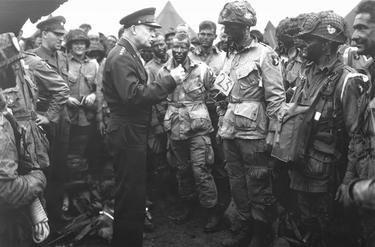

Dwight Eisenhower addresses U.S. paratroopers before they board their aircraft to participate in the D-Day Invasion.

Source: Digital Stock
In the early morning grayness of June 6, 1944, lookouts manning scores of German artillery emplacements above the Normandy beaches of northern France saw the unbelievable sight of nearly 6,000 Allied ships of all types and sizes steaming toward them. Shocked as they were, they knew what those thousands of ships meant: The long-expected Allied invasion of Adolf Hitler's fortress Europe had begun.
A short time later, at about 6:30 a.m., the drop-down doors of hundreds of landing craft opened out as ramps into the surf and more than 160,000 British, American, Canadian, French and Polish troops stormed ashore in what was the largest seaborne invasion in world history. Attacking on a 45-mile stretch of five beaches designated Utah, Omaha, Sword, Juno and Gold, the Allied troops faced obstacles unlike nearly any encountered by invading troops in the history of warfare.
They attacked what military experts agree were the most formidable defenses ever constructed in modern warfare. Hitler had placed Field Marshall Erwin Rommel, the famed "Desert Fox" of North Africa, in charge of the German defensive effort. His "Atlantic Wall," an elaborate array of concrete gun installations, bunkers and pillboxes, allowed considerable interlocking fire that could be devastating to any attackers. Fortunately for the Allies those defenses, despite four years of effort, were still incomplete.
The Allied troops waded ashore into withering German machine-gun fire. Those who made it to the beach ran a gauntlet of land mines and barbed wire. While on the beach their only cover was the steel landing obstacles that offered little protection from German gunners. On Omaha beach, soldiers of the U.S. 1st and 5th Ranger battalions soon became pinned down, huddled under the 100-foot-tall chalk cliffs at Point du Hoc. The U.S. First Army commander, General Omar Bradley, seriously considered pulling them off the beach, a move that would have crippled the attack.
In actuality, Operation Overlord, as the invasion landings were code-named, began just after midnight on June 6 when some 24,000 glider-borne troops from the U.S. 82nd and 101st Airborne Divisions parachuted behind the German front lines. Their mission: to protect the flanks of the invading troops, secure bridges and main roads, and prevent the Germans from bringing in reinforcements from the north.
The airborne landings were at best a mixed success. Many gliders missed their landing zones, some men parachuted into swamps and drowned, while others were shot as they slowly drifted to earth. But the partial success they achieved made the difference.
And in spite of all odds, the invasion succeeded. By nightfall the invading troops had secured small beachheads on all five beaches. These were the first of an oncoming wave of Allied troops over the next two weeks. The Allies advanced and didn't stop until they got to the heart of Germany.
American resolve on the world scene, as displayed at that time, is not so easily found today. Clearly something has changed!

Did God play a hand in those events?

June 6, 2014, marks the 70th anniversary of D-Day. Virtually all of the men who stormed ashore that awful day 70 years ago are dead, but a small handful, men in their late 80s and 90s, will visit those Normandy beaches for perhaps the final time to commemorate that important victory.
Despite the enormous cost of more than 9,000 Allied soldiers killed and wounded on that day, D-Day was a success. But many do not realize that it could easily have been a disaster. As supreme commander of Allied forces that day, U.S. Gen. Dwight Eisenhower knew as well as Rommel that if the invasion could be stopped at the beaches, it might be fatal to the Allied cause.
Over the decades, many have wondered if God had a hand in that historic day.
Let's look at the evidence. To begin with, Eisenhower and British General Bernard Montgomery, who commanded the land forces, successfully misled Hitler and the German High Command into believing that the invasion would take place across the narrow part of the English Channel at Pas de Calais. Over the previous year, they had planned and pulled off an elaborate ruse using fake guns, tanks, coded messages and other diversions to convince the German Fuehrer that a totally fictitious First U.S. Army Group was poised behind the cliffs of Dover for the attack.
When the landings took place, Hitler believed they were only a diversion from the main attack that he still believed would occur at Pas de Calais, 100 miles to the north of Normandy. Despite the urgent pleas of Rommel and General Gerd Von Rundstedt, the main German commanders, he refused to order the movement of troops to the south.
Could those thousands of extra troops have made the difference? Could they, as Hitler vowed, have thrown the Allied troops back into the sea?
Weeks after the landings it was revealed that a dispute between German commanders had kept most of the German panzer tank divisions away from the landing zones. By the spring of 1944 the Allies ruled the skies over France, and Rommel wanted most of the 10 panzer divisions near the beaches to minimize their exposure to Allied air attacks while in transit.
However, panzer commander General Leo von Gehr wanted the divisions kept closer to Paris. Hitler ordered what turned out to be a bad compromise: A few Panzer divisions would be at the beaches, but most would be kept inland.
Similarly, most of the Luftwaffe 's aircraft had been relocated far from the coast to defend Germany's heartland from American and British bomber attacks and weren't a factor when the invasion commenced.
Rommel had earlier told his aide: "The war will be won or lost on the beaches. We'll have only one chance to stop the enemy and that's while he's in the water . . . struggling to get ashore. Reserves will never get up to the point of attack and it's foolish even to consider them . . . the first twenty-four hours of the invasion will be decisive . . . for the Allies, as well as Germany, it will be the longest day" (quoted by Cornelius Ryan, The Longest Day: June 6, 1944, 1959, pp. 27-28).
Would the outcome have been different had those forces been deployed near the beaches?
Weather and the timing of the invasion were other crucial factors. Eisenhower and Montgomery knew the invasion had to take place in a narrow window of opportunity: A full or near-full moon was needed for glider pilots to see their landmarks, and successful beach landings required high spring tides to clear as many of the German defensive obstacles as possible.
That narrow window presented itself only from June 5 to 7. The Allied generals knew that missing that window would force them to put off the invasion for at least two weeks. Secrecy might have been lost, and German defenses would be even stronger.
Storms and high seas arrived with the first days of June. Eisenhower had planned the invasion to coincide with the full moon of June 5. But June 4 was an especially stormy day. Forced to delay the invasion, Eisenhower huddled with his staff. His chief meteorologist, J.M. Stagg, forecast a brief break in the weather for June 6. Though some of his officers disagreed, Eisenhower made the fateful decision: The attack would take place on June 6.
As it turned out, the bad weather unexpectedly weakened German defenses. Viewing the winds and stormy seas, the German commanders concluded that no one in his right mind would launch an invasion under such conditions. Senior officers ordered their troops to stand down, and many of them were away for the weekend. The Luftwaffe canceled normal reconnaissance flights, which would have given them advance warning of the invasion.
Even Rommel, the supreme German commander, overworked and exhausted from overseeing efforts to finish the formidable coastal defenses he anticipated being completed in a few weeks, decided to return to Germany for the weekend to visit his wife on her birthday—June 6. He also wanted to make a personal visit with Hitler to plead once more to have the German tank divisions repositioned to the coast rather than held in reserve far to the rear where they would be too far away to make a difference.

A "great crusade" hung in the balance

Much has been written about seemingly miraculous events that turned the tide of World War II. Historians have long referred to the Miracle of Dunkirk, where calm seas allowed an evacuation that saved more than 300,000 British troops from annihilation or capture in May 1940 while heavy fog grounded German planes.
Others have pointed to the extremely fortuitous instance of the British navy finding and sinking the dreaded German battleship Bismarck in May 1941.
Did God Himself intervene to clear the seas and skies enough on June 6 to permit the glider and seaborne landings, yet have this come amid terrible weather to make the German defenders think no attack would be forthcoming?
One has to pause and consider. Had D-Day been delayed, would Hitler have caught on to the deception? Would he have transferred thousands of troops, guns and tanks from Pas de Calais to Normandy? Would he have made good on his vow to drive the invaders back into the sea?
On the day of the invasion, Eisenhower sent a message to the airborne and seaborne troops: "You are about to embark upon the great crusade, towards which we have striven these many months. The eyes of the world are upon you. The hopes and prayers of liberty-loving people everywhere march with you . . . Let us all beseech the blessing of Almighty God upon this great and noble undertaking." He also carried in his pocket a second message—one to be read in case the invasion failed.
Years later, in referring to his agonizing decision to postpone the invasion from June 5 to June 6, Eisenhower said this: "If there were nothing else in my life to prove the existence of an Almighty and Merciful God, the events of the next twenty-four hours did it" (quoted by John McCollister, God and the Oval Office, 2005).

A superpower emerges victorious

Seven decades have passed since D-Day. With its success, which from a human perspective was by no means guaranteed, Hitler's Nazi grip on Europe was reduced to less than a year. By mid-May 1945, Berlin lay in ruins, Hitler was dead, and the war in Europe was over.
Many don't realize that your Bible had foretold the national power and prestige that America and Britain, historical allies, experienced over the course of the 19th and 20th centuries. Was there any prophetic significance to Anglo-American victory in World War II? Surprising at it may sound, ancient Israel was the forerunner of our modern
English-speaking nations of the United States and many of the British Commonwealth nations. (To learn more about this, read our free study aid, The United States and Britain in Bible Prophecy . )
Two parallel biblical passages, Leviticus 26 and Deuteronomy 28, prophesied blessings or curses that would come on Israel for either obedience or disobedience to the divine laws God put in place. For example, Deuteronomy:28:7 speaks of great military victories if the people would obey and honor their Creator: "The Lord will cause your enemies who rise up against you to be defeated before your face; they will come out against you one way and flee before you seven ways" (emphasis added throughout).
The United States emerged from World War II as the world's leading national power. Tyranny had been defeated, and the country even embarked on a massive and generous rebuilding plan to help its defeated former enemies get back on their feet.
America assumed the role of the world's policeman, and in the bipolar world of the Cold War era, the United States was the clear leader of the free world—pitted against its totalitarian rival, the Russian-led Soviet Union.

America quickly losing power and influence

Over the decades since, America has played its leading role with decreased effectiveness. Despite trillions of dollars spent and tens of thousands of lives lost, the result of U.S. conflicts in Korea, Vietnam, Iraq and Afghanistan has been stalemate or a negotiated peace that eventually turned to victory for America's enemies.
Past decades saw a willingness of the United States to go to the mat for its national interests. President John F. Kennedy faced down Soviet Premier Nikita Khrushchev in October 1962 during the Cuban missile crisis, ordering Soviet missiles to be taken out of Cuba. Yet only recently America has seen its power and ability to influence outcomes checkmated in Syria, in Iran, and most recently in Ukraine, where many in the province of Crimea pushed the secession of the province to be annexed by Russia (see " Ukraine: Feeble U.S. Stand Allows Russian Imperialism ").
What has changed from the earlier period of American resolve to the present?
In late February U.S. Defense Secretary Chuck Hagel submitted a proposed fiscal 2015 defense budget that would reduce U.S. military personnel to about 450,000, the smallest since 1945. It would also reduce the U.S. Navy to its smallest size in decades. Despite these proposed cuts, the U.S. military would yet remain the world's most powerful—though Russia and China, seeing American weakness and withdrawal, are vigorously updating and expanding their military capabilities.
Again we ask, what has changed?

A return to the Cold War?

The United States has had little power to influence the outcome of the situation in Crimea, which for all intents and purposes is now effectively part of Russia. Notice what God prophesied about the modern descendants of ancient Israel, who today include the major English-speaking nations: "I will break the pride of your power" (Leviticus:26:19). Though it still has the world's largest military, U.S. willingness and ability to use that military seems to be stymied around the world.
Recently suffering a humiliating withdrawal from Iraq and leaving that nation divided with parts of it taken over by radical Islamists, and now facing a similar withdrawal in Afghanistan, how is it that the world's greatest military power has essentially been fought to a draw by insurgents whose weaponry consists of AK-47s, rocket-propelled grenades and improvised roadside bombs?
America's sliding morals, national scandals and increasing disregard of God's law has brought consequences. Again, while Moses pointed out the blessings for obedience, he was also inspired to write about the consequences of disobedience:
"The Lord will cause you to be defeated before your enemies; you shall go out one way against them and flee seven ways before them; and you shall become troublesome to all the kingdoms of the earth" (Deuteronomy:28:25).
We are commanded to watch and give heed to what is taking place around us (Matthew:24:42). At this time we have no way of knowing in full where the Ukrainian crisis will lead. But the stark reality of international events of recent weeks is stirring millions in the Western world to a renewed concern that the Cold War of decades ago has returned. An NBC News/ Wall Street Journal poll during the week of March 10 revealed that 72 percent of Americans now view Russia as a threat, up from just 26 percent a few months ago.
As we reflect back on the amazing events of 70 years ago, we should ponder the years to come.
The God who created mankind has a plan for how these events will finally play out, and you need to learn more about that plan. And you need to know where the English-speaking peoples are identified in your Bible and what God has in store for them.


Wednesday, June 4, 2014

US Govt Concluded Bowe “Abdullah” Bergdahl Was Deserter Back in 2010; Converted to Islam, Taught Taliban to Ambush US

A very interesting post from www.debbieschlussel.com about the captive that the U.S. received back in exchange for the release of five Guantanamo Bay jihadists. This follows this post about a Muslim who murdered his wife in the U.S. This follows this article about American energy independence and preventing money from going to hostile countries. For more about what you can do to get more involved click here and you can read two very interesting books HERE. You can follow me at blogspot here and at twitter here https://twitter.com/brianleesblog. Please consider following both in case one goes down!


US Govt Concluded Bowe “Abdullah” Bergdahl Was Deserter Back in 2010; Converted to Islam, Taught Taliban to Ambush US


By Debbie Schlussel
So, despite claims that it’s merely “speculation” that Bowe Bergdahl–now “Abdullah” Bergdahl–is a deserter (he deliberately left his base without a weapon or armor, but took his diary–and a number of troops in his unit say he deserted), the Obama Administration had apparently concluded Bergdahl was a deserter four years ago, and yet went ahead with the ridiculous, lopsided Gitmo trade for Bergdahl anyway (thanks to reader Duane for the tip):
bergdahlsix


The Pentagon concluded in 2010 that Army Sgt. Bowe Bergdahl walked away from his unit, and after an initial flurry of searching the military curbed any high-risk rescue plans. . . . But the former Pentagon official said it was “incontrovertible” that he walked away from his unit. The military investigation was broader than a criminal inquiry, this official said, and it didn’t formally accuse Bergdahl of desertion. In interviews, members of his unit portrayed him as a naive, “delusional” person who thought he could help the Afghan people by leaving his army post, the official said. . . .


Nathan Bradley Bethea, who served as an officer in Bergdahl’s unit, said in an article Monday on the Daily Beast website that Bergdahl was not on patrol, as some reports have suggested.
“There was no patrol that night,” he wrote. “Bergdahl was relieved from guard duty, and instead of going to sleep, he fled the outpost on foot. He deserted. I’ve talked to members of Bergdahl’s platoon_including the last Americans to see him before his capture. I’ve reviewed the relevant documents. That’s what happened.” Hagel, visiting troops in Afghanistan, was met with silence when he told a group of them in a Bagram Air Field hangar: “This is a happy day. We got one of our own back.”
And, yet, despite that conclusion, Bergdahl was promoted TWICE! while in captivity. HUH? Instead of promoting this deserter, they should have been preparing his court martial . . . the only reason we should have worked for his release. And, yet, as I noted yesterday, the government has already decided that five years was enough for the six lives of American soldiers he cost and countless other lives lost because we traded top Gitmo terrorists for him.
More:
A captured American soldier is training Taliban fighters bomb-making and ambush skills, according to one of his captors and Afghan intelligence officials. Private Bowe Bergdahl disappeared in June 2009 while based in eastern Afghanistan and is thought to be the only U.S. serviceman in captivity. The 24-year-old has converted to Islam and now has the Muslim name Abdullah, one of his captors told The Sunday Times.
A Taliban deputy district commander in Paktika, who called himself Haji Nadeem, told the newspaper that Bergdahl taught him how to dismantle a mobile phone and turn it into a remote control for a roadside bomb. Nadeem claimed he also received basic ambush training from the U.S. soldier.
It’s disgusting, given all this, that Susan Rice–the Obama Administration’s Goebbelsette–would say this al-schmuck “served with honor.” HUH?
THIS. IS. WEAKNESS. Back in the day, Bergdahl would have faced the music. Today, he’s dancing a jig to the music. While those who died for him can’t make a move or say a word. They are gone forever.
The U.S. Armed Forces . . . No Deserter Convert to Islam Left Behind.
Exit Question: What exactly did Bowe Bergdahl do to “help the the Afghan people”? We already know what he did to “help” six Americans to their eternal sleep.
Exit Question #2: Was Bowe Bergdahl’s desertion and conversion to Islam his way of rebelling against those ballet lessons his parents made him take as a kid? Just askin’.
Related Posts with Thumbnails
Print Friendly


Tags: , , , ,


25 Responses


Obamadan considers him a hero
HK on June 3, 2014 at 8:55 am

IMPEACH OBAMA !!!
HK on June 3, 2014 at 8:58 am

He is not a hero and Jane Fonda should not be honored as one of the top Women of the Century! How insulting is all this to the American people?
My concern of those prisoners released is how many more lives will be lost as a result.
These fanatics need to be eradicated. I’ll never forgot when a journalist asked General Powell something like how do you deal with an enemy that has no value for life, and he replied, “You accomadate them”.
Keep up the great work Debbie.
Frank E. Rotondo on June 3, 2014 at 9:15 am

Now let me see if I understand this correctly. A President named Hussein voted in as the next President after 9/11, exchanged a Muslim deserter who has Muslim parents and is responsible for the deaths of 6 of his comrades in arms, exchanged for 6 top terrorists who will inevitably kill more Americans and all with the blessings of the Secretary of Defense and the U.S. Ambassador to the U.N. Thank God I’m a Canadian.
David Cameron on June 3, 2014 at 9:33 am

What is happening to this country??? Who could imagine this?? It’s a world turned upside- down.
Yehudit18 on June 3, 2014 at 9:51 am

    Oh yeah what happened to this wonderful country based on a genocide,slavery and racial segregation,it’s so sad
    J93 on June 3, 2014 at 4:23 pm

      SCIENTISTS SAY that sarcastic cynics die younger than most people…for you ONLY may this be true!
      It's just me again on June 3, 2014 at 7:25 pm

As some have pointed out, Obama believes this to be some sort of crazy confidence building measure which will aid in his negotiations with the Taliban. Obama wants to exit Afghanistan, and so he desperately needs an agreement with the Taliban. This is a sign of his desperation. It is already coming back to bite him, as people begin to understand exactly what was done for a solider who may very well turn out to be guilty of treasonous acts.
Adam on June 3, 2014 at 10:41 am

AS OBAMA ANTICIPATES THE END OF HIS TERM HE IS RAMPING UP HIS SABOTAGING , ANTI USA ACTIONS…..CANT ANYONE STOP HIM ???
HK on June 3, 2014 at 11:15 am

    HK,
    The military could stop him, like in Egypt or Thailand. They could throw him or his successor Hillary out of power, declare a national emergency, and then get rid of the communists in the media. But that is probably a few years down the road.
    John M on June 3, 2014 at 11:28 am

I’m going to play devil’s advocate here: Bowe Bergdahl is not the issue, regardless of what you think of his actions – in hindsight, his behavior is all about our Afghanistan policy.
We have our troops there on an unclear mission fighting an enemy this Administration has made it clear doesn’t exist. So why shouldn’t Bergdahl seek out and befriend the Taliban? That is exactly what he did. And that is now Obama’s view, too.
I’m not one of those who says we should court-martial him. We’d be hypocrites and not to face up to the fact that his embrace of Islamic terrorists is now also official American policy.
We’re keeping American troops in Afghanistan on a pointless mission. Unless that mission is to make friends with those who blow up Americans. Seen in that light, Bergdahl’s conduct is entirely rational. He understood his mission and his country better than his critics understand him.
I’m not one to judge here and the reason I won’t attack him is because he and his family only did what his country asked of them in Afghanistan. People may say that doesn’t make him a hero but let’s be fair here: there is nothing heroic about the American mission in Afghanistan, period.
This isn’t about what Bergdahl may or may not have done. This is all about our country and how it treats soldiers sent to do anything but fight a war. Which was never Bergdahl’s assignment and we have no right to condemn him for deserting a battlefield that never existed.
All of that is true and a lot more could be said. One is thing is for sure: the Taliban are laughing at us precisely because we are unsure of why we put American soldiers’ in harm’s way. And if I was Bergdahl’s father, I can understand exactly why he thought it was time to bring his son home.
Our Afghanistan mission is in search of a reason to be there that people have a very hard time coming up with. And I think its high past to bring all our of troops, along with Bergdahl, home.
NormanF on June 3, 2014 at 11:33 am

    “I’m not one to judge here and the reason I won’t attack him is because he and his family only did what his country asked of them in Afghanistan.”
    Well, NormanF, then I gather you must believe that the overwhelming majority of his former fellow soldiers did NOT do what their country asked of them.
    skzion on June 3, 2014 at 2:30 pm

      The point is soldiers’ lives are being thrown away for nothing. Bergdahl was a babysitter for Islamic terrorists and so are the rest of our troops.
      We are not there to defeat the Taliban! If any one can explain for us why Bergdahl should be made a scapegoat for official US policy failure in Afghanistan, I’d love to hear it.
      As Debbie has pointed out in the past, we are not in it to win. Only if that was true, is Bergdahl a traitor. His actions are not all that different from the one the Obama Administration has been embracing there.
      NormanF on June 3, 2014 at 6:30 pm

        “The point is soldiers’ lives are being thrown away for nothing. Bergdahl was a babysitter for Islamic terrorists and so are the rest of our troops.”
        NormanF, on this point I certainly agree. But that’s not the main point you were making. Granting this point, one could certainly say that a soldier who caused even more soldier deaths should not be cheered. Bergdahl did.
        skzion on June 3, 2014 at 7:08 pm

    He deserted Norman. He got 6 men killed. He gave training to the enemy.
    You’re lost in the big picture my friend. Come back down to earth big guy.
    passengerpigeon on June 3, 2014 at 2:41 pm

      PG,
      Are we fighting a war there? Heck, no! We are running an expensive and thankless social work scheme to benefit those who hate us and want to see us dead.
      That is not what our military is trained for! Bergdahl got the impression we need to make friends with our enemies. Exactly what the Obama Administration is doing.
      You are one in need come down to earth. I never said he was a hero but then again as I already pointed out, nothing about Afghanistan mission is worth the life of a single American soldier.
      I am sure you know that already.
      NormanF on June 3, 2014 at 6:36 pm

        That “birddog” VOLUNTEERED to join the Army. NOT ONE PERSON FORCED HIM!
        He knew there was a war on and I bet you that he is spoiled mama’s boy who flew by the seat of his pants. He NEVER really he gave fig or a thought to helping Afghans…or anybody else! He wanted adventure and he GOT IT, then turned white feather CHICKEN!
        He is crybaby brat!
        He should be tried for treason, convicted and promptly hung!
        Signed,
        Mom of a retired US soldier who served. Then volunteered to serve again! He NEVER RAN AWAY in the face of danger, changed orders OR BOREDOM!
        It's just me again on June 3, 2014 at 7:36 pm

    “there is nothing heroic about the American mission in Afghanistan, period.” – are you on drugs today or have you just got your head stuck up your ass again?
    Every single one of those guys that went out to look for his useless POS ass are heroes.
    If they weren’t 6 of them would still be alive.
    passengerpigeon on June 3, 2014 at 2:45 pm

Don’t think he wasn’t rebelling. Like father, like son, like president. Chrislam marching soldiers.
passengerpigeon on June 3, 2014 at 2:28 pm

“The U.S. Armed Forces . . . No Deserter Convert to Islam Left Behind.”
It all started with Petraus and his asinine move to cranberry berets. Now soldiers look like boy scouts and it immediately took away the distictiveness of Special Forces uniform.
Oh, amd made us more resemble the French army.
DS_ROCKS! on June 3, 2014 at 2:33 pm

Everybody in the picture has the same religion.
passengerpigeon on June 3, 2014 at 2:35 pm

Sad for these guys,but it’s war and at war soldiers die
I don’t like talibans,they’re extremists,but US invade their country and kill many innocent people among many childrens,i think it’s worst and more sad than the death of five imperialist soldiers
J93 on June 3, 2014 at 4:27 pm

    “I don’t like talibans,they’re extremists,but US invade their country and kill many innocent people among many childrens,i think it’s worst and more sad than the death of five imperialist soldiers.”
    Well now J93, the “invasion” that initiated this happened to be 9/11. You Moooooslims kill people and then complain that others are making war on you when they fight back.
    I don’t limit my dislike to “talibans”–I extend it to all Muslims, including “childrens.” After all, Moooooslim offspring are simply immature Bnei Amalek.
    skzion on June 3, 2014 at 7:11 pm

There was once a time in western Armies that if you were accused of “grousing” ,that is,talking down your comrades or bitching about life in the army, you were placed in the stockade ,without benefit of legal counsel. If you were accused of cowardice in the face of the enemy as this former soldier is accused of,you were shot dead after a summary Court martial. usually in the field.
it is important to any soldier that you retain discipline,that is how you stay alive.
The American army under Obama has adopted the swedish child raising doctrine of “no smacking,you must negotiate” style of leadership.
This traitor has not only attempted to talk down his comrades,he has deserted in the face of the enemy and joined their ranks.
Added to this is the fact his actions of cowardicwe led to the deaths of fellow soldiers is beyond contempt .
perhaps the rest of his life in Gitmo is the answer. He can then comune with the fabled leader of his death cult..mohammad as he contemplates the lives he has taken in the name of the islamic death cult.
Aron B on June 3, 2014 at 5:47 pm

BO is both a moslem and marxist so his actions come as no surprise. I am betting the 5 released terrorists are the ones to watch, unfortunately.
Marily on June 3, 2014 at 11:25 pm

Leave a Reply


* denotes required field


Monday, February 17, 2014

Urgent! The IRS is at it again‏

A timely post about from http://americansforprosperity.org/ about the IRS targeting political opponents of the current president. This follows this post about Texas legislators who are graded "Worse than Wendy." This are GOP legislators!  In the meantime, you can get more involved if you like here and read an interesting book HERE.


Urgent! The IRS is at it again‏


The IRS is at it again.

First, we discovered that the IRS was secretly targeting conservative organizations for more rigorous screening during their application process to receive tax-exempt status. Now, the IRS wants to go even further to silence conservative 501(c)(4) groups like Americans for Prosperity.

If implemented, the new IRS regulations will severely restrict our free speech by:

  • Limiting affected groups' ability to criticize or praise the policies of any federal, state, or local politicians within 30 days of a primary or 60 days of a general election
  • Forcing affected groups to remove any references to politicians from their websites during these time periods
  • Limiting affected groups' ability to hold candidate debates or forums during these time periods
  • Limiting affected groups' ability to distribute voting guides and legislative scorecards
  • Limiting affected groups' ability to weigh in on nominees for federal, state, or local appointed government positions
take action button


AFP is committed to holding politicians accountable. We want constituents to know when their legislators are being true to their word -- and when they're not. The IRS is trying to make that much more difficult for us.
In spite of all this, President Obama claims there's "not even a smidgen of corruption" going on at the IRS. But many Americans seem to think otherwise -- 64% of voters think the IRS is corrupt. Even a majority of Democrats think so!

Please join us --  and 55+ other conservative organizations -- in stopping the IRS' latest power grab.

Sincerely,

Tim Phillips
Americans for Prosperity President


P.S. Go to BlockTheIRS.com to send a message to the IRS right now.


Thursday, June 6, 2013

Why Do We Need Weed?

An interesting article from http://www.ucg.org/ about marijuana being legalized in states such as Colorado and Washington. This follows this post about God.  For a free magazine subscription or to get the book shown  for free click HERE! or call 1-888-886-8632.


Voters in Colorado and Washington state approved the legalization of the possession and sale of marijuana for recreational use. What is missing in life that drives people to abuse drugs?


[Gary Petty] During the latest rounds of political elections, a number of states voted to legalize marijuana. Of course this is a great concern for a lot of people—the legalization of a drug that has been proven to be very detrimental to people.


The real question is why are we a nation that needs so much to rely on drugs?


What is it that we're trying to escape from—whether it's marijuana or alcohol abuse or abuse of illegal drugs or even abuse of legal drugs that people get through prescriptions?


Why are we a nation that's trying to hide something that's happening inside of us?


Well, the reality is what we're trying to deal with, that emptiness, that ache, that angst, that anxiety is really an issue between us and God and us and other people. The reason we use drugs is to cover up the fact that inside every one of us is a deep seeded need for a personal relationship with our Creator.


The more we run from that, the more we try to hide from that, the more we try to find that answer in whatever it is, whether it's drugs or money or illicit sex. In the end we end up still empty, still searching.


God wants to heal your life. God wants to change who you are. God wants to fill that hole.


Turn to God. Pick up your Bible. Get on your knees and ask God to come into your life to help you understand and to lead you to where He wants you to go.


You will find you won't have a need any longer for those things. It's going to take some work. It's going to take a lot of work. It's going to be painful, but in the end you will be a child of God.


This is BT Daily. Join us again

Comments http://www.ucg.org/user/register/?destination=comment%252Freply%252F29064%2523comment-form

Monday, May 20, 2013

Editorial: Executive Branch Scandals!

Editorial

Recently in the news there have been the Executive Branch scandals of the Benghazi Investigation, the IRS attack on TEA Party groups, the EPA e-mail scandal, the HHS advertising scandal, the DOJ AP e-mails scandal, and the EEOC Hosanna-Tabor Scandal, and a good source of this is www.HughHewitt.com .

Yet nevertheless, it can be considered that the Gang of Eight Amnesty is still chugging along according to www.Alipac.US , so are these scandals really hurting the Executive Branch?

Tuesday, May 14, 2013

Violence against American diplomats in Libya

An interesting article from http://www.ucg.org/ about the Americans who were killed in Libya. This follows this post about interpersonal problems that some have. For a free magazine subscription or to get the book shown  for free click HERE! or call 1-888-886-8632.

Wars of Religion


Violence against American diplomats in Libya remind us how quickly religion can inflame the region.


[Darris McNeely] The Middle East has once again erupted into violence. Unfortunately this week, an attack took place on the American Embassy Compound in Libya, the city of Benghazi. Four American diplomats were killed, including the ambassador to Libya, Christopher Stevens. It was a very unfortunate situation. This marks the first time since 1979 that a sitting ambassador has been killed in the country in which he is serving. And it highlights once again the volatility of the entire region, but as well the impact of religion and what it can do to suddenly provoke a problem and a reaction, and again even a larger war within this highly important area of the Middle East.


[Steve Myers] There's no doubt that religion had a major part to play in this whole incident because that was the backdrop, whether the leaders were actually convinced of that, but it was certainly used to provoke this whole incident. And it shows how easily people can be motivated by some of these kinds of things.


[Darris McNeely] In this case it was a video that was done that was purporting to cast the Prophet Muhammad in an unfavorable light. And yet likely this was planned because it also took place on the anniversary of 9/11 - the attacks on Washington and New York City 11 years ago.  But again it just brings up the point that the wars of religion - we did a program on Beyond Todaya few years ago about the wars of religion. Religion is still a very potent force in world affairs and culture. And as much as some people in the West especially would like to think that religion in a sense does not play a significant role, things like this happen in the Middle East to remind us that religion does play a very important role.


[Steve Myers] It's a huge role, and it's a prophetic role that we can't ignore. Daniel 11 talks a lot about that, it talks about the coming times, and how religion really will be a cornerstone to some of the issues that are going to be facing the world here shortly.


[Darris McNeely] Daniel 11:40And at the time of the end shall the king of the south push at him: and the king of the north shall come against him like a whirlwind, with chariots, and with horsemen, and with many ships; and he shall enter into the countries, and shall overflow and pass over.


See All... is a key verse in Bible prophecy that we are looking at to be fulfilled. It talks about the time of the end yet ahead of us when "The king of the South shall attack him and the king of the North shall come against him like a whirlwind." Now what in general terms this prophecy is doing is describing a provocation where it says, "The king of the North shall attack." Excuse me, "The king of the South will attack." The king of the South is identified as the power coming out of the Middle East and in whatever way it provokes a reaction against another power here called the king of the North to come and to invade into the region. And interestingly as this prophecy goes on - of course, this is verse 40 - it goes on in verse 43 to mention even the very country Libya that we're talking about here (Daniel 11:43But he shall have power over the treasures of gold and of silver, and over all the precious things of Egypt: and the Libyans and the Ethiopians shall be at his steps.


See All...).


[Steve Myers] It certainly does. And do you see these attitudes already there today? If you read through all of Daniel 11 you find these descriptors of people's attitudes and their minds, where it talks about strife, where it talks about violence, where it talks about stirring things up. And boy have we seen that this week. That's what's happening.


[Darris McNeely] And we don't know yet what will happen additionally this week with other problems, but it just points up the fact to continue to be watching the Middle East. Be aware of what is taking place and understand how quickly events can unfold - even small events can become very big. This is a very significant event. It's not something to take lightly.


[Steve Myers] That's BT Daily . We'll see you next time.

.

Friday, December 28, 2012

The Benghazi Report and the Diplomatic Security Funding Cycle

A very interesting post from www.Stratfor.com about the Benghazi Report. This follows this post about Shale deposits as a petroleum resource.  This follows this article about American energy independence and preventing money from going to hostile countries such as Iran . For more about what is happening in the nation now click here and read a very interesting book HERE.


The Benghazi Report and the Diplomatic Security Funding Cycle


Stratfor

By Scott Stewart

Vice President of Analysis


On Dec. 18, the U.S. State Department's Accountability Review Board released an unclassified version of its investigation into the Sept. 12 attack on the U.S. Consulate in Benghazi, Libya. U.S. Ambassador to Libya Christopher Stevens and three other Americans were killed in the attack, so the report was widely anticipated by the public and by government officials alike.


Four senior State Department officials have been reassigned to other duties since the report's release. Among them were the assistant secretary of state for diplomatic security; two of his deputy assistant secretaries, including the director of the Diplomatic Security Service, the department's most senior special agent; and the deputy assistant secretary responsible for Libya in the State Department's Bureau of Near Eastern Affairs.


The highly critical report and the subsequent personnel reassignments are not simply a low watermark for the State Department; rather, the events following the attack signify another phase in the diplomatic security funding cycle. The new phase will bring about a financial windfall for the State Department security budgets, but increased funding alone will not prevent future attacks from occurring. After all, plenty of attacks have occurred following similar State Department budgetary allocations in the past. Other important factors therefore must be addressed.


Predictable Inquiries

The cycle by which diplomatic security is funded begins as officials gradually cut spending on diplomatic security programs. Then, when major security failures inevitably beset those programs, resultant public outrage compels officials to create a panel to investigate those failures.


The first of these panels dates back to the mid-1980s, following attacks against U.S. facilities in Beirut and Kuwait and the systematic bugging of the U.S. Embassy in Moscow. These security lapses led to the formation of the Secretary of State's Advisory Panel on Overseas Security, chaired by former Deputy CIA Director Adm. Bobby Inman. The law that passed in the wake of the Inman Commission came to be known as the Omnibus Diplomatic Security and Antiterrorism Act of 1986, which requires that an accountability review board be convened following major security incidents.


There are a few subsequent examples of these panels. Former Chairman of the U.S. Joint Chiefs of Staff Adm. William Crowe chaired an Accountability Review Board following the bombings of U.S. embassies in East Africa in 1998. And after the Benghazi attacks, an Accountability Review Board was chaired by former U.S. Ambassador Thomas Pickering. The Dec. 18 report was the findings of the Pickering board.


Predictably, the review boards, including Pickering's, always conclude that inadequate funding and insufficient security personnel are partly to blame for the security breaches. In response to the reports, Congress appropriates more money to diplomatic security programs to remedy the problem. Over time, funds are cut, and the cycle begins anew.


Funding can be cut for several reasons. In times of financial austerity, Congress can more easily cut the relatively small foreign affairs budget than it can entitlement benefits budgets. Cuts to the overall State Department budget generally result in cuts for security programs.


Moreover, rivalries among the various State Department entities can affect spending cuts. The Diplomatic Security Service's budget falls under the main State Department budget, so senior diplomats, rather than Diplomatic Security Service agents, represent the agency's interests on Capitol Hill. Some within the security service do not believe that senior diplomats have their best interests at heart when making the case for their budgets -- at least until a tragedy occurs and Congressional hearings are held to air these problems. For their part, others in the department resent the Diplomatic Security Service for the large budgetary allocations it receives after a security failure.


More than a Matter of Funding

With Congress and the presumed next Secretary of State John Kerry now calling for increased spending on diplomatic security, the financial floodgates are about to reopen. But merely throwing money at the problems uncovered by the accountability review boards will not be enough to solve those problems. Were that the case, the billions of dollars allocated to diplomatic security in the wake of the Inman and Crowe commission reports would have sufficed.


Of course, money can be useful, but injecting large sums of it into the system can create problems if the money provided is too much for the bureaucracy to efficiently metabolize. Government managers tend to spend all the money allocated to them -- sometimes at the expense of efficiency -- under a "use it or lose it" mentality. Since there is no real incentive for them to perform under budget, managers in a variety of U.S. government departments spend massive amounts of money at the end of each fiscal year. The same is true of diplomatic security programs when they are flush with cash. But the inevitable reports of financial waste and mismanagement lead to calls for spending cuts in these programs.


If the U.S. government is ever going to break the cycle of funding cuts and security disasters, the Diplomatic Security Service will need to demonstrate wisdom and prudence in how it spends the funds allocated to them. It will also be necessary for Congress to provide funding in a consistent manner and with an initial appropriation that is not too big to be spent efficiently.


Beyond money management and a consistent level of funding, the State Department will also need to take a hard look at how it currently conducts diplomacy and how it can reduce the demands placed on the Diplomatic Security Service. This will require asking many difficult questions: Is it necessary to maintain large embassies to conduct diplomacy in the information age? Does the United States need to maintain thousands of employees in high-threat places like Iraq, Afghanistan and Pakistan at the expense of smaller missions, or can the critical work be done by hundreds or even dozens? Is a permanent U.S. presence even required in a place like Benghazi, or can the missions in such locations be accomplished by a combination of visiting diplomats, covert operatives and local employees?


At the very least, the State Department will need to review its policy of designating a facility as a "special mission" -- Benghazi was designated as such -- to exempt it from meeting established physical security standards. If the questions above are answered affirmatively, and if it is deemed necessary to keep a permanent presence in a place like Benghazi, then security standards need to be followed, especially when a facility is in place for several months. Temporary facilities with substandard security cannot be allowed to persist for months and years.


Host Countries

As they consider these issues, officials need to bear in mind that the real key to the security of diplomatic facilities is the protection provided by the host country's security forces as dictated by the Vienna Convention. If the host country will not or cannot protect foreign diplomats, then the physical security measures mandated by security standards can do little more than provide slight delay -- which is what they are designed to do. No physical security measures can stand up to a prolonged assault. If a militant group armed with heavy weaponry is permitted to attack a diplomatic facility for hours with no host government response -- as was the case in Benghazi -- the attack will cause considerable damage and likely cause fatalities despite the security measures in place.


The same is true of a large mob, which given enough time can damage and breach U.S. embassies that meet current department security standards. The U.S. Embassy in Tripoli, a state-of-the-art facility completed in 2009, was heavily damaged by a mob of pro-Gadhafi supporters in May 2011 and rendered unserviceable.


In another example, a large crowd caused extensive damage to the U.S. Embassy in Tunis and the adjacent American School just three days after the Benghazi attack. In that incident, Tunisian authorities responded and did not provide the attacking mob the opportunity to conduct a prolonged assault on the embassy. Though the mob caused millions of dollars worth of damage to the compound, it was unable to breach the main embassy office building. Without host country security support, there is little that can be done to assure the safety of U.S. diplomats, no matter what happens to security budgets.

.


Read more: The Benghazi Report and the Diplomatic Security Funding Cycle
Stratfor
