Wknd Box Office: Saving Mr. Banks, American Hustle, Inside Llewyn Davis
By Debbie
Schlussel
**** SCROLL DOWN FOR UPDATE ****
I cannot recommend any of the new movies coming out this weekend (and it’s more bad news for the movies coming out Christmas Day–I semi-liked one of them), but I’m especially disgusted with the Disney offering, “Saving Mr. Banks.” My review of “Anchorman 2: The Legend Continues,” which debuted on Wednesday is here.
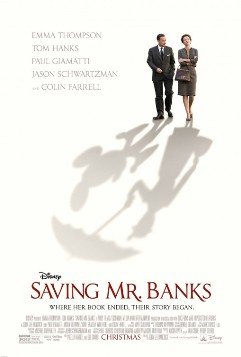

* “Saving Mr. Banks“: Disney is marketing this as a cheerful kids film about the making of the Mary Poppins movie. Don’t believe the hype. This is a dreadful movie that tells kids fathers are bad and subjects them to inappropriate storylines about alcoholism, death, and suicide. From Magical Kingdom to Tragical Kingdom–Yay, Disney!
We learn that P.L. Travers, the woman who wrote the Marry Poppins, had a horrible childhood because her father was an alcoholic who died when she was a kid, and she felt guilty that she killed him because, as a kid, she gave him more alcohol and she dropped a basket of pears. The movie keeps flashing back to boring, awful scenes of her drunken father getting fired, embarrassing the family, and being an overall failure. Oh, and the movie shows us how her mother tries to commit suicide, and again, the young girl must stop her mother from committing suicide.
As if that isn’t enough, we learn that Walt Disney’s father was a horrible guy, too. And not just a horrible dad, but a horrible CAPITALIST dad. You see, Walt tells Travers that, when he was a kid, his rich father didn’t want to pay people wages to deliver newspapers (he owned the major Kansas City newspaper routes). So, instead, he made his two young sons wake up in the middle of the night to deliver the papers in the freezing cold snow and then do it again to deliver the evening paper. Oh, and the Disney dad refused to buy his kids new shoes, instead, forcing them to trudge in the cold, wet snow with holes in their shoes and resultant frostbitten feet.
And while the movie does its best to traumatize kids and demonize dads, Walt Disney is, of course, portrayed as a jolly, avuncular, kind, decent guy. In real life, Disney was a fan of Hitler and not a fan of his many Jewish employees. Even his own museum admits he was an anti-Semite. None of this, of course, is mentioned in this love letter to Walt Disney produced by the Disney company. I guess it’s fitting that the anti-Semitism is skipped over, since it jibes with the anti-Semitic, anti-Israel sentiments of Emma Thompson, who plays Travers in this movie.
As for the rest of the movie, well, I’m just not sure there is so little of interest in this world that I needed to waste over two hours of my time watching a movie whose story is that P.L. Travers was a difficult woman and didn’t want Walt Disney to make her books into a musical film. That story could have been told in maybe 20 minutes at the most. So, they keep filling it with these depressing flashbacks about Travers’ alcoholic dad and suicidal, weepy mom. No thanks.
Yes, there are some funny lines and scenes. Yes, the period costumes (this takes place in the 1960s), sets, and so on are eye candy, “Mad Men”-style. And I liked the chauffeur character played by the always pleasant Paul Giamatti. Ditto for Jason Schwartzman, B.J. Novak, and Bradley Whitford, who play song- and script-writers trying to create the Mary Poppins movie despite Travers’ constant objections to everything. But none of that made up for the underlying message and many tragic scenes poisonous to kids and, frankly, poisonous to the movie and any enjoyment that might have been gotten from it. I also don’t believe most kids today know who Mary Poppins is. That was my generation and earlier generations. Kids today know who the Kardashians and Miley Cyrus are.
The story: Travers is a stuck up, difficult woman who refuses to sell Walt Disney (Tom Hanks, who looks nothing like the real Walt Disney) the rights to make a movie out of her Mary Poppins books (he’s promised his daughters, years earlier, that he’ll make a Mary Poppins movie). But after years of saying no, she needs the money and goes to California to do the deal and help make the movie. She’s insisted that she has final approval on everything, and doesn’t want anything Disney and his crew want in the movie. She opposes music, singing, and dancing in the movie. She opposes any comical lines and objects to the casting of Dick Van Dyke. While all of this is happening, Walt Disney is trying to charm Travers and convince her to agree to these things. But, in the end, she doesn’t agree until Walt discovers the real story about her difficult childhood, alcoholic dad and suicidal mother, and shares with her his story about his horrible father.
Dad-hating misery loves company–that’s the cheerful Christmas message of Disney’s holiday offering. But, hey, feminists will love it. And so will the psychologists and psychiatrists who get to treat kids in the aftermath of the viewing experience.
**** UPDATE: A frequent anti-Semitism-denier and commenter on this site is questioning Walt Disney’s anti-Semitism and embrace of Hitler. But facts are stubborn things. From my post on Walt Disney’s anti-Semitic/anti-Israel great-niece Abigail Disney:
 ” by Neal Gabler. ****
THREE MARXES PLUS FOUR BETTY FRIEDANS


Watch the trailer . . .
* “American Hustle“: This movie is mistitled. It should really be called, “Not Abscam.” Since when did Abscam–the successful FBI sting of elected public officials who were willing to accept bribes from a fake Arab sheikh–become a story about a Jewish con artist (who wears a giant gold Star of David, just in case you don’t know he’s Jewish) and his fake-Brit extra-marital girlfriend? Since when was it a story about a bumbling FBI agent who perms his hair, lives with his mother, and blackmails his boss? Well, actually, almost none of these things are true.
Yes, there was a convicted felon, Melvin Weinberg, who was Jewish (in name only), who was recruited by the FBI to help out in the Abscam sting. But he was a side character whom the FBI asked to take part. This movie presents the Jewish con artist, “Irving Rosenfeld” (Christian Bale) as the creator of several giant cons, who invents more cons–including, eventually the fake Arab sheikh, which is a sidebar in this movie–when he gets caught by the FBI. The real life FBI agent, Anthony Amoroso, who successfully helped plan Abscam and posed as the representative of the Arab sheikh (in this movie, Rosenfeld is the representative of the sheikh) is portrayed as a bumbling, coke-snorting, Studio-54-going idiot, “FBI Agent Richie DiMaso” (Bradley Cooper). Weinberg’s wife, Marie, who was nearly 50 at the time of Abscam, is portrayed by 23-year-old Jennifer Lawrence (who was 21-22 at the time of filming).
No surprise that the movie is phony history and a phony version of what Abscam was. No surprise also that the movie is a giant anti-Semitic lie. Hey, it’s Hollywood, which makes gazillions lying to America and creating fake “history” which the movie-going public believes is all true. And it’s, sadly, a fact that so many JINO (Jew In Name Only) Hollywood writers, producers, and directors seem to revel in making Jews look bad. We are less than 2.1% of the American population and nearly 100% of the criminals in the Christmas movies (stay tuned for my review of “Wolf of Wall Street,” next week).
Yes, the movie begins with the caption, “Some of this actually happened.” But the morons who pay ten-plus bucks to see this will, sadly, believe most of it actually happened, just like they believe the BS of “The Butler,” “JFK,” and other faux-history movies as truth. And, by the way, the movie does not mention the name John Murtha, one of several scumbag liberal Democrats who took the bribe money from the fictional sheikh, nor does it mention Republican U.S. Senator Larry Pressler who declined to take the money, saying it might be illegal. (Frankly, the whole Abscam thing–a foreigner bribing public officials to expedite visas to the U.S.–wouldn’t make sense today because an Arab sheikh can just show he’s going to spend several hundred thousand dollars in America and he can get an expedited “green card” and citizenship.)
Yes, there are some funny lines and funny scenes in this movie (I laughed several times), and I’d be lying if I didn’t say it was entertaining. I also liked the cool 1970s clothes and jewelry the women wore, though I don’t remember women wearing so many bra-less, “sideboob”-revealing open shirts (I was going to vote for Amy Adams for “best unsupported actress”). But, on top of being a gross distortion of history and reality, the movie was repetitive and way too long. It went on and on and on for nearly 2.5 hours (it clocks in at 138 minutes running time).
The story: Irving Rosenfeld (Bale) is a con artist who tricks people into giving him $5,000 for large loans they’ll never get. And he also sells fake art. He meets Sidney (Amy Adams), who pretends to be from England and uses a phony accent. Together, they go into the con artist biz together. But they get caught by FBI agent DiMaso (Cooper), and he forces them to engage in a sting operation that involves bribing Newark, New Jersey’s mayor (Jeremy Renner). Soon, Rosenfeld comes up with a larger scam involving a Saudi sheikh and wants to expand it to Congressman and Senators. The mob is also involved (and Robert De Niro, in a novel role for him, makes a cameo as a mobster). FBI agent DiMaso repeatedly blackmails, threatens, and attacks his boss. Rosenfeld’s wife (Lawrence) is an idiot who sticks her nose into his business and nearly ruins everything.
The movie is actually kind of depressing in the end and I felt like I was robbed of nearly 2.5 hours I’ll never get back. We’re doubly and triply robbed because the American public will think this is the real Abscam story and that it was all because of a Jew. None of that is true.
The title of the movie is appropriate though. America is definitely being hustled by this film.
THREE MARXES PLUS AN OBAMA

Watch the trailer . . .
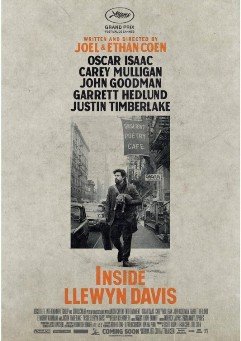
* “Inside Llewyn Davis“: One of the most depressing, pointless, long, boring, waste-of-time movies I’ve seen all year. Llewyn Davis (Oscar Isaac) is a Manhattan-based folk singer in the early ’60s, who is struggling to make it after his partner in a folk-singing duo commits suicide by jumping off a bridge. He has no money, is always broke, and can never catch a break. He lives by sleeping on various friends’ couches. He can’t even afford gloves or a warm coat in the middle of New York winter. He’s gotten a number of women pregnant, including his best friend’s wife. And he pays for them to get abortions, but finds out the first pregnant girlfriend had the baby and lives in Ohio.
Every time he might have a chance at success, he either is struck by bad luck, bad decisions, or a combination of both. He uses every last penny he has to hitchhike a trip to Chicago to meet up with a promoter, and the promoter tells him that there is no money in his act. Davis is also forever chasing around a cat that escaped from the apartment of one of his friends on whose couch he sleeps on.
Dreary and depressing to the max. I wasn’t sure why they made this movie (other than the make money) or why I sat through it. But don’t make the mistake I made. Unless you think you are too happy and in too good a mood and need a big-time cinematic downer, stay away.
TWO-AND-A-HALF MARXES

**** SCROLL DOWN FOR UPDATE ****
I cannot recommend any of the new movies coming out this weekend (and it’s more bad news for the movies coming out Christmas Day–I semi-liked one of them), but I’m especially disgusted with the Disney offering, “Saving Mr. Banks.” My review of “Anchorman 2: The Legend Continues,” which debuted on Wednesday is here.
* “Saving Mr. Banks“: Disney is marketing this as a cheerful kids film about the making of the Mary Poppins movie. Don’t believe the hype. This is a dreadful movie that tells kids fathers are bad and subjects them to inappropriate storylines about alcoholism, death, and suicide. From Magical Kingdom to Tragical Kingdom–Yay, Disney!
We learn that P.L. Travers, the woman who wrote the Marry Poppins, had a horrible childhood because her father was an alcoholic who died when she was a kid, and she felt guilty that she killed him because, as a kid, she gave him more alcohol and she dropped a basket of pears. The movie keeps flashing back to boring, awful scenes of her drunken father getting fired, embarrassing the family, and being an overall failure. Oh, and the movie shows us how her mother tries to commit suicide, and again, the young girl must stop her mother from committing suicide.
As if that isn’t enough, we learn that Walt Disney’s father was a horrible guy, too. And not just a horrible dad, but a horrible CAPITALIST dad. You see, Walt tells Travers that, when he was a kid, his rich father didn’t want to pay people wages to deliver newspapers (he owned the major Kansas City newspaper routes). So, instead, he made his two young sons wake up in the middle of the night to deliver the papers in the freezing cold snow and then do it again to deliver the evening paper. Oh, and the Disney dad refused to buy his kids new shoes, instead, forcing them to trudge in the cold, wet snow with holes in their shoes and resultant frostbitten feet.
And while the movie does its best to traumatize kids and demonize dads, Walt Disney is, of course, portrayed as a jolly, avuncular, kind, decent guy. In real life, Disney was a fan of Hitler and not a fan of his many Jewish employees. Even his own museum admits he was an anti-Semite. None of this, of course, is mentioned in this love letter to Walt Disney produced by the Disney company. I guess it’s fitting that the anti-Semitism is skipped over, since it jibes with the anti-Semitic, anti-Israel sentiments of Emma Thompson, who plays Travers in this movie.
As for the rest of the movie, well, I’m just not sure there is so little of interest in this world that I needed to waste over two hours of my time watching a movie whose story is that P.L. Travers was a difficult woman and didn’t want Walt Disney to make her books into a musical film. That story could have been told in maybe 20 minutes at the most. So, they keep filling it with these depressing flashbacks about Travers’ alcoholic dad and suicidal, weepy mom. No thanks.
Yes, there are some funny lines and scenes. Yes, the period costumes (this takes place in the 1960s), sets, and so on are eye candy, “Mad Men”-style. And I liked the chauffeur character played by the always pleasant Paul Giamatti. Ditto for Jason Schwartzman, B.J. Novak, and Bradley Whitford, who play song- and script-writers trying to create the Mary Poppins movie despite Travers’ constant objections to everything. But none of that made up for the underlying message and many tragic scenes poisonous to kids and, frankly, poisonous to the movie and any enjoyment that might have been gotten from it. I also don’t believe most kids today know who Mary Poppins is. That was my generation and earlier generations. Kids today know who the Kardashians and Miley Cyrus are.
The story: Travers is a stuck up, difficult woman who refuses to sell Walt Disney (Tom Hanks, who looks nothing like the real Walt Disney) the rights to make a movie out of her Mary Poppins books (he’s promised his daughters, years earlier, that he’ll make a Mary Poppins movie). But after years of saying no, she needs the money and goes to California to do the deal and help make the movie. She’s insisted that she has final approval on everything, and doesn’t want anything Disney and his crew want in the movie. She opposes music, singing, and dancing in the movie. She opposes any comical lines and objects to the casting of Dick Van Dyke. While all of this is happening, Walt Disney is trying to charm Travers and convince her to agree to these things. But, in the end, she doesn’t agree until Walt discovers the real story about her difficult childhood, alcoholic dad and suicidal mother, and shares with her his story about his horrible father.
Dad-hating misery loves company–that’s the cheerful Christmas message of Disney’s holiday offering. But, hey, feminists will love it. And so will the psychologists and psychiatrists who get to treat kids in the aftermath of the viewing experience.
**** UPDATE: A frequent anti-Semitism-denier and commenter on this site is questioning Walt Disney’s anti-Semitism and embrace of Hitler. But facts are stubborn things. From my post on Walt Disney’s anti-Semitic/anti-Israel great-niece Abigail Disney:
Walt Disney had a well earned reputation as an anti-Semite and Hitler fan (some of his cartoons had anti-Semitic themes, he welcomed Nazi filmmaker (and Hitler paramour) Leni Riefenstahl to Hollywood, and even the Walt Disney Museum acknowledges that he had “difficult relationships” with Jews).That akcnowledgement/admission is quoted in the book, “Walt Disney: The Triumph of the American Imagination
” by Neal Gabler. ****THREE MARXES PLUS FOUR BETTY FRIEDANS
Watch the trailer . . .
* “American Hustle“: This movie is mistitled. It should really be called, “Not Abscam.” Since when did Abscam–the successful FBI sting of elected public officials who were willing to accept bribes from a fake Arab sheikh–become a story about a Jewish con artist (who wears a giant gold Star of David, just in case you don’t know he’s Jewish) and his fake-Brit extra-marital girlfriend? Since when was it a story about a bumbling FBI agent who perms his hair, lives with his mother, and blackmails his boss? Well, actually, almost none of these things are true.
Yes, there was a convicted felon, Melvin Weinberg, who was Jewish (in name only), who was recruited by the FBI to help out in the Abscam sting. But he was a side character whom the FBI asked to take part. This movie presents the Jewish con artist, “Irving Rosenfeld” (Christian Bale) as the creator of several giant cons, who invents more cons–including, eventually the fake Arab sheikh, which is a sidebar in this movie–when he gets caught by the FBI. The real life FBI agent, Anthony Amoroso, who successfully helped plan Abscam and posed as the representative of the Arab sheikh (in this movie, Rosenfeld is the representative of the sheikh) is portrayed as a bumbling, coke-snorting, Studio-54-going idiot, “FBI Agent Richie DiMaso” (Bradley Cooper). Weinberg’s wife, Marie, who was nearly 50 at the time of Abscam, is portrayed by 23-year-old Jennifer Lawrence (who was 21-22 at the time of filming).
No surprise that the movie is phony history and a phony version of what Abscam was. No surprise also that the movie is a giant anti-Semitic lie. Hey, it’s Hollywood, which makes gazillions lying to America and creating fake “history” which the movie-going public believes is all true. And it’s, sadly, a fact that so many JINO (Jew In Name Only) Hollywood writers, producers, and directors seem to revel in making Jews look bad. We are less than 2.1% of the American population and nearly 100% of the criminals in the Christmas movies (stay tuned for my review of “Wolf of Wall Street,” next week).
Yes, the movie begins with the caption, “Some of this actually happened.” But the morons who pay ten-plus bucks to see this will, sadly, believe most of it actually happened, just like they believe the BS of “The Butler,” “JFK,” and other faux-history movies as truth. And, by the way, the movie does not mention the name John Murtha, one of several scumbag liberal Democrats who took the bribe money from the fictional sheikh, nor does it mention Republican U.S. Senator Larry Pressler who declined to take the money, saying it might be illegal. (Frankly, the whole Abscam thing–a foreigner bribing public officials to expedite visas to the U.S.–wouldn’t make sense today because an Arab sheikh can just show he’s going to spend several hundred thousand dollars in America and he can get an expedited “green card” and citizenship.)
Yes, there are some funny lines and funny scenes in this movie (I laughed several times), and I’d be lying if I didn’t say it was entertaining. I also liked the cool 1970s clothes and jewelry the women wore, though I don’t remember women wearing so many bra-less, “sideboob”-revealing open shirts (I was going to vote for Amy Adams for “best unsupported actress”). But, on top of being a gross distortion of history and reality, the movie was repetitive and way too long. It went on and on and on for nearly 2.5 hours (it clocks in at 138 minutes running time).
The story: Irving Rosenfeld (Bale) is a con artist who tricks people into giving him $5,000 for large loans they’ll never get. And he also sells fake art. He meets Sidney (Amy Adams), who pretends to be from England and uses a phony accent. Together, they go into the con artist biz together. But they get caught by FBI agent DiMaso (Cooper), and he forces them to engage in a sting operation that involves bribing Newark, New Jersey’s mayor (Jeremy Renner). Soon, Rosenfeld comes up with a larger scam involving a Saudi sheikh and wants to expand it to Congressman and Senators. The mob is also involved (and Robert De Niro, in a novel role for him, makes a cameo as a mobster). FBI agent DiMaso repeatedly blackmails, threatens, and attacks his boss. Rosenfeld’s wife (Lawrence) is an idiot who sticks her nose into his business and nearly ruins everything.
The movie is actually kind of depressing in the end and I felt like I was robbed of nearly 2.5 hours I’ll never get back. We’re doubly and triply robbed because the American public will think this is the real Abscam story and that it was all because of a Jew. None of that is true.
The title of the movie is appropriate though. America is definitely being hustled by this film.
THREE MARXES PLUS AN OBAMA
Watch the trailer . . .
* “Inside Llewyn Davis“: One of the most depressing, pointless, long, boring, waste-of-time movies I’ve seen all year. Llewyn Davis (Oscar Isaac) is a Manhattan-based folk singer in the early ’60s, who is struggling to make it after his partner in a folk-singing duo commits suicide by jumping off a bridge. He has no money, is always broke, and can never catch a break. He lives by sleeping on various friends’ couches. He can’t even afford gloves or a warm coat in the middle of New York winter. He’s gotten a number of women pregnant, including his best friend’s wife. And he pays for them to get abortions, but finds out the first pregnant girlfriend had the baby and lives in Ohio.
Every time he might have a chance at success, he either is struck by bad luck, bad decisions, or a combination of both. He uses every last penny he has to hitchhike a trip to Chicago to meet up with a promoter, and the promoter tells him that there is no money in his act. Davis is also forever chasing around a cat that escaped from the apartment of one of his friends on whose couch he sleeps on.
Dreary and depressing to the max. I wasn’t sure why they made this movie (other than the make money) or why I sat through it. But don’t make the mistake I made. Unless you think you are too happy and in too good a mood and need a big-time cinematic downer, stay away.
TWO-AND-A-HALF MARXES
Mid-Week Box Office: “Anchorman 2: The Legend Continues”
By Debbie
Schlussel
Was it really necessary to make a sequel to 2004′s “Anchorman: The Legend of Ron Burgundy” (other than to fill the coffers of various Hollywood hucksters)?
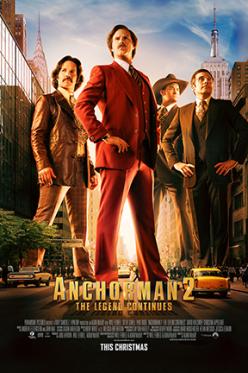
I’m not so sure. The sequel, “Anchorman 2: The Legend Continues,” in theaters today, is incredibly stupid (with mostly groanworthy jokes) and not nearly as funny as the first one. It is obviously a well-hyped money-making machine and little else. There are lots of celebrity cameos toward the end, so half of Hollywood gets in on the cash action.
On the other hand, there are, at times, some very funny lines and the movie has some surprisingly incisive social commentary about the sorry state of cable news–and TV newscasts in general. The movie is mostly a parody of CNN at its inception, though the criticisms apply to FOX News, too. The best that I can say for it is that I loved the period clothes and set design–the movie takes place in the early ’80s. Ditto for the soundtrack of constant ’70s and ’80s hits. (And the studio gave out cool Ron Burgundy coasters with a “removable mustache” (I’ll post some pics in another post).
The story: TV news anchorman Ron Burgundy (Will Ferrell) is married to co-anchor Veronica Corningstone (Christina Applegate) and, at the beginning of the movie, he’s fired. This results in his breakup with Veronica and a desperate turn as a drunken master of ceremonies at a Sea World-esque water park. But he gets fired from that, too. Soon, though, he’s approached by a producer (Dylan Baker) for a new idea: a 24-hour cable news network. Burgundy laughs at him and the idea, but is desperate for a job and he accepts. Burgundy gets his old news team (Steve Carell, Paul Rudd, and David Koechner) back together for the gig.
Once in New York at GNN, the new 24-hour cable news network, Burgundy and his team fight with other personnel and manage to finagle their way from a middle of the night newscast to prime time. And Burgundy “revolutionizes” news coverage by insisting on covering live car chases, stupid fights, and other idiocy that are, today, staples of cable, national, and local newscasts.
The rest of the movie is concerned with Burgundy’s interracial affair with his Black boss, his attempt to reconcile with Veronica, and his struggle to make his relationship with his young son a priority. That’s all dumb stuff, kinda like most of the rest of the movie.
If you have nothing to do for two hours and a need for an (only slightly) better investment option than $10 in MegaMillions lottery tickets, this is mildly entertaining (and you’ll have several laughs, but a whole lot more groans). And it’s not anything unexpected for a Ron Burgundy or sundry Will Ferrell movie. You get what you expect. I just expect more from my movies. My favorite line (of those I can remember and wrote down) is when Will Ferrell describes the two times he left the United States: “The second time I left the country, I went to Salem, Oregon.” Spot on.
By the way, while I’m not sure I need to give this warning (given that it’s an understood thing for a Ron Burgundy movie), this isn’t for kids. The movie is filthy, but only got a PG-13 designation. It deserves an “R” rating.
While, as I noted, there are some very funny lines and parts of the movie, I’m being incredibly generous when I give this . . .
HALF A REAGAN

Was it really necessary to make a sequel to 2004′s “Anchorman: The Legend of Ron Burgundy” (other than to fill the coffers of various Hollywood hucksters)?
I’m not so sure. The sequel, “Anchorman 2: The Legend Continues,” in theaters today, is incredibly stupid (with mostly groanworthy jokes) and not nearly as funny as the first one. It is obviously a well-hyped money-making machine and little else. There are lots of celebrity cameos toward the end, so half of Hollywood gets in on the cash action.
On the other hand, there are, at times, some very funny lines and the movie has some surprisingly incisive social commentary about the sorry state of cable news–and TV newscasts in general. The movie is mostly a parody of CNN at its inception, though the criticisms apply to FOX News, too. The best that I can say for it is that I loved the period clothes and set design–the movie takes place in the early ’80s. Ditto for the soundtrack of constant ’70s and ’80s hits. (And the studio gave out cool Ron Burgundy coasters with a “removable mustache” (I’ll post some pics in another post).
The story: TV news anchorman Ron Burgundy (Will Ferrell) is married to co-anchor Veronica Corningstone (Christina Applegate) and, at the beginning of the movie, he’s fired. This results in his breakup with Veronica and a desperate turn as a drunken master of ceremonies at a Sea World-esque water park. But he gets fired from that, too. Soon, though, he’s approached by a producer (Dylan Baker) for a new idea: a 24-hour cable news network. Burgundy laughs at him and the idea, but is desperate for a job and he accepts. Burgundy gets his old news team (Steve Carell, Paul Rudd, and David Koechner) back together for the gig.
Once in New York at GNN, the new 24-hour cable news network, Burgundy and his team fight with other personnel and manage to finagle their way from a middle of the night newscast to prime time. And Burgundy “revolutionizes” news coverage by insisting on covering live car chases, stupid fights, and other idiocy that are, today, staples of cable, national, and local newscasts.
The rest of the movie is concerned with Burgundy’s interracial affair with his Black boss, his attempt to reconcile with Veronica, and his struggle to make his relationship with his young son a priority. That’s all dumb stuff, kinda like most of the rest of the movie.
If you have nothing to do for two hours and a need for an (only slightly) better investment option than $10 in MegaMillions lottery tickets, this is mildly entertaining (and you’ll have several laughs, but a whole lot more groans). And it’s not anything unexpected for a Ron Burgundy or sundry Will Ferrell movie. You get what you expect. I just expect more from my movies. My favorite line (of those I can remember and wrote down) is when Will Ferrell describes the two times he left the United States: “The second time I left the country, I went to Salem, Oregon.” Spot on.
By the way, while I’m not sure I need to give this warning (given that it’s an understood thing for a Ron Burgundy movie), this isn’t for kids. The movie is filthy, but only got a PG-13 designation. It deserves an “R” rating.
While, as I noted, there are some very funny lines and parts of the movie, I’m being incredibly generous when I give this . . .
HALF A REAGAN


 Posts
Posts


