Showing posts with label Canada. Show all posts

Thursday, October 27, 2016

Editorial: Civil War on November 9?

Editorial


Regardless of who wins the election, will there be a civil war in the U.S. the next day?


Clinton supporters already believe that their candidate is ten points ahead in the polls and if she loses, they won't be able to believe that the media had lied that badly to them. There have already been threat of moving to Canada by many and states like California are threatening to "build a wall" against Trump's America.


Trump supporters on the other hand, believe that if they don't win this election, that the flood of people from Mexico, Syria, and elsewhere, could make this the LAST presidential election. Many are planning to bunker down, feeling there is nowhere else in the world to go, and states like Texas and others could possibly try to secede.


On the other hand, both parties have members within that don't like their own nominee and many others don't like either candidate!


Will a civil war be the likely outcome of all this?


http://www.vdare.com/articles/hillarys-climate-of-hate

Friday, July 1, 2016

A Detailed Prophecy of Blessings and Curses

An interesting article from http://www.ucg.org/ about national blessings and curses. This follows this post about Benghazi, Libya. For a free magazine subscription or to get the books recommended for free click HERE! or call 1-888-886- 8632. 


Obedience to His law would bring national prominence, including victory when military conflict was inevitable: “The Lord will grant that the enemies who rise up against you will be defeated before you. They will come at you from one direction but flee from you in seven” (Deuteronomy 28:7, New International Version).
On the other hand, willful violation of His righteous law would result in defeat and lack of influence: “The Lord will cause you to be defeated before your enemies. You will come at them from one direction but flee from them in seven” (Deuteronomy 28:25, NIV).
Why did God make these promises of blessings and curses? Is there anywhere we can search in the Bible to see His purpose in offering the ancient Israelites—and their modern-day descendants—the chance for national greatness?
In an even earlier time, before He made His covenant with the Israelites, God began to work with their ancestor, Abraham. In the covenant with Abraham, God told him: “I will multiply your descendants as the stars of heaven and the sand which is on the seashore … In your seed all the nations of the earth shall be blessed, because you have obeyed My voice” (Genesis 22:17-18).
God had determined thousands of years before America and Great Britain ascended to world power status that these would be His model nations. Like “a city on a hill that is not hidden” (Matthew 4:14), God had ordained that Great Britain and the United States be shining examples to other nations.
But today we see just the opposite, as America has followed Britain into decline, retreating throughout the world. To understand the amazing story foretold in the pages of your Bible, read the free study aid booklet The United States and Britain in Bible Prophecy  .

You might also be interested in...

Thursday, June 23, 2016

First the End of an Empire - Now, the End of Britain?

An interesting article from http://www.ucg.org/ about Great Britain. This follows this post about London's Muslim terror. For a free magazine subscription or to get the books recommended for free click HERE! or call 1-888-886- 8632. 

I can still remember when the news came over the radio. It was a Sunday morning in late January 1965. Sir Winston Churchill had died.

His funeral was the following Saturday. He was only the second commoner in the history of Great Britain to be given a state funeral, normally reserved for royalty. The first had been for the duke of Wellington, the military genius who thwarted Napoleon’s plans for world conquest at the Battle of Waterloo in 1815, thereby ushering in a century of Pax Britannica. Sir Winston had defeated an even greater evil, Hitler’s Third Reich. He didn’t do it single-handedly, of course, but without him the outcome could have been entirely different.

I also well remember the silence after the funeral. It was the only time I can remember all the television and radio stations closing down for a period of silence in honor of the great old man to whom Britons owed so much.

People were truly thankful that Winston Churchill had led them to victory in World War II—at a time when everybody else seemed inclined to compromise with Nazi Germany.

Churchill rejected the honor of a dukedom and turned down the opportunity to be buried in Westminster Abbey along with many other famous Britons.

Churchill’s funeral was, for Britain, the end of an age.

Ironically, his death came at the end of a 20-year period that had seen the nation reject just about everything he stood for.

Postwar Britain

It had started 20 years earlier, shortly after VE Day. With the European war ended, Churchill called an election. Almost everyone thought his Conservative Party would win. People the world over were shocked when the results came in: The Labour (socialist) Party won by a landslide. Although grateful for Churchill’s role as a wartime leader, people had decided they wanted change; they longed for a different world. They didn’t want their young men fighting wars in far-off places they had never heard of, nor did they want them coming home to low-paying jobs or unemployment.

After being universally acclaimed as the British lion that roared in defiance of Hitler and the man who had led Great Britain to victory, Churchill appeared to be headed for victory. But, seemingly, it was time for Britain’s rapid decline to begin. The prophet Daniel reminds us that it is God who “removes kings and raises up kings” (Daniel 2:21). The same God who had given Britain its victory took away the empire He had given to them, the multitude of nations promised to Joseph’s son Ephraim (Genesis 48:19).
The next few years saw massive changes, including the nationalization of key industries (steel, railways, coal mines) and the institution of a government-run medical system. To concentrate on these radical reforms, the country turned its back on an empire that had been built up over the course of 400 years. Britain granted India and Pakistan independence in 1947. By the time of Churchill’s death, all the major colonies were gone. Britain had, to quote American statesman Adlai Stevenson, “lost an empire and not yet found a role.”

It might have been different if Churchill had won that pivotal election. He was an empire loyalist. His love of history taught him that Britain’s security lay with the multitude of nations it had built up gradually since the time of Queen Elizabeth I. Later, after he won the 1951 election as prime minister at the time of the accession of Queen Elizabeth II, he talked of a “new Elizabethan age” that might surpass the first in greatness. But it was not to be.

Britain had embarked on a new course that continues to this day. With the British Empire gone, it was Britain’s turn to be dismantled.

The abolition of Britain

A thought-provoking book on this subject by British writer Peter Hitchens, The Abolition of Britain, contrasts the country at the time of Churchill’s funeral with the nation 32 years later at the funeral of Princess Diana. By his own account, it is as if he is looking at two different countries.

Outside the British Isles many people get confused at exactly what constitutes Great Britain and where England, Scotland, Wales and Ireland fit into the equation. At one time all four nations were separate entities. Their eventual union came about over a long period.

England conquered Wales during the time of Edward I in the 13th century. Edward proclaimed his son the prince of Wales, emphasizing that Wales is a separate principality, but was to be administered as a part of England. For 700 years, the heirs to the British throne have been given the title “prince of Wales.”
Scotland and England (with Wales) united later. When Elizabeth I died in 1603, she left no heirs. Historically, Scotland had often allied itself with France against England. It was time for the two countries to unite so this would not happen again. Upon her death her cousin’s son, James VI of Scotland, became King James I of England. James gave the country its new name, Great Britain (and was instrumental in giving the world the King James Version of the Bible). The new flag was nicknamed the Union Jack after him.

The two kingdoms were still administered separately, but they had the same monarch. A century later (1707) they fully united under one parliament, giving Scots a share in the benefits of the growing empire. Another century later the Irish parliament was abolished, and the United Kingdom of Great Britain and Ireland formed (1801).

Reversal of direction

The dismantling of the kingdom actually began 80 years ago when most of Ireland was given its independence as the Irish Free State, theoretically still subject to the crown. In 1949 the Free State became the Irish Republic, severing its tie with the United Kingdom.

The six counties of Northern Ireland that have remained within the United Kingdom have been strife-torn for more than three decades. Although in recent years strenuous efforts have been made to negotiate a permanent peace, the problem remains virtually insoluble. At some point it is likely that another “reform” government in London will force a change on the province, as British governments since Churchill’s time have eventually given in to terrorists in every disputed territory.
With increasing support for Scottish and Welsh nationalists, the present British government, led by Prime Minister Tony Blair, came to power in 1997 promising “devolution.” The two ancient Celtic peoples would acquire their own parliaments and be responsible for their own internal affairs. London would still conduct foreign policy. Both Scotland and Wales now have their own assemblies with increased calls for full independence.

Some of the English, meanwhile, are resentful of the fact that they do not have their own parliament. Scots, Welsh and Northern Irish members still sit in the House of Commons in London and can vote on legislation that affects the English people, while the English people do not have a say in the internal affairs of the Celtic nations around them.
Meanwhile, the European Union (EU) has been fulfilling its dream of an ever-closer union. The Irish Republic has benefited from its membership in the EU, ironically partly subsidized through Brussels by U.K. taxpayers. This has reduced some fears of Irish unity in the North. The South had always been poor, the North far wealthier, so even Catholics had been somewhat apprehensive of unity with the South. Not any more.

Polls show the English to be increasingly weary of the EU. Scottish nationalists, however, see the EU as increasing the likelihood of Scottish independence. No longer would the five million people of an independent Scotland be unable to make it economically on their own. Within the EU they would prosper, just like Ireland and other small countries. Similar feelings are evident in Wales.

In coming years the English could find themselves outside of a politically unified EU, with the Scots, Welsh and Irish inside. Queen Elizabeth I’s worst nightmare would have come true, four centuries later, of an England surrounded by hostile nations in alliance with the continental powers.

Historians such as Norman Davies think that none of this matters. In his recent book The Isles he reminds readers that England at one time was physically a part of the European landmass. At other times it was a part of Europe. It was the westernmost province of the Roman Empire from A.D. 43 to 410, a span of almost four centuries. The English church was a part of the Roman church for almost 1,000 years. The Plantagenets in the Middle Ages ruled England as well as parts of France, spending most of their time in the bigger and warmer part of their territories.

But Paul Johnson, another British historian, sounded a warning in the pivotal year 1972 (between the British Parliament’s vote to join Europe and Britain’s accession the next January): “Disunity has always proved fatal to the offshore islanders.” (The Offshore Islanders was the title of his book dealing with Britain’s relationship with Europe throughout history.) In other words, the disuniting of the United Kingdom has always proved fatal, enabling hostile powers to invade the country. Why should it be different this time?

Biblical wisdom holds true: “Every kingdom divided against itself is brought to desolation, and every city or house divided against itself will not stand” (Matthew 12:25).

New generation, new outlook

A new generation is in power now.

Mr. Blair, British prime minister, prefers to identify with a new age. He is the first British prime minister who does not remember Winston Churchill. In a speech just before the election that brought him to power, he described himself this way: “I am a modern man. I am a part of the rock and roll generation—the Beatles, colour TV, that’s the generation I come from” (The Abolition of Britain, paperback edition, p. xix).
The current generation is a victim of revisionist history. It’s a history with an emphasis on multiculturalism, which downplays Britain’s role in frequently leading its empire into conflict against despotic European powers that wanted to conquer the world. At the same time, the revised version of history emphasizes the mistakes Britain made, negatively presenting the empire as a shameful era.

It’s also a generation that, as in the United States and other Western countries, has grown up with an emphasis on material values, with little concept of morality and often lacking any knowledge of God.

Writing of “the end of Britain” in Newsweek magazine (July 10, 2000), columnist George Will reminded readers of the late English writer George Orwell’s dismissive comment on English intellectuals: “England is perhaps the only great country whose intellectuals are ashamed of their nationality.” (Orwell died in 1950 before this disease spread to the United States.)

Mr. Will added, “Many Europhiles are English intellectuals of the sort George Orwell despised because they despised their nation.” It’s hard to understand the hatred so many people have for the old values Sir Winston Churchill symbolized. “God, king and country” have no place in the minds of many, including many English intellectuals.

Does this matter to Americans and the rest of the world?

Let George Will have the final say: “What is vanishing, and not slowly, is the nation to which the United States traces much of its political and cultural DNA. Unless this disappearance is resisted, and reversed, soon all that will linger… will be a mocking memory of the nationhood that was the political incarnation of a people who (as has been said), relative to their numbers, contributed more to civilization than any other people since the ancient Greeks and Romans” (ibid.).

Recommended reading

What’s behind the remarkably rapid dissolution of the British Empire? How—and why—did the world’s greatest empire disappear in only a few short decades? Does Bible prophecy give us any indication?

Strange as it may sound, this remarkable turnaround was written well before it happened—in the pages of the Bible almost 3,500 years ago.

The publishers of Virtual Christian Magazine have produced an astounding, eye-opening booklet, The United States and Britain in Bible Prophecy. You’ll be amazed to learn the truth about where these nations appear in Bible prophecy—and what Scripture says will happen to them in the end time.
 

You might also be interested in...

Friday, February 12, 2016

Bilingualism, Canada, and Marco Rubio

A timely post from http://www.vdare.com about bilingualism in Canada and Marco Rubio. This follows this post about the TRUE CATHOLIC teaching on immigration. This follows this post about rap songs referencing Donald Trump. This follows this post about Pope Francis's true opinion of Mexicans.
You can follow me here.


Note: you can contact Conservative Party members of Canada's parliament about this here:
http://www.parl.gc.ca/default.aspx?Language=E

The Fulford File | Rubio, Republicans, “Our New Spanish-Speaking Overlords,” And How To Fight Creeping Bilingualism


Conservatism Inc. is falling over itself to welcome “our new Spanish-speaking overlords”—to adapt the famous scene from The Simpsons (itself adapted from the 1977 movie Empire of the Ants). The Republican Congressional leadership has chosen newly-minted Florida Senator Marco Rubio to give the response to President Obama’s February 12 State Of The Union—half in Spanish.

(It’s a pattern—Rubio gave the GOP response to the Supreme Court’s Obamacare decision partly in Spanish, and spoke in Spanish, briefly, at the Republican Convention).
Does this mean the United States is turning into Mexico?
No, it’s worse—it means the United States is turning into Canada.
Canada has a lot of experience with bilingualism, all of it bad.
I’ve noted before that the ludicrous Canadian custom of making speeches in both languages—saying everything twice, once in English and once in the minority language—is coming to America.
Well, the Canadians have invented an even worse absurdity: the speaker alternates between languages, leaving large parts of the audience unsure what he’s saying.
Thus Ottawa Citizen columnist Dan Gardner blogged acidly (April 19, 2010):
John Ralston Saul`s public speech entitled: “Reinventing the language of citizenship/ inventer la langue de la citoyennete” will be presented in Canada`s two official languages Please note the speech will alternate between French and English with no simultaneous translation.
John Ralston Saul is a member of the globalist elite, born in Ottawa, educated in Montreal and London. He writes books in English, but his website offers visitors the choice of English, French, or Spanish.
Gardner asked
I can understand why the lecture might be given in French. Or in English. Or in either with translation. But both with no translation? Do that and you will ensure that more than nine out of ten people in the city [VDARE.com note: Vancouver, B. C.] in which you are giving the lecture will be unable to understand what you are saying. So what is this except a symbolic gesture of… Of what, exactly? Bilingual idealism? Contempt for the unilingual?
The explicitness of that notice is rare but neither the attitude nor the practice are, at least not in Ottawa. Years ago, after moving here, I was amazed at how, in Official Ottawa—i.e. the Ottawa of the federal government—it`s perfectly acceptable for public speakers to switch back and forth between languages, without translation, even to the extent of setting up a joke in one language and delivering the punchline in another. This would be admirable in an ideal world in which all Canadians could laugh along. But in this world, this is a very effective way to shutting out the overwhelming majority of Canadians who are unilingual.
Funny. But in fact creeping bilingualism is not funny at all. It’s a serious threat to unilingual members of the majority language community a.k.a. English-speakers, in both Canada and  the U.S.
Among other things, bilingualism ultimately means job preference for the minority language group—and years of language lessons for English-speakers who want those jobs.
 Thus in Canada, many federal civil service jobs are reserved for people who speak both languages, which means, de facto¸ it is dominated by French speakers.
George Jonas, a Hungarian immigrant to Canada, has described the dynamic:
If Canada was to be a bilingual country with most power concentrated in Ottawa`s federal government, in the nature of things it would be Francophones [VDARE.com note: CanSpeak for French-speakers, but  really it’s a matter of blood] who would end up occupying most positions of authority in it. The inclination is always stronger for minorities to learn the language of a majority. Anglos weren`t going to be bilingual in significant numbers.  Francophones would be, and so rule the land.
[Unintended Consequences, by George Jonas, National Post, October 14, 2005]
“Rule the land” means a lot of French-speakers in the higher reaches of the Federal Civil Service.
It also means that leadership of the Liberal Party has tended to alternate between a person of French ancestry and Anglo ancestry.  But, either way, they must be fluent in French.
Canada’s Conservatives, for whom few Francophones vote, also try to recruit candidates who can speak French the way Rubio can speak Spanish—or at least the way George W. Bush could: badly but sincerely. Candidates who can’t do that fall by the wayside, although otherwise qualified and electable. VDARE.com Editor Peter Brimelow wrote in Commentary magazine back in 1987 that
When the federal Progressive Conservative party chose a new leader in 1983, it came under intense pressure to pick one fluent in both “official languages,” although virtually all of its support came from unilingual English Canada and it could technically have won enough seats there to form a government without any Francophone support at all. This scared out of the race a strong Western candidate, the premier of Alberta, and seriously destabilized the campaign of John Crosbie, from the Atlantic province of Newfoundland (who would probably still have succeeded if the English-speaking convention delegates had not been supplemented by French speakers conjured up by affirmative action in Quebec).
The winner was an unrepresentative, Wendell Willkie-type sport, Brian Mulroney, an emollient Montreal labor lawyer with roots in the semi-Francophone Irish community of rural Quebec. Mulroney had only joined the party because of an accident of sectarian politics in his youth. He had never fought a parliamentary election, and his Conservative credentials were essentially based on his self-appointed role as the party’s ambassador to the Francophones. [A Cautionary Case of Bilingualism Commentary Magazine, November 1987]
Sound familiar?
Canada`s federal official bilingualism turned into a jobs program for Canadians of French ancestry—the minority language group—entrenching them in control of the federal Civil Service with remarkable speed. Francophones are less than a quarter of Canada’s population. But less than twenty years after the passage of the Official Languages Act,
“Of deputy ministers and senior administrators the proportion is now 32% francophone. The Privy Council Office is 48.2% francophone. The Federal-Provincial Relations Office is 49.1%, the Canadian Intergovernment Secretariat a resounding 81.8%. The big-spending Department of Supply and Services, which decides whether a contract will go, say, to Montreal or Vancouver, is 41.1% francophone The Secretary of State Department, which hands out federal largesse, is 67.9%. The Public Service Commission, which chiefly decides on promotions within the civil service—will the job go to Peter Black from Winnipeg or Pierre Leblanc of Trois Rivieres?—is 60.5% francophone. And if the francophone proportion of the armed forces during the Second World War was somewhat lacking, the francophone proportion of the Department of Veterans Affairs compensates. It is 41.2% francophone”
[Here are a few percentages Mr. Masse hasn`t mentioned, By Ted Byfield, Alberta Report, July 25, 1988]
In the U.S., I’ve reported that police officers already have to learn Spanish (a) for survival and (b) so they can get points for promotion.
That’s bad, but what’s worse is that one of the jobs that Anglos may be unable to fill is President of the United States.
Marco Rubio is an inexperienced freshman Senator. He’s giving the GOP’s SOTU response to Obama, instead of a grown-up Senator like, say, Jeff Sessions, because he can speak Spanish and is “Hispanic” (actually, a white Cuban).
That was enough to get him almost nominated for Vice-President. It might still get him nominated for President.
And Hispanics still wouldn’t vote Republican.
Here’s a news story from 2000:
“I hope very much that I`m the last president in American history who can`t speak Spanish,“ Clinton said in a nod to presidential candidates Al Gore and George W. Bush, both of whom are comfortable throwing Spanish phrases into their speeches…”
Clinton didn’t get his wish—the current president speaks no foreign languages at all.
But the report of his speech was headed Clinton says speaking Spanish is not enough for Hispanics, [By Calvin Woodward, Associated Press, June 13, 2000]. Clinton made the obvious point that Hispanics vote for Bill Clinton’s party because they like stuff from the government.
Peter Brimelow commented, based on his Canadian experience (he wrote an entire book on Canada):
…English Canadians speak only English. Therefore they are ineligible for the top offices, and many government positions, in their own country.
The beneficiaries of bilingualism: firstly, the minority language group, who have more opportunity to become bilingual; secondly, the Anglo upper class, who are more likely to spend money on time on language education.
Dubya to Reagan Democrats (not for the first time): drop dead.
Exactly as Brimelow warned, twelve years later—notwithstanding all the Hispanic hype—it is the GOP’s failure to appeal to the white working class, especially in the Rust Bowl states, that cost Romney the Presidency.
Of course, there are options. In complete contrast to Canada’s federal bilingualism, the government of the French-speaking province (=state) of Quebec has defended and imposed French unilingualism.
As Peter Brimelow said at the Pro English panel at CPAC last year:
Over a period of several years in the 70s and 80s, successive governments in the province of Quebec passed legislation which essentially crushed the use of English in Quebec. You could not require an employee to speak English in most circumstances. You couldn’t even display signs in English in Quebec….
I think this example of what the Quebeckers have done, although it’s not pretty, is most interesting. It has actually completely broken the back of the Anglophone resistance to Quebec separatism. If people don’t like Quebec separatism, they leave. In fact the Quebec Anglos are now the most bilingual of all the ethnic groups in Canada….they’re essentially assimilated.
I think that something like this Quebec language legislation is going to have to happen here in the U.S.
It’s not enough to have Official English as the government level. I get email all the time, from people in places like eastern Washington State, who say their kids can’t get jobs in McDonalds and stuff because they don’t speak Spanish. This creeping institutional bilingualism is a ferocious attack on the living standards of the American working class, the blue collar workers—just as current immigration policy in general is.
It will take Quebec-style legislation to stop it. They’ve shown us the way.
Quebec has shown the way. But it’s increasingly clear that the GOP/ Conservatism Inc. is not capable of taking it.
James Fulford is a writer and editor for VDARE.com.


Wednesday, December 17, 2014

Tens of thousands tweet #illridewithyou hashtag over cafe jihad backlash fears

A very interesting post from www.jihadwatch.org about the hashtag, #Illridewithyou. This follows this post about the President threatening sanctions against Israel. This follows this article about American energy independence and preventing money from going to hostile countries. For more, you can read two very interesting books HERE.
I am leaving TWITTER SOON. Please continue to follow me here.


Tens of thousands tweet #illridewithyou hashtag over cafe jihad backlash fears

Australia police“Reprisal attacks are something that should not happen.” Indeed so. They should not happen, and for the most part they don’t. Jihad attacks are also something that should not happen. Where are the Muslims offering to ride with Infidels in order to defend them against other Muslims who may wish to bomb them, behead them, or take them hostage as they step into a coffee shop today?
“#illridewithyou supports Muslims amid Sydney siege,” AFP, December 15, 2014 (thanks to Lookmann):
Australians came out Monday in solidarity with the Muslim community following a siege at a Sydney cafe, as tens of thousands tweeted the hashtag #illridewithyou to counter concern about an anti-Islam backlash.
The hostage-taking at the Lindt chocolate cafe triggered a security lockdown in the heart of Australia’s biggest city, with the government and Muslim leaders condemning the attack and calling for unity.
Amid uncertainty about the hostage-taker’s motives and fears of reprisals after an Islamic flag was raised in the cafe, an Australian woman reportedly started the #illridewithyou hashtag to show solidarity with Muslims who might feel threatened on public transport.
“#373 bus between Coogee & Martin Place. #illridewithyou @ me if you just want to wear your headdress & not be bothered,” @sirtessa tweeted.
Within hours, Australians around the country repeated the hashtag, with more than 40,000 tweets helping #illridewithyou become one of the top trends on the social media site.
“I make a commitment, right now, to always say something when I see any kind of abuse on public transport. #illridewithyou,” one user tweeted.
Another user in South Australia wrote, “If you wear religious attire, & need to get from #Adelaide’s west suburbs to the city on Tues but don’t want to travel alone #illridewithyou.”
Others offered help beyond travel support: “I’m mostly housebound so Im not useful for #illridewithyou but if you’re ever in tarneit VIC and need somewhere safe to hide out, contact me.”
Australia’s race discrimination commissioner Tim Soutphommasane said he was heartened by the campaign, adding: “let’s not allow fear, hatred and division to triumph.”
Anti-Islam groups had earlier expressed outrage about the siege, with the Australian Defence League writing on Facebook: “Here it is folks, homegrown islamic terrorism in our backyard, courtesy of successive australian governments and their brainwashed voters.”
New South Wales Police Commissioner Andrew Scipione said officers were working with the Muslim community.
“Reprisal attacks are something that should not happen,” he added.
More than 40 Muslim groups condemned the siege, saying in a statement that they rejected “any attempt to take the innocent life of any human being or to instil fear and terror into their hearts”.
Note the key word “innocent.” Which human beings exactly are innocent?

Wednesday, November 19, 2014

Why Is Israel the Focus of Muslim Hostility?

An interesting article from http://www.ucg.org/ about Muslim hostility towards Israel. This follows this post about the claims of the Pope's authority. For a free magazine subscription or to get the books recommended for free click HERE! or call 1-888-886- 8632.
I am leaving TWITTER SOON. Please continue to follow me here.


Why Is Israel the Focus of Muslim Hostility?


At the heart of the ongoing conflict in the Middle East is ongoing hatred among Muslim nations toward Israel and the Jewish people. What are the underlying causes? 
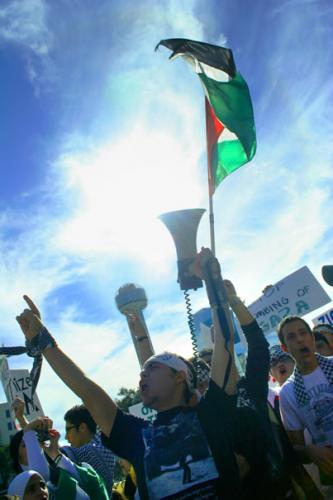
Why Is Israel the Focus of Muslim Hostility?
Source: Wikimedia
The conflict between the Israelis and surrounding Muslim nations has been raging since the Jewish state's inception —and the origins go back much further. Today the hostility is growing in openness and intensity, making the prospects for peace in the Middle East dim.
The Arab Spring uprisings throughout the region are allowing the wider expression of popular sentiments among the Muslim masses—inflaming the ancient animosity.
While not all Muslims feel antipathy toward Jews and Israel, there is widespread dislike and resentment by the majority, as repeatedly borne out in polls and surveys. The Pew Global Attitudes Project survey conducted last summer found that almost no one in the Muslim Middle East thinks positively toward Israel and the Jewish people.
"Ratings of Jews are dismal in the seven predominantly Muslim nations surveyed" (Pew Research Center, Common Concerns About Islamic Extremism: Muslim-Western Tensions Persist, July 21, 2011, p. 22). In the six of these nations that are in the Middle East or adjacent to it, only 2 to 4 percent express favorable opinions of Jews.
It is amazing that the small nation of Israel, composed of only about 8,000 square miles of land—roughly two times the size of Rhode Island—generates so much ill feeling.
Israel's territory is only about one-sixth of one percent that of the 22 hostile Arab nations that are 640 times her size. And they have 45 times more people than Israel—340 million Arabs versus 7.7 million Israeli citizens (more than a million of whom are themselves Arab).
Yet fiery rhetoric calling for the destruction of Israel can be heard in political speeches and mosque sermons throughout the Muslim world, from Iran to Libya and in other places around the globe—including Western nations.
An example of the growing hostility toward Israel can be found across its southern border in Egypt with the increasing influence there of the Muslim Brotherhood. This organization has sired 86 branches across the Islamic world since the 1920s. The more dominant ones are in Egypt, Jordan, Syria and the Palestinian territories (the branch in the latter being the terror group Hamas, which now runs Gaza).
Comments like the following from Muslim Brotherhood spokesman Kamal al Halbawi, made while speaking at an official visit to Iran in July 2011, are all too common: "Both nations [Iran and Egypt] underline the necessity for Muslim nations to maintain solidarity and unity to annihilate this cancerous tumor (Israel) . . . Every night when I go to bed, I pray to wake up the next day to see Israel is wiped off the map" (quoted by "ADL [Anti-Defamation League] Report: Muslim Brotherhood's Open Hostility to Israel Could Play Destabilizing Role In Egypt And Region," ADL.org, Sept. 19, 2011).
Let's consider the root causes of such widespread Muslim animosity against Israel.

Indoctrination and propaganda

Conflict between Muslims Jews, and Christians has been around since Islam began in the seventh century A.D. But it's been exacerbated in recent times by an indoctrination of religious intolerance and anti-Semitic propaganda in the Muslim world.
The indoctrination is led by Saudi Arabia, the birthplace of Islam, which has been asserting itself as the world's authoritative voice for the religion. An important avenue for its gaining influence has been through Saudi charities funding Wahhabi madrassas (schools) and mosques in many nations (Wahhabism being an extremist form of Islam embraced by terror groups like al-Qaeda).
An illustration of the ongoing indoctrination is furnished by a 2006 study by theCenter for Religious Freedom and the Institute for Gulf Affairs: "As demonstrated by excerpts from the dozen current Islamic studies textbooks analyzed in this report, the Saudi public school religious curriculum continues to propagate an ideology of hate toward the 'unbeliever,' that is, Christians, Jews, Shiites, Sufis, Sunni Muslims who do not follow Wahhabi doctrine, Hindus, atheists and others.
"This ideology is introduced in a religion textbook in the first grade and reinforced and developed in following years of the public education system, culminating in the twelfth grade, where a text instructs students that it is a religious obligation to do 'battle' against infidels in order to spread the faith" ("Saudi Arabia's Curriculum of Intolerance," 2006, p. 10).
That's what the study found after the Saudi Arabian government said it had reformed its school system and textbooks to be more tolerant. The study goes on to provide numerous excerpts that make the point, like these from an eighth-grade schoolbook:
"'They [the Jews] are the people of the Sabbath, whose young people God turned into apes, and whose old people God turned into swine to punish them.' 'As cited in Ibn Abbas: The apes are Jews, the keepers of the Sabbath; while the swine are the Christian infidels of the communion of Jesus'" (p. 24).
With such ideology exported to madrassas around the world, a great many Muslims everywhere have been using textbooks with the same perspective and approach.
One might wonder why the Saudi government would sponsor the radicalization of Islamic education. It appears the strategy has been to direct the hatred of the native populace toward Israel and Western nations and away from dissatisfaction with the local national government, which might lead to rebellion.
The same has been true in other Muslim states, where government-controlled education and press have incited populations against the Israelis, Americans and other Westerners. Again, the focus is thereby taken away from dissatisfaction with local regimes.
The Arab Spring has brought the focus back on local government, but the instilled misperceptions and hatred of Israel and the West remain (with many wanting to strike out in contrast to the inaction of past regimes).
On top of the damage of formal education in this regard is a steady onslaught of media propaganda poisoning Muslim minds against the Jewish people from a young age. Arab cartoons and other children's shows typically portray Jews as evil and bloodthirsty, and some present suicide bombing against them as heroic. A TV show for Palestinian children was hosted by a Mickey Mouse–style character calling for war against the Israelis—until he was depicted as being killed on the show by "terrorist" Jews!
Such incessant indoctrination and propaganda has had a real impact. In the Arab countries surveyed by the Pew Research Center, large majorities of Muslims who say some religions are more prone to violence consider Judaism to be the most violent religion by 77 to 97 percent (p. 23). This despite the fact that it's the Jewish Israelis who've been repeatedly attacked by Muslims and Muslims themselves who have killed hundreds of thousands of other Muslims in conflicts and wars during recent decades!
Add to all this a left-leaning media in the West that looks on the Jewish state as a past partner in perceived U.S. imperialism abroad, as a nation basing its right to exist on what they see as the antiquated and foolish notion of biblical authority, as an "occupier" and "oppressor" of the Palestinians, and as the intractable main obstacle to Middle East peace, and the hatred of Israel seems further justified to many of the Muslims in Western nations.
Then there's the semblance of legitimacy to condemning the Jewish state lent by the United Nations General Assembly, which has been anti-Israel for years. This body represents the nations of the world, but many of them are Islamic and thuggish dictatorships trying to direct focus away from their own atrocities and misrule—Israel providing a convenient target of scorn and censure.

Distortion of the refugee issue

No doubt, the principal issue over which the state of Israel has been criticized is that of the Palestinians—the refusal to allow refugees their "right of return" and the "occupation" of Palestinian lands both garnering region-wide and worldwide sympathy. Israel's supposed recalcitrance is blamed for the ongoing failures of the peace process—leading to widespread condemnation and bitterness.
Yet here, too, propaganda is a major factor. Ignored is the fact that this situation exists because the Arab states attempted to destroy the state of Israel at its founding in 1948 and later in the Six-Day War of 1967.
The League of Arab States, or Arab League, was formed in 1945—mainly to unite Arab countries in opposition to the emergence of a Jewish state. Then, in 1948, five nations of the newly formed Arab League took up arms against the state of Israel following its U.N.-mandated independence.
Arabs in territory allotted to Israel who joined the invaders at that time ended up fleeing or were driven out. They became refugees in surrounding Arab states, and these states have refused them settlement, preferring to keep them in refugee camps to maintain political pressure against Israel—to get the Israelis to accept their right to return.
The Israelis, however, recognize this is a strategy to destroy the Jewish state by flooding Israel with millions of descendants of those original Arab refugees who will use Israel's democratic form of government to transform it into just another Arab state.
Following the Arabs' blockade of Israel that led to the 1967 war, the Israelis took possession of the Jordanian territory known as the West Bank, of the Syrian territory of the Golan Heights, and of the Egyptian territories of Gaza and Sinai (eventually returning Sinai and withdrawing from Gaza). Besides the fact that the West Bank is really the ancient Israelite homeland of Samaria and Judah, the Israelis took over and have maintained control of this territory principally as a defensive measure—since without this buffer territory Israel is less than 10 miles wide at some points.
It's interesting to note that it was in 1964, well before the 1967 war, that the Arab League established the Palestine Liberation Organization (PLO), whose charter states that "the liberation of Palestine, from an Arab viewpoint, is a national duty." This was before Israel's acquisition of the West Bank and other territories in the Six-Day War. While Israel had made small territorial gains in 1948, it's important to see that in Arab eyes, the intended area of "Palestine liberation" was the entire area of the state of Israel.
And just who has and has not been willing to negotiate? Following the 1967 War, the Arab League issued the Khartoum Resolution with its "Three No's": "no peace with Israel, no recognition of Israel, no negotiations with it."
For many years the PLO under its longtime chairman Yasser Arafat was basically a terrorist organization. After he and the group were eventually legitimized in the sight of the Western world, negotiations were entered into. But these did not lead to peace—only more intifadas or uprisings.
Former Israeli Prime Minister Ehud Barak offered extreme concessions, eventually 91 percent of the West Bank, but it was not enough for Arafat. It's been speculated that Palestinian leaders did not then actually want self-governance, as they would've needed to spend the large amounts of aid sent to them on national infrastructure and could no longer blame the plight of their people on the Israelis.
Not much changed when Mahmoud Abbas succeeded Arafat as president of the Palestinian Authority. Former U.S. Secretary of State Condoleezza Rice recalls a personal one-on-one meeting in 2008 with then Israeli Prime Minister Ehud Olmert:
"Olmert started talking again. 'I know what he [Abbas] needs. He needs something on refugees and on Jerusalem. I'll give him enough land, maybe something like 94 percent with swaps. I have an idea about Jerusalem. There will be two capitals, one for us in West Jerusalem and one for the Palestinians in East Jerusalem'" ( No Higher Honor: A Memoir of My Years in Washington, 2011, p. 651).
In addition, Olmert was willing to put an international body in charge of holy sites and allow 5,000 Arab refugees to settle in Israel.
Rice says that while Abbas started negotiations right away, his insistence that a larger number of refugees and their descendants be allowed to settle in Israel under the right of return became a deal breaker.
Over the last few years the Palestinian Authority has, with one short exception, avoided direct talks with Israel. Instead, this past September Abbas took a request for statehood to the United Nations, effectively bypassing the direct negotiations required by the 1993 Oslo accords signed by both Israel and the Palestinian Authority.
So the idea that Israel is the hindrance to peace negotiations really doesn't hold water.

A worldview of expansion with no retreat

Key to all this is a critical factor many fail to understand. Underlying the Palestinian conflict and Muslim attitudes toward Israel is the fact that the very existence of the Jewish state is intolerable from the perspective of many Muslims.
The establishment of the state of Israel in 1948 and the ensuing defeat of the invading Arab armies was seen by the Arabs as a disastrous humiliation—known as the Nakba or "catastrophe." Later defeats and the fact that Israel still exists magnify the disgrace.
Yet it was not a mere nationalist humiliation. This was a catastrophe because it was a shaming affront to their religion—striking at the very heart of Islam.
What needs to be realized is that, in Islamic theology, the world is divided into two great spheres of influence. One is Dar al-Salaam, meaning "Abode of Peace," a term used to describe Muslim-controlled lands (sometimes also called Dar al-Islam, meaning "Abode of Islam").
The other is Dar al-Harb, meaning "Abode of Struggle" or "Abode of War." This term is used to denote all other lands. By this very terminology, all non-Muslim lands are defined as areas where Islam must struggle or war so that these areas may be converted to Dar al-Islam, lands ruled by Islam—the ultimate objective being the entire world brought under the rule of Islam.
It's important to understand that, in the thinking of millions of the world's 1.5 billion Muslims, it is an abomination for any land that was once Dar al-Islam, territory controlled by Muslims, to become Dar al-Harb, "Abode of Struggle," in which Muslims have lost control and seen it revert back to rule by non-Muslims (infidels). This goes directly against the Koran and other teachings of Muhammad, which avow that ultimately the entire world is to be under the control of Islam (see "Does the Koran Promote Peace and Cooperation?").
Because these concepts are so foreign to Western thinking, these distinctions are lost on most Westerners—and, tragically, particularly on their governments and leaders. Yet it explains why, in more than a dozen nations across the globe, Muslims are waging war along the edges of the Islamic world to convert more lands to Dar al-Islam.

Israeli territory claimed to belong to Muslims

It also explains why most Muslims in general, and Arabs in particular, are fundamentally opposed to the existence of a Jewish state of Israel. They don't want a two-state solution, unless it is only as a temporary measure. They want a single Palestinian state "from the sea to the sea" as they define it—from the Dead Sea to the Mediterranean Sea, with no place for Israel at all.
Israel, you see, is an "infidel" country sitting on land that was once Dar al-Islam, the land of Islam, and thus its existence is an abomination. We can see this ideology plainly set forth in the charter of the Islamic Resistance Movement, better known as the terrorist group Hamas (the same group that controls Gaza, from which rockets and mortar shells are regularly fired into Israeli towns):
"The Islamic Resistance Movement believes that the land of Palestine [which in Hamas' perspective includes not just Gaza and the West Bank but the entire state of Israel] is an Islamic Waqf [inalienable endowment] consecrated for future Moslem generations until Judgement Day. It, or any part of it, should not be squandered: it, or any part of it, should not be given up.
"Neither a single Arab country nor all Arab countries, neither any king or president, nor all the kings and presidents, neither any organization nor all of them, be they Palestinian or Arab, possess the right to do that. Palestine is an Islamic Waqf land consecrated for Moslem generations until Judgement Day. This being so, who could claim to have the right to represent Moslem generations till Judgement Day?
"This is the law governing the land of Palestine in the Islamic Sharia (law) and the same goes for any land the Moslems have conquered by force, because during the times of (Islamic) conquests, the Moslems consecrated these lands to Moslem generations till the Day of Judgement...This Waqf remains as long as earth and heaven remain. Any procedure in contradiction to Islamic Sharia, where Palestine is concerned, is null and void" ("Hamas Covenant," Aug. 18, 1988, Article 11).
Given this underlying ideology, it's no wonder that the Arab nations formed the Arab League to oppose the emergence of the Israeli state. This explains why the failure to prevent its establishment was viewed as a humiliating catastrophe. And we can clearly see why the "liberation of Palestine" is considered an Arab national duty. After all, the validity of Islam itself is at stake!
But there's more to it still. Worse than being a tiny infidel nuisance, Israel is a major power in the region—largely because of support from the West, particularly the United States and Great Britain. Indeed, Israel is seen as an agent of the United States in the Muslim Middle East. The Jewish state and Britain have been referred to as "the Little Satans," while America is labeled "the Great Satan." Thus, the Great Satan is perceived as having a foothold amidst Dar al-Islam.
According to a recent Zogby International poll conducted in Egypt, Jordan, Lebanon, Morocco, Saudi Arabia and the United Arab Emirates—sponsored by the Arab American Institute Foundation—"when asked to choose 'the greatest obstacle to peace and stability in the Middle East,' once again the 'occupation of Palestinian lands' and 'U.S. interference in the Arab world' rank as the top two concerns" ("Arab Attitudes, 2011," p. 5). Probably the real concern is these posing a threat to Islam—upsetting the Dar al-Salaam ("Abode of Peace").
Indeed, as the United States and Britain are predominantly Christian, their interference in the Middle East and presumed use of Israel as a proxy are seen by many Muslims as, effectively, a continuation of the Crusades (fought a thousand years ago between professing Christians and Muslims for control of the Holy Land). Yet, while the Christian powers are next in line to be dealt with in the thinking of many, Israel, because of proximity and its occupation of formerly Muslim territory, is seen as the immediate threat in need of elimination.
All this is a major part of why Israel has had to fight five wars for survival in a little over 60 years of existence and suffers from continuing terrorist bombings and rocket attacks. And it's a big reason Israel's continued existence is an ongoing intolerable disgrace to fundamentalist Muslims around the world, with a number perpetually calling for it to be wiped from the map.
Yet the irrational hatred goes even deeper.

Ancient family feud and evil spirit influence

The origins of the strife we see today between many Islamic Arab people and the Jews in Israel can actually be traced back nearly 4,000 years.
The Bible records that God appeared to a man named Abram, later renamed Abraham, and promised him a son whose descendants would become a great nation. When his wife Sarai could not afterward conceive a child, she suggested that Abram take her Egyptian servant girl Hagar as a surrogate mother. And Hagar bore a son named Ishmael.
God gave Hagar this prophetic promise: "I will so increase your descendants that they will be too numerous to count . . . You are now with child and you will have a son. You shall name him Ishmael ['God hears'], for the Lord has heard of your misery.
"He will be a wild donkey of a man; his hand will be against everyone and everyone's hand against him, and he will live in hostility toward all his brothers" (Genesis:16:10-12, New International Version, 1984, emphasis added throughout).
Some 12 to 13 years after Ishmael was born, God appeared again to Abram with another promise: "As for Sarai your wife...I will bless her and also give you a son by her; then I will bless her, and she shall be a mother of nations; kings of peoples shall be from her'" (verses 15-16).
God changed her name to Sarah. She had been barren all her life and was past normal childbearing age. Through God's miraculous intervention she bore a son, Isaac. His descendants would become the 12 tribes of the nation of Israel, which included the tribe of Judah—predominately today's Jews.
Ishmael, God said, would father 12 princes and become a "great nation" (verse 20), though God's greater blessings and covenant would be with Isaac. The Arabs acknowledge Ishmael as their progenitor.
Ishmael and his mother were eventually sent away from the family. And another divide in the family came when Isaac's son Jacob (later renamed Israel) schemed against his brother Esau or Edom. The divisions in the family—between Israelites and Ishmaelites and between Israelites and Edomites—would persist until the last days, with hostility increasing, as God foretold.
For more details on what happened and how this family division has continued over the ages, request or download our free booklet The Middle East in Bible Prophecy .
And besides the family dynamic and specific prophecies God has given, another underlying reason for the hatred of Israel among Muslim nations is no doubt the same one that exists for virulent anti-Semitism around the world. As the level of hatred and antagonism is completely irrational, we should recognize in it a spiritual cause.
The world is ruled over and deceived by a spirit being, Satan the devil, and his demonic cohorts, who hate God. And they have incited people to hatred against God's people throughout history. Moreover, the preservation of the Jewish people and their return to the Holy Land to establish a state is a validation of the promises and prophecies of the Bible—a great frustration to enemies of God's Word.  

Hostility builds at the time of the end

What all this adds up to is these under-lying forces continuing to generate Muslim hostility towards the Jews and Israel, growing in intensity as we approach the end of this age.
Psalm 83 contains an intriguing prophecy that reveals this growing hostility will play out in a confederation of Muslim peoples determined to eliminate Israel as a nation:
"They have taken crafty counsel against Your people, and consulted together against Your sheltered ones. They have said, 'Come, and let us cut them off from being a nation, that the name of Israel may be remembered no more'" (verses 3-4).
This prophecy goes on to mention specific areas and peoples that will be involved. Our research reveals that some or all of the following will likely participate in this anti-Israel alliance—the Palestinian West Bank and Gaza, Turkey, Lebanon, Jordan, northern Iraq, and Arab states throughout the Middle East and North Africa.
Out of this group of nations will likely come the end-time leader Daniel the prophet calls the "king of the South." He will arise from the Muslim world and set in motion a cascade of events that will lead to unimaginable carnage in the final world war before Jesus Christ returns (Daniel:11:40).
This confrontation begins with some aggressive move of the king of the South toward what Daniel calls the "king of the North," an end-time European-centered superpower that will then occupy parts of the Middle East, including Israel.
The entire world will eventually be pulled into this developing maelstrom. Jesus Christ called the time of this final world war the "great tribulation" and said He would have to intervene to save humankind from total annihilation (Matthew:24:21-22).
The good news is that peace between these hostile peoples will finally come as former enemies learn the way of peace from the Prince of Peace. Hatred and violence will at last be no more!