Weekend Box Office: The Choice; Hail, Caesar!
By Debbie Schlussel

Well, maybe the movies are getting a little better as we inch our way
to May blockbusters. The studios held screenings at the same time on
the same night for all three new movies debuting in theaters today. And
I could only pick one of the others to see at early showings last night
(both were at the same time). So, I did not see “Pride and Prejudice
and Zombies” (which sounds dumb to me–just saying). I was pleasantly
surprised by the pro-life nature of one of this weekend’s new movies.
* “The Choice” – PG-13: This is a pro-life and a pro-religion movie–a refreshing surprise and departure away from the typical Nicholas Sparks movie. (Sparks produced this and it’s based on one of his many best-selling novels.) It’s not one of his usual cloying, manipulative tear-jerker chick flicks, although it starts out to be and is packaged like one. But looks are deceiving.
I don’t want to give too much away, but I feel that one of the trailers I saw for this movie already gives some of it away, so I won’t give away what the trailer doesn’t. The film, as the title indicates, is about a choice–well, actually many choices, each of them important, but one more important than all of them. At first, you believe that the choice is really only about a woman’s choice between two competing suitors who want her to spend their lives with them. And it is that. But that’s the trick. Instead, it is about the bigger choice: whether to keep a loved one alive when he or she is in a coma and all of the medical professionals urge pulling the plug. It’s also about the choice to believe in G-d–to realize that there is a higher power above us all who has a grander plan that supercedes ours. Best laid plans . . . .
Gabby (Teresa Palmer, an Aussie who does a great American accent and resembles a blonde Kristen Stewart) is a medical student who’s moved to a small North Carolina coastal town. Her new next door neighbor is Travis (Benjamin Walker), a veterinarian. When they meet, it’s because she’s angry that he’s playing music loud and claims that his dog has impregnated hers. But, eventually, they hit it off and fall in love, despite her belief in G-d and his lack of belief. She asserts that all of the beautiful nature around them (the cinematography in this is gorgeous) and the other things that are happening in life remind her that there is a greater power and that G-d has such a larger plan that is much bigger than us. Travis, though, doesn’t believe in G-d because his mother died of cancer when he was 14, and he says the only thing you can believe in and rely upon are your friends and family. Still, their relationship grows over a month. And Gabby takes Travis to church, where his widower father is in his glory (he turned to Christianity, the Bible, and faith when he wife was sick and died).
The thing is: Gabby is already in a long-term, serious relationship with a boyfriend, a local, wealthy doctor (Tom Welling, TV’s Superman of “Smallville” fame), who is out of town for a month to open his family’s new medical clinic. When he returns, Gabby is torn between the two men, and the two men fight for her love. That is the first choice made in this movie.
But there is another choice involving life or death. There is a serious accident, and Gabby ends up in a coma. She’s signed a “do not resuscitate” document. So what do to? Is there really a higher power who has plans we don’t know–plans beyond what available science and medicine can do?
That’s the real message of this movie and it provides the answers that I’m sure liberal movie critics will hate, but I loved.
While this movie looks to be formulaic and predictable in its beginning, it throws you for a loop in what it’s really about.
In 2004, another movie threw us for a loop. In my first ever formal movie review column, I wrote about the bait-and-switch pro-euthanasia message that was really the agenda of “Million Dollar Baby,” which was promoted and billed as “Rocky in a Sports Bra.” It wasn’t. My review was quoted by Rush Limbaugh on his nationally-syndicated radio show, as well as the New York Times, USA Today, and a number of other media outlets. Soon after, I began regularly reviewing movies.
But this movie isn’t like that. The movie lets you know in at least one trailer that I saw that it’s about a romance that involves a very serious choice after a very serious accident and shows the female protagonist surrounded by tubes in a hospital bed.
Since this isn’t your typical chick flick and it’s got a great message, it’s a very bearable–and, in fact, enjoyable–romance to which to take your significant other on the upcoming Valentine’s Day weekend, next week. Guys, this is one of the more pleasant ones to sit through.
But it’s not for kids and probably won’t be embraced by religious conservatives, given that premarital sex is involved in a couple of scenes. Still, it’s a classy movie for the most part and tastefully done.
It’s rare that Christianity and the pro-life issue are portrayed so positively in a Hollywood production, and I am proud to add that the movie production involves two of my fellow Jewish co-religionists, director Ross Katz, and producer Peter Safran and his The Safran Company.
Even if you are not into the message, it’s an entertaining movie.
THREE REAGANS

Watch the trailer . . .
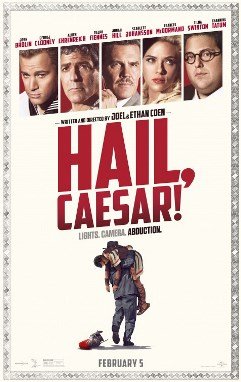
* “Hail, Caesar!” – PG-13: I have mixed feelings about this latest offering from Ethan Coen and Joel Coen a/k/a the Coen Brothers. While it is light and entertaining, there isn’t anything very suspenseful or interesting about it.
And I had a couple of beefs with it. First, there is the belittling and mocking of the Communist threat that was present in Hollywood at the time of this movie (the early 1950s). The threat was very real, and now the threat–a bunch of morally-bankrupt far-lefties who generally hate America–is running Hollywood, which is why America is so depraved. There’s also the mocking of the ’50s’ singing-and dancing musicals as just a bunch o’ gay men. Danny Kaye and Fred Astaire are rolling over in their graves right now.
But I loved the ’50s style and glamor that is ever-present in this movie, despite the presence of two obnoxious lefties (George Clooney and Josh Brolin) in starring roles. The Coens went to great lengths to consult experts on ’50s synchronized swimming and tap-dancing and use these in the movie. It’s very charming and glamorous, and it’s entertaining eye candy.
Brolin is Eddie Mannix, a devout Catholic and head of Capital Pictures, a film studio which is owned by some rich guy back in New York. Mannix is being courted to leave his job and go for a higher-paying, easier, more cushy job at Lockheed, and he’s considering the offer, given all the stress and long hours of what he’s doing at Capital. His job includes a lot of “fixing” of scandals. He must deal with a drunk star actress who is posing for sleazy photos, grooming the image of a cowboy and western actor whom he wants in “higher brow” fare that takes place in the salons of the wealthy, and then there’s the pregnant starlet who is single (and whom he is trying to get married off so the kid won’t be born out of wedlock. In the meantime, his star actor in a Romans-versus-Jesus film has been kidnapped. And, on top of it all, there are feuding twin sister gossip columnists (played by Tilda Swinton in the vein of Hedda Hopper) trolling around for dirt for their newspaper columns. While we are watching this all unfold, we see five different movies being filmed.
There is an old-style Western with gun-slinger Hobie Doyle (Alden Ehrenreich–the Jewish actor who was discovered by Steven Spielberg at a friend’s Bat Mitzvah can even lasso your finger with spaghetti, as he does in the movie). He’s the one being groomed for fancier stuff, and he’s also fixed up with a Carmen Miranda type of actress, whom the studio wants him to date . . . all for his and the studio’s public image. But he can’t get rid of his Southern accent and it makes a mess of snobby English director Laurence Laurentz’s (“Laurence Laurentz Presents!”) fancy movie about the bored and wealthy in a fancy mansion–in which the studio has forced Laurentz (Ralph Fiennes) to cast Doyle as the lead.
Then, there is the tap-dancing musical about sailors about to set sail for months without women. That’s the one in which gay sex is heavily implied. It stars Burt Gurney (Channing Tatum). And there’s “Hail, Caesar!,” which features movie star airhead Baird Whitlock (Clooney). Whitlock is poisoned on the set by two extras (including Sienfeld’s Wayne Knight — Newman!). Then, he’s kidnapped by a group of Communists, called “The Future,” which demands $100,000 in ransom.
And there is also the Esther-Williams-style synchronized swimming movie, starring DeeAnna Moran (Scarlett Johansson). When the cameras stop, she is a boisterous, low-class, pregnant chick with a high-pitched obnoxious, New-York-accented voice. Mannix is repeatedly begging her to allow him to arrange a marriage, so she doesn’t have an illegitimate kid, which would be bad for the studio and its movies (including her movie). How times have changed since that golden era.
And that’s what I mostly liked about this movie. It harkens back to the Golden Age of Hollywood, when morals there and in the rest of America actually counted for something (as did American patriotism) and when bad moral behavior was scandalous and embarrassing. Now it’s applauded and promoted by the studios.
This is supposed to be a comedy and there are some parts that are funny, but it’s not really that funny, and the laughs are far and few between (as well as inconsistent), relative to what you’d expect from the Coen Brothers. The best scene in the movie is that in which a rabbi, a Catholic priest, a Methodist minister and other religious leaders feud over “Hail, Caesar!” when they are called by Mannix to consult on the movie. Very funny scene.
The movie is relaxing and light, but not earth-shattering. It’s also fun and a good escape.
TWO REAGANS
Watch the trailer . . .


* “The Choice” – PG-13: This is a pro-life and a pro-religion movie–a refreshing surprise and departure away from the typical Nicholas Sparks movie. (Sparks produced this and it’s based on one of his many best-selling novels.) It’s not one of his usual cloying, manipulative tear-jerker chick flicks, although it starts out to be and is packaged like one. But looks are deceiving.
I don’t want to give too much away, but I feel that one of the trailers I saw for this movie already gives some of it away, so I won’t give away what the trailer doesn’t. The film, as the title indicates, is about a choice–well, actually many choices, each of them important, but one more important than all of them. At first, you believe that the choice is really only about a woman’s choice between two competing suitors who want her to spend their lives with them. And it is that. But that’s the trick. Instead, it is about the bigger choice: whether to keep a loved one alive when he or she is in a coma and all of the medical professionals urge pulling the plug. It’s also about the choice to believe in G-d–to realize that there is a higher power above us all who has a grander plan that supercedes ours. Best laid plans . . . .
Gabby (Teresa Palmer, an Aussie who does a great American accent and resembles a blonde Kristen Stewart) is a medical student who’s moved to a small North Carolina coastal town. Her new next door neighbor is Travis (Benjamin Walker), a veterinarian. When they meet, it’s because she’s angry that he’s playing music loud and claims that his dog has impregnated hers. But, eventually, they hit it off and fall in love, despite her belief in G-d and his lack of belief. She asserts that all of the beautiful nature around them (the cinematography in this is gorgeous) and the other things that are happening in life remind her that there is a greater power and that G-d has such a larger plan that is much bigger than us. Travis, though, doesn’t believe in G-d because his mother died of cancer when he was 14, and he says the only thing you can believe in and rely upon are your friends and family. Still, their relationship grows over a month. And Gabby takes Travis to church, where his widower father is in his glory (he turned to Christianity, the Bible, and faith when he wife was sick and died).
The thing is: Gabby is already in a long-term, serious relationship with a boyfriend, a local, wealthy doctor (Tom Welling, TV’s Superman of “Smallville” fame), who is out of town for a month to open his family’s new medical clinic. When he returns, Gabby is torn between the two men, and the two men fight for her love. That is the first choice made in this movie.
But there is another choice involving life or death. There is a serious accident, and Gabby ends up in a coma. She’s signed a “do not resuscitate” document. So what do to? Is there really a higher power who has plans we don’t know–plans beyond what available science and medicine can do?
That’s the real message of this movie and it provides the answers that I’m sure liberal movie critics will hate, but I loved.
While this movie looks to be formulaic and predictable in its beginning, it throws you for a loop in what it’s really about.
In 2004, another movie threw us for a loop. In my first ever formal movie review column, I wrote about the bait-and-switch pro-euthanasia message that was really the agenda of “Million Dollar Baby,” which was promoted and billed as “Rocky in a Sports Bra.” It wasn’t. My review was quoted by Rush Limbaugh on his nationally-syndicated radio show, as well as the New York Times, USA Today, and a number of other media outlets. Soon after, I began regularly reviewing movies.
But this movie isn’t like that. The movie lets you know in at least one trailer that I saw that it’s about a romance that involves a very serious choice after a very serious accident and shows the female protagonist surrounded by tubes in a hospital bed.
Since this isn’t your typical chick flick and it’s got a great message, it’s a very bearable–and, in fact, enjoyable–romance to which to take your significant other on the upcoming Valentine’s Day weekend, next week. Guys, this is one of the more pleasant ones to sit through.
But it’s not for kids and probably won’t be embraced by religious conservatives, given that premarital sex is involved in a couple of scenes. Still, it’s a classy movie for the most part and tastefully done.
It’s rare that Christianity and the pro-life issue are portrayed so positively in a Hollywood production, and I am proud to add that the movie production involves two of my fellow Jewish co-religionists, director Ross Katz, and producer Peter Safran and his The Safran Company.
Even if you are not into the message, it’s an entertaining movie.
THREE REAGANS
Watch the trailer . . .
* “Hail, Caesar!” – PG-13: I have mixed feelings about this latest offering from Ethan Coen and Joel Coen a/k/a the Coen Brothers. While it is light and entertaining, there isn’t anything very suspenseful or interesting about it.
And I had a couple of beefs with it. First, there is the belittling and mocking of the Communist threat that was present in Hollywood at the time of this movie (the early 1950s). The threat was very real, and now the threat–a bunch of morally-bankrupt far-lefties who generally hate America–is running Hollywood, which is why America is so depraved. There’s also the mocking of the ’50s’ singing-and dancing musicals as just a bunch o’ gay men. Danny Kaye and Fred Astaire are rolling over in their graves right now.
But I loved the ’50s style and glamor that is ever-present in this movie, despite the presence of two obnoxious lefties (George Clooney and Josh Brolin) in starring roles. The Coens went to great lengths to consult experts on ’50s synchronized swimming and tap-dancing and use these in the movie. It’s very charming and glamorous, and it’s entertaining eye candy.
Brolin is Eddie Mannix, a devout Catholic and head of Capital Pictures, a film studio which is owned by some rich guy back in New York. Mannix is being courted to leave his job and go for a higher-paying, easier, more cushy job at Lockheed, and he’s considering the offer, given all the stress and long hours of what he’s doing at Capital. His job includes a lot of “fixing” of scandals. He must deal with a drunk star actress who is posing for sleazy photos, grooming the image of a cowboy and western actor whom he wants in “higher brow” fare that takes place in the salons of the wealthy, and then there’s the pregnant starlet who is single (and whom he is trying to get married off so the kid won’t be born out of wedlock. In the meantime, his star actor in a Romans-versus-Jesus film has been kidnapped. And, on top of it all, there are feuding twin sister gossip columnists (played by Tilda Swinton in the vein of Hedda Hopper) trolling around for dirt for their newspaper columns. While we are watching this all unfold, we see five different movies being filmed.
There is an old-style Western with gun-slinger Hobie Doyle (Alden Ehrenreich–the Jewish actor who was discovered by Steven Spielberg at a friend’s Bat Mitzvah can even lasso your finger with spaghetti, as he does in the movie). He’s the one being groomed for fancier stuff, and he’s also fixed up with a Carmen Miranda type of actress, whom the studio wants him to date . . . all for his and the studio’s public image. But he can’t get rid of his Southern accent and it makes a mess of snobby English director Laurence Laurentz’s (“Laurence Laurentz Presents!”) fancy movie about the bored and wealthy in a fancy mansion–in which the studio has forced Laurentz (Ralph Fiennes) to cast Doyle as the lead.
Then, there is the tap-dancing musical about sailors about to set sail for months without women. That’s the one in which gay sex is heavily implied. It stars Burt Gurney (Channing Tatum). And there’s “Hail, Caesar!,” which features movie star airhead Baird Whitlock (Clooney). Whitlock is poisoned on the set by two extras (including Sienfeld’s Wayne Knight — Newman!). Then, he’s kidnapped by a group of Communists, called “The Future,” which demands $100,000 in ransom.
And there is also the Esther-Williams-style synchronized swimming movie, starring DeeAnna Moran (Scarlett Johansson). When the cameras stop, she is a boisterous, low-class, pregnant chick with a high-pitched obnoxious, New-York-accented voice. Mannix is repeatedly begging her to allow him to arrange a marriage, so she doesn’t have an illegitimate kid, which would be bad for the studio and its movies (including her movie). How times have changed since that golden era.
And that’s what I mostly liked about this movie. It harkens back to the Golden Age of Hollywood, when morals there and in the rest of America actually counted for something (as did American patriotism) and when bad moral behavior was scandalous and embarrassing. Now it’s applauded and promoted by the studios.
This is supposed to be a comedy and there are some parts that are funny, but it’s not really that funny, and the laughs are far and few between (as well as inconsistent), relative to what you’d expect from the Coen Brothers. The best scene in the movie is that in which a rabbi, a Catholic priest, a Methodist minister and other religious leaders feud over “Hail, Caesar!” when they are called by Mannix to consult on the movie. Very funny scene.
The movie is relaxing and light, but not earth-shattering. It’s also fun and a good escape.
TWO REAGANS
Watch the trailer . . .







 Posts
Posts


