Showing posts with label #purim. Show all posts

Friday, March 25, 2016

The Good Friday-Easter Sunday Question

An interesting article from http://www.ucg.org/ about Easter. This follows this previous post about it. This follows this post about the Pope and immigration. For a free magazine subscription or to get the books recommended for free click HERE! or call 1-888-886- 8632.

In the northern hemisphere, the spring of each year brings several of Christianity’s most important religious observances. The Lenten period from Ash Wednesday to Easter is observed by some with fasting and penance. Good Friday, or Holy Friday, as it is sometimes called, is celebrated two days before Easter as a commemoration of the crucifixion of Jesus Christ. Easter Sunday is revered as the day of Jesus’ resurrection, sometimes by sunrise services.
Once we realize that two Sabbaths were involved—first an annual Holy Day, which was observed from Wednesday evening until Thursday evening, and the normal weekly Sabbath from Friday evening to Saturday evening, the fulfillment of Christ’s words becomes clear.
These practices are so much an ingrained tradition in the church calendar that many would consider it heretical to question them. But most of the world is scarcely aware that the original apostles did not institute or keep these customs, nor were they observed by the early Christian Church. Try as you might to find them, Lent, Good Friday and Easter are not so much as mentioned in the original Greek wording of the New Testament. The word Easter appears only once in the King James Version of the Bible (Acts 12:4) in a flagrant mistranslation of the Greek word pascha , which should be translated “Passover,” as most versions render it.
The justification for the Lenten 40-day preparation for Easter is traditionally based on Jesus’ 40-day wilderness fast before his temptation by Satan ( Harper’s Bible Dictionary , “Lent”; Matthew 4:1-2; Mark 1:13). The problem with this explanation is that this incident is not connected in any way with Jesus’ supposed observance of Easter. The 40-day pre-Easter practice of fasting and penance did not originate in the Bible.

Pre-Christian practices adopted

Many people still follow such practices, assuming that such activities honor God and are approved by Him. But, we should ask, how does God regard such extrabiblical customs? Consider God’s instructions to those who would worship Him:
“Take heed to yourself that you are not ensnared to follow them, after they are destroyed from before you, and that you do not inquire after their gods, saying, ‘How did these nations serve their gods? I also will do likewise.’ You shall not worship the Lord your God in that way; for every abomination to the Lord which He hates they have done to their gods; for they burn even their sons and daughters in the fire to their gods. Whatever I command you, be careful to observe it; you shall not add to it nor take away from it” (Deuteronomy 12:30-32, emphasis added throughout).
The International Standard Bible Encyclopedia notes: “The term Easter was derived from the Anglo-Saxon ‘Eostre,’ the name of the goddess of spring. In her honor sacrifices were offered at the time of the vernal [spring] equinox” (Eerdmans, Grand Rapids, 1982, Vol. 2, “Easter”).
Many battles were fought over its observance date, but the Council of Nicea finally fixed the date of Easter in A.D. 325 to fall on the first Sunday after the full moon on or after the vernal equinox (March 21).
Not generally known is that:
“the preparation for Easter season, beginning on Ash Wednesday and continuing for a week after Easter Day, was filled with pagan customs that had been revised in the light of Christianity. Germanic nations, for example, set bonfires in spring. This custom was frowned on by the Church, which tried to suppress it . . . In the sixth and seventh centuries [monks] came to Germany, [bringing] their earlier pagan rites[,] and would bless bonfires outside the church building on Holy Saturday. The custom spread to France, and eventually it was incorporated into the Easter liturgy of Rome in the ninth century. Even today the blessing of the new fire is part of the Vigil of Easter.
“Medieval celebrations of Easter began at dawn. According to one old legend, the sun dances on Easter morning, or makes three jumps at the moment of its rising, in honor of Christ’s resurrection. The rays of light penetrating the clouds were believed to be angels dancing for joy.
“Some Easter folk traditions that have survived today are the Easter egg, rabbit and lamb. During medieval times it was a tradition to give eggs at Easter to servants. King Edward I of England had 450 eggs boiled before Easter and dyed or covered with gold leaf. He then gave them to members of the royal household on Easter day. The egg was an earlier pagan symbol of rebirth and was presented at the spring equinox, the beginning of the pagan new year.
“The Easter rabbit is mentioned in a German book of 1572 and also was a pagan fertility symbol. The Easter lamb goes back to the Middle Ages; the lamb, holding a flag with a red cross on a white field, represented the resurrected Christ [rather than the sacrifice of His life, as a fulfillment of the Passover lamb, that paid for the sins of the world (John 1:29)]” (Anthony S. Mercatante, Facts on File Encyclopedia of World Mythology and Legend , New York and Oxford, 1988, “Easter”).

Passover out, Easter in

Easter traditions are embraced by many who profess Christianity. However, none of these practices are to be found in the Bible or the customs of the early Church. Jesus and His apostles did not establish or perpetuate such practices, which obscure the true biblical meanings and observances of this time of year. In fact, a 4th-century church historian, Socrates Scholasticus, wrote in his Ecclesiastical History that neither the apostles nor the Gospels taught the observance of Easter, nor did they or Jesus give a law requiring the keeping of this feast. Instead, “the observance originated not by legislation, but as a custom” (chapter 22, emphasis added).
Even as early as the close of the 2nd century, the theologian Irenaeus bore witness in his letter to Victor, bishop of Rome, that some early Roman bishops forbade the observance of Passover on the 14th of Nisan. This was the date of the biblical observance practiced each spring by Jesus and the apostles. At the time that the Nisan 14 Passover observance was banned, ecclesiastical authorities introduced Lent and Easter into Christian practice.

Distorting Jesus’ words

A century later the Syriac Didascalia recorded the attempts of teachers in Rome to reconcile Jesus’ words that He would be entombed “three days and three nights in the heart of the earth” (Matthew 12:40) with a Friday-afternoon crucifixion and a Sunday-morning resurrection. According to their reasoning, Jesus’ sufferings were part of the three days and three nights of Scripture. Friday morning from 9 to noon was counted as the first day, and noon to 3 p.m. (which was darkened) was considered the first night. Three in the afternoon to sunset was reckoned as the second day, whereas Friday night to Saturday morning constituted the second night. The daylight part of Saturday was the third day, and the night portion to Sunday morning was the third night.
In other words, the three days and three nights in the grave that Jesus said would be the sign that He was indeed sent from God were transformed into a period of two days and two nights, or a total of no more than 48 hours. This has subsequently been reduced even further in modern times by figuring from late-afternoon Friday to early Sunday morning, which takes away another 12 hours or more. Such reasoning has to discount or somehow explain away Jesus’ clear promise that He would be entombed three days and three nights.
Easter and Lent are nonbiblical and were not observed by the apostles or the 1st-century Church. The biblical record shows, however, that the early Church diligently kept other observances, the New Testament Passover and Feast of Unleavened Bread, just as Jesus and the apostles had done (Matthew 26:17-19; Acts 20:6; 1 Corinthians 5:8; 1 Corinthians 11:23-26). These were supplanted in later years by the customs and practices of Easter and Lent.
Passover is an annual reminder of Jesus’ sacrificial death to pay the penalty for our sins (Matthew 26:26-28). The Feast of Unleavened Bread is a celebration that focuses on a Christian’s need to live in sincerity, truth and purity (1 Corinthians 5:8). The nonbiblical festivals of Lent and Easter, added decades after the time of Jesus Christ and the apostles, only cloud the true significance of Christ’s life, death and resurrection and the purpose of His coming.
The Passover was instituted in Exodus 12 and continues, by Jesus Christ’s example and command, but with a change of symbols. Jesus’ death fulfilled the symbolism of the sacrificial Passover lamb (Matthew 26:17-28; John 1:29), but the New Testament Passover has been improperly replaced as an annual memorial of the resurrection of Christ by Easter. We are commanded to commemorate Christ’s death, not His resurrection (1 Corinthians 11:23-28).

Facts about Jesus’ last days

Jesus Christ’s promise was fulfilled exactly as He said, a fact that is made clear when we study and compare the Gospel accounts. These records give a clear, logical explanation that is perfectly consistent with Christ’s words. Let’s focus on Jesus’ last days on earth to gain the proper perspective and understanding of how and when these events occurred.
Jesus said that, like the prophet Jonah, He would be entombed three days and three nights and that He would be raised up the third day after His crucifixion and death (Matthew 12:39-40; Matthew 17:23; Matthew 20:19). Putting these scriptures together, we see that He was resurrected at the end of the third day after His death. Luke 23:44 shows that He died around the ninth hour (Jewish reckoning), or 3 p.m. He would have been buried within the next few hours so that His body could be entombed before the approaching Sabbath (John 19:31).
Jesus’ resurrection could not have been on a Sunday morning because John 20:1-2 shows that He had already risen before Mary Magdalene came to the tomb early in the morning, arriving “while it was still dark.” Therefore, neither could His death have occurred Friday afternoon, since that would not allow for His body to be in the grave three days and three nights. Clearly, the Good Friday-Easter Sunday explanation and tradition is without scriptural foundation.
Notice also that John 19:31 mentions that the Sabbath immediately after Jesus’ death was “a high day”—not the weekly seventh-day Sabbath (from Friday evening to Saturday evening), but one of the annual Sabbaths, the first day of the Feast of Unleavened Bread (see Leviticus 23:6-7), which can fall on any day of the week.
In fact, two Sabbaths—first an annual Holy Day and then the regular weekly Sabbath—are mentioned in the Gospel accounts, a detail overlooked by most people. This can be proven by comparing Mark 16:1 with Luke 23:56.
Mark’s account tells us, “Now when the Sabbath was past, Mary Magdalene, Mary the mother of James, and Salome bought spices, that they might come and anoint Him” (Mark 16:1). However, Luke’s account describes how the women who followed Jesus saw how His body was laid in the tomb. “Then they returned and prepared spices and fragrant oils” for the final preparation of the body. “And they rested on the Sabbath according to the commandment” (Luke 23:56).
Mark tells us that the women bought the spices after the Sabbath, “when the Sabbath was past.” Luke, however, tells us that they prepared the spices and oils, after which “they rested on the Sabbath according to the commandment.” How could the women have bought spices after the Sabbath, yet then prepared them and rested on the same Sabbath?
That is obviously impossible—unless two Sabbaths are involved, with a day between them. Once we realize this, the two accounts become clear (see “ The Chronology of Christ’s Crucifixion and Resurrection “). Christ died near 3 p.m. and was placed in the tomb near sunset that day—a Wednesday in 31. That evening began the “high day” Sabbath, the first day of the Feast of Unleavened Bread, which fell on Thursday that year.
The women rested on that day, then on Friday purchased and prepared the spices and oils for Jesus’ body, which could not be done on either the Holy Day or the weekly Sabbath. They then rested again on the weekly Sabbath before going to the tomb before daybreak on Sunday morning, at which time they discovered that Christ had already been resurrected.

Two Sabbaths confirmed in text

The fact that two Sabbaths are involved is confirmed by Matthew 28:1, where the women went to the tomb “after the Sabbath.” The Sabbath mentioned here is actually plural in the original Greek and should be translated “Sabbaths.” Some Bible versions, including Alfred Marshall’s Interlinear Greek-English New Testament , Ferrar Fenton’s translation, Green’s Literal Translation and Young’s Literal Translation , make this clear.
Once we realize that two Sabbaths were involved—first an annual Holy Day, which was observed from Wednesday evening until Thursday evening, and the normal weekly Sabbath from Friday evening to Saturday evening, the fulfillment of Christ’s words becomes clear.
The Savior of all humanity died near 3 p.m. on Wednesday and was buried shortly before sunset that day. From Wednesday sunset to Thursday sunset is one day and one night; from then until Friday sunset is two days and two nights; and from then until Saturday sunset is three days and three nights. Jesus Christ was resurrected at the end of this three-day and three-night period, near sunset on Saturday. Thus He was already risen long before the women came to the tomb before daylight on Sunday morning.
Jesus Christ’s words were thus perfectly fulfilled, as verified by the Gospel accounts. He was not crucified on Friday afternoon, nor was He resurrected on a Sunday morning. The biblical evidence shows the Good Friday-Easter Sunday tradition to be a fabrication.
A correct harmonization of all the facts demonstrates that Jesus died near 3 p.m. that Wednesday afternoon, was entombed near sunset and was resurrected near sunset on Saturday, exactly three days and three nights later—just as He had stated. These are the facts, the correct biblical chronology that verifies the divinity of Jesus Christ, the Son of God.

The biblical festivals

Actually, the principal festivals and holidays observed by mainstream Christendom are a poor and pale reflection of true biblical teachings. Easter and Lent are a poor substitute for the wondrous truths revealed by keeping God’s feasts.
The New Testament Church continued to observe the annual Passover to commemorate the death of Jesus Christ, but used the new symbols of bread and wine that He instituted (1 Corinthians 11:23-28). Today some continue to commemorate this eminently important event in the same manner, in accordance with Christ’s instructions.
Again, the Bible contains no record of the Church observing Easter or Lent during the time of the apostles, nor any biblical command to observe Good Friday or Easter Sunday, especially since Christ did not die on Good Friday and was not resurrected on Easter Sunday. Instead, the apostles faithfully followed Christ’s instructions to observe the biblical Passover “in remembrance” of Him (Luke 22:19; 1 Corinthians 11:24-25).
The marvelous plan of God has been obscured by theologians and religious leaders trying to merge nonbiblical practices with biblical events. To better understand why Jesus instructed His followers to observe Passover along with the other biblically defined festivals, read the Bible study aid  God’s Holy Day Plan: The Promise of Hope for All Mankind  .

You might also be interested in...

Wednesday, March 23, 2016

Easter: The Rest of the Story

An interesting article from http://www.ucg.org/ about Easter. This follows this post about terrorism. This follows this post about former Muslims in America. This follows this post about the Pope and immigration. For a free magazine subscription or to get the books recommended for free click HERE! or call 1-888-886- 8632.

Table of Contents

The resurrection of Christ: Hope for the ages

The life, death and resurrection of Jesus Christ is the key historical and spiritual reality for a Christian. Without His resurrection, "your faith is futile" (1 Corinthians 15:17). Christ's resurrection is the culmination of the most important series of events of all time.

Easter vs. the Bible

For millions of professing Christians Easter is the most important day of the calendar year because it commemorates Jesus' resurrection. Easter sunrise services are considered the holiest assembly of the year—a time when Christians reaffirm that Jesus is risen and their hope in Him is true.

How Easter replaced the biblical Passover

Why did Easter replace the Passover?

Three days and three nights

The choice of a Sunday date for Easter is based on the assumption that Christ rose from the grave early on a Sunday morning. The popular belief is that Christ was crucified on a Friday and rose on a Sunday. But neither of these suppositions is true. A close reading of the Bible makes that quite clear.

We need a Savior

A main theme in the Bible is sin, which is defined in the Bible as the violation of God's law (1 John 3:4, King James Version), and our need for forgiveness and reconciliation to God (the theme of the biblically commanded Passover and the Days of Unleavened Bread).

What's the rest of the story about Easter?

As we have seen, Easter and its customs did not come from the Bible, but from pagan fertility rites. It is a curious mixture of ancient mythological practices and arbitrary dating that obscures and discredits the proof of Jesus Christ's Messiahship and resurrection.

Friday, March 18, 2016

King David's line: Tea-Tephi or Scota?

An interesting article from http://www.ucg.org/ about King David. This follows this post about St. Patrick. This follows this post about the Pope and immigration. For a free magazine subscription or to get the books recommended for free click HERE! or call 1-888-886- 8632.

Moreover, these appellations, meaning what they did in Hebrew, could possibly have been applied to a Hebrew princess accompanying Jeremiah even if they were not her actual names—stories about her, then, may have confused her with other women. Also in favor is that if the other names mentioned were aligned with Jeremiah, she would fall into place as well.

And there is another possible explanation regarding her identity. One of the primary Irish chronicles, The Annals of the Kings of Ireland by the Four Masters , mentions “Tea, daughter of Lughaidh, son of Itha, whom Eremhon married in Spain” (1636, Vol. 1, p. 31). At first glance, this would seem to rule out her being the daughter of Zedekiah. However, Lughaidh may not refer to an actual person. The Irish are referred to as the “race of Lughaidh” and Ireland as “the land of Lughaidh”—“one of the many arbitrary bardic names for Ireland” ( Annals of the Four Masters , Vol. 6, appendix).

Lughaidh in old Gaelic could mean “House of God”—broken down as Logh, “God,” and aidhe, “house, habitation, fortress” (Edward O’Reilly, An Irish-English Dictionary , 1821, 1864). “House of God” (Hebrew Beth-El) may have been a designation for David’s dynasty or even for the “large, rough stone” reportedly brought by Jeremiah (see Appendix 7: “The Stone of Destiny” ). The word Lughaidh may also come from lugha or lughadh , meaning “oath”—apparently because it invokes God (O’Reilly, note by editor John O’Donovan, p. 671; N. MacLeod and D. Dewar, A Dictionary of the Gaelic Language , 1831, 1909)—and could be related to God’s oath to David.

The name Itha or Ith may mean “crown,” as does the related Welsh yd (O’Reilly). Ith, coming from Spain, is said to be the son of Breoghan in some accounts, but this may simply be because the Milesian line of kings came to Ireland from Brigantium (modern Corunna near Santiago de Compostella) on the northwest coast of Spain. Indeed, Tea is in at least one old poem called Temor of Bregia. Brega or Breagh, it should be noted, was the immediate territory of Tara in ancient Ireland, named after the Celtic tribe known as the Brigantes (or vice versa). The Brigantes were located in southeast Ireland by the Roman geographer Ptolemy around 150 A.D. He also mentioned them as being one of the Celtic tribes in Britain at that time, as other sources also attest (see www.roman-britain.org/tribes/brigantes.htm ). Some now believe that they derived their name from the Celtic goddess Brigid. Indeed, it could be that she is simply a later deification of Tea, combined with features of other pagan goddesses. According to some scholars, the name Brigid “comes from the Old Irish brigante , meaning ‘the exalted one’” ( In Search of Ancient Ireland , Program 2: “Saints,” PBS Home Video, 2002). This title could conceivably correspond to the modern “highness” for a royal personage. In any event, it is certainly possible that the name Brigantes or Brega originally came from Brigantium in northwest Spain—all perhaps relating to a royal title.

Thus, “Tea, daughter of Lughaidh, son of Itha, son of Breoghan” could conceivably be read as “Tea, daughter of the House of God [or oath], child of the crown, child of Brigantium [or child of royalty].” This would well describe a Jewish princess of David’s line who came to Ireland by way of the Iberian Peninsula.

On the other hand, it may be that Lughaidh and Ith were actual people and that this Tea was not Zedekiah’s daughter. Perhaps, instead, Lughaidh was synonymous with the earlier mentioned Gathelus who supposedly married a “pharaoh’s daughter” named Scota in the Irish and Scottish histories. She may well have been Zedekiah’s daughter, as some contend. Gathelus and Scota, in certain accounts, never made it to Ireland. And in this scenario, Tea-Tephi, their daughter, would have been the granddaughter of Zedekiah. If so, this would still have fulfilled God’s promise that David would have a descendant ruling in “all generations”—as long as the overturn of the throne from Judah to Ireland was accomplished before the generation alive at Jerusalem’s fall passed away.

However, there are problems with the above explanation, chief of which is that Gathelus and Scota’s son, one of several sons, is said to have become king—not their daughter (incidentally this too still fits with God’s promise to David). Yet most of their sons are reported to have died—leaving the youngest, Heremon, to rule. But perhaps Heremon was actually not their son. It could be that he was their son-in-law, married to their daughter Tea-Tephi.

Then again, it could just as well be that this is all wrong, that there was no intervening generation in the transfer of the throne to Ireland, and that Tea-Tephi was the same as Scota. Others believe Scota was the sister of Tea (as Jeremiah escorted the king’s “daughters”—plural). And still others argue that Gathelus and Scota can’t be linked with Zedekiah in any fashion since they supposedly long predated Zedekiah and Jeremiah (see Appendix 8: “Gathelus, Scota and the Exodus”  ).

You might also be interested in...

Thursday, March 5, 2015

Purim, Jews and Netanyahu's Warning

An interesting article from http://www.ucg.org/ about Purim and Netanyahu. This follows this post about Esther. For a free magazine subscription or to get the books recommended for free click HERE! or call 1-888-886- 8632.
I am leaving TWITTER SOON. Please continue to follow me here.


Purim, Jews and Netanyahu's Warning


Israeli Prime Minister Benjamin Netanyahu's speech this week comes at the same time as the Jewish festival of Purim. Interesting.


Media Download Options [ Download Media: right-click on link ]
filesVideo
MP4 Video
Video
MP4 Video - Low Quality
Audio
MP3 Audio - Purim, Jews and Netanyahu's Warning


[Darris McNeely] The news that I’ve been watching is abuzz with Prime Minister Benjamin Netanyahu’s scheduled speech before the United States Congress this week. You know, it’s interesting – I didn’t realize it until putting together some of the dates that Prime Minister Netanyahu’s speech just two days before the Jewish celebration of Purim, an ancient celebration that dates all the way back to an event in the book of Esther in the Bible during the ancient Persian Empire. The Jews were in captivity and Persia was the big kid on the block. Back at that time, there was an effort made that is told in the book of Esther to exterminate the Jews. It’s history’s first holocaust. Anti-Semitism is a very, very old evil. In Esther:3:13, it makes this one statement, and I think it captures the danger that was there for the Jews in the Persian Empire at the time, that “letters were sent by couriers into all the king’s provinces, to destroy, to kill, and to annihilate all the Jews, both young and old, little children and women, in one day, on the thirteenth day of the twelfth month, which is in the month of Adar, and to plunder their possessions.” Again, history’s first effort to exterminate the Jews. The story in Esther shows that it didn’t happen due to the courage of the young Jewess named Esther, who along with her uncle Mordecai thwarted the effort that was being hatched at that time.
Well, the Jews celebrate Purim every year to mark this particular event. Prime Minister Benjamin Netanyahu is coming to talk to the American Congress about the Iranian effort to build and develop a nuclear weapon. This has been dominating the news for years, and it has finally come to a critical point in the negotiations. Many fear that a bargain will be struck that will allow Iran to develop that weapon. Israel, the State of Israel, has a very, very acute visionary understanding of what is taking place there. Iran for years has said that they will destroy the State of Israel, they will push the Jewish state into the Mediterranean. With one bomb, one nuclear weapon detonated over Israel, that could happen. Israel has said it will not happen. And so, the Prime Minister comes to the United States to make this plea, to make this call, this warning, and it promises to be a very interesting speech.
But to connect it all together, as this warning is given, with what we know from the story of history, the Bible as told in the book of Esther, and connected with this very interesting Jewish celebration of Purim, we recognize that we are at a very, very serious time right now.
There’s a map that I had recently seen in one of the newspapers that kind of showed exactly what is taking place with Iran, which is in the heart of the ancient Persian Empire, as they have extended their influence into Syria, into Lebanon, down into Yemen, and their efforts also in Iraq, to almost encircle the State of Israel with the danger they pose there. It’s a very critical, perilous period going on in the Middle East right now, and the negotiations toward Iran’s efforts for a weapon, the warnings that are being sounded, are ones that should be understood, listened to. We’re at a very critical period. There’s a great deal at stake.
That’s BT Daily . Join us next time.

Wednesday, March 4, 2015

Esther: A Woman of Faith and Courage

An interesting article from http://www.ucg.org/ about Esther. This follows this post about the nation of Israel. This follows this post about Homeland Security. For a free magazine subscription or to get the books recommended for free click HERE! or call 1-888-886- 8632.
I am leaving TWITTER SOON. Please continue to follow me here.


Esther: A Woman of Faith and Courage


Printer-friendly version


The Bible offers Christians many examples of faith from which we can learn and be encouraged. One of the most remarkable examples is that of Queen Esther.

Has fear ever paralyzed you, made you afraid to make a critical decision because of possible or probable serious consequences?
It has been said that courage is not the absence of fear; it is the mastery of it. The Bible, however, adds an important element to the definition of courage: trust and faith in God. Moses told the ancient Israelites not to fear the other nations when they crossed over the Jordan River into the promised land, because God was with them and would not forsake them (Deuteronomy:31:6).
How can you have this kind of faith? How can you step out and confidently make decisions that will affect the course of your physical-and maybe even your spiritual-life?

From an orphan to a queen

For the answer, consider the example of a Jewish girl from ancient Persia.
In the third year of his reign, Ahasuerus, king of the Medes and Persians, searched for a new queen from among the beautiful virgins in his kingdom. She was to replace Queen Vashti. Vashti had humiliated her husband in front of many people including all his officials. She had refused to allow him to display her beauty before everyone at his special feast (Esther:1:10-22).
Esther, a young orphan, was among the women the king ordered brought to the palace for special pampering and preparation for the king's scrutiny as possible royal replacements. Her cousin, Mordecai, had reared her. Mordecai was a Jewish servant "in the king's gate" (Esther:2:19), which implied that he held a position in the king's court. Following her cousin's advice, Esther did not reveal her ethnic identity. After the king chose her as queen, she maintained her contact with her cousin (Esther 2).

Plot to wipe out a race

Sometime later Ahasuerus appointed Haman, a man prominent in the kingdom, to a special office over his princes. Ahasuerus commanded that each servant should bow down to Haman, paying him homage. Mordecai refused.
Haman was enraged by Mordecai's actions. But he wasn't satisfied just to seek revenge on one man; he devised a scheme to destroy all the Jews in the kingdom. He approached the king and informed him that the Jews did not keep the king's laws. He convinced Ahasuerus to issue a decree saying 10,000 talents of silver would go to anyone who would destroy the Jews (Esther 3).
In ancient Persia, when the king made a decree and sealed it with his signet ring, it was not to be revoked or amended. Ahasuerus's decree went out, resulting in great mourning and fasting among the Jews throughout the land. Clothed in sackcloth and ashes of mourning, Mordecai sat in the square near the king's gate. When Esther learned of Mordecai's circumstance, she told her maids to take garments to clothe him and to take away his sackcloth. But Mordecai would not accept them.
Esther then sent Hathach, one of the king's eunuchs who attended her, to find out what was wrong with Mordecai. Mordecai told him all that had happened and gave him a copy of the written decree to show to Esther. He also told him to tell her to go to the king and plead for her people.
Esther had not seen the king for 30 days. The king enforced a law that anyone who came into the inner court to approach him whom he had not specifically called was to die. However, the king could make an exception by holding out his golden scepter, thereby sparing the person. So Esther sent the eunuch back to Mordecai with the message that she could not enter the court to see the king.
Mordecai answered that, if she did nothing, she risked death along with all her countrymen in the kingdom. He also asked a piercing question: What if God had elevated Esther to her position as queen for the specific purpose of helping save her people at this critical time? (Esther:4:13-14).

Esther's dilemma

What a decision for such a young woman! Death seemed certain regardless of what she decided. Vashti had been only banished from her position as queen. Esther might actually be killed!
She had to answer Mordecai. What would she do? She must have prayed and agonized over her decision. Tension and anxiety must have consumed her. She was sickened with fear for herself and her people.
She must have asked herself a hundred times would God really let her die if she refused to help the Jews? She was so young. Surely God did not want her to die. On the other hand, could she stand silently by and watch heartless Haman annihilate her people? Why couldn't her dilemma just go away like a bad dream?
In the midst of her turmoil, Esther realized she could not allow fear to paralyze her into inaction; that in itself would be a decision. Instead, she left the outcome with God. It was clear she had only one real choice.
Even in giving Mordecai her answer, Esther knew she did not have the courage within herself to face Ahasuerus. But she did know where to go for the courage she lacked: to God in fasting and prayer. Placing her life in God's hands, she let Him decide the outcome for her and her people.
She sent word to Mordecai requesting that he ask their fellow Jews to fast for her for three days and nights. She and her maids would do likewise. Then she promised to go before the king, knowing full well she was risking her life (Esther:4:16).
You can read the remainder of the book of Esther to see what happened. The king did extend his golden scepter, and he spared Esther's life. After several special banquets for the king and Haman, Esther finally revealed Haman's plot and made known her request for her people. The king ordered Haman hanged on the very gallows he had prepared for Mordecai's execution.
The king issued a new decree: The Jews were free to defend themselves and destroy anyone who would assault them. He promoted Mordecai, and the Jews were saved. To this day, many Jews observe the Feast of Purim in honor of this event.

What can we learn?

Sometimes fear is our normal human reaction when we are faced with a seemingly impossible decision. Acknowledging our lack of courage is the first step to overcoming it. But we must not allow fear to paralyze us into taking no action at all.
You must realize that you need help and that you cannot go it alone. Recognize that God is all powerful, that He has promised never to leave you or forsake you (Hebrews:13:5). Go to Him in prayer and fasting to seek His will in making the right decision. Then confidently make your decision, with the courage and conviction that God is on your side.
Perhaps a fitting conclusion to this story of godly courage can come from the words on a memorial in Westminster Abbey. Inscribed on the monument to Lord Lawrence are these words: "He feared man so little because he feared God so much."
Nobody has commented yet. Be the first to kick off the discussion!
Login/Register to post comments

Friday, March 14, 2014

Profiles of Faith: Queen Esther - A Woman Willing to Save Others

An interesting article from http://www.ucg.org/  about the interesting woman of the Bible named Esther. This follows this post about Spring Break warnings. For a free magazine subscription or to get the book shown for free click HERE! or call 1-888-886- 8632. You can follow me at blogspot here and at twitter here https://twitter.com/brianleesblog. Please consider following both in case one goes down!


Profiles of Faith: Queen Esther - A Woman Willing to Save Others

Printer-friendly version


The story of Esther and Mordecai transcends time and culture. The situation they faced still applies and teaches valuable spiritual lessons. We should have godly, loving faith built on a loving, trusting relationship with God.


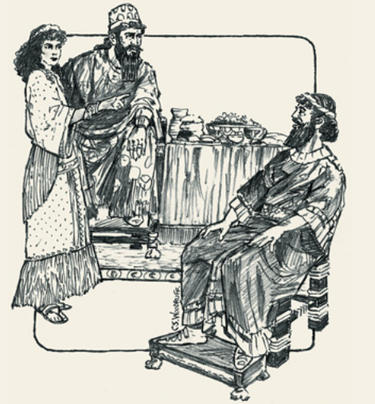
Esther turned and pointed toward Haman: “The adversary and enemy is this wicked Haman!” Haman was mortified.

Source: Illustration by Michael Woodruff
The Jewish exile Mordecai knew the situation was dire and dangerous. Through a sinister plot, the Jews in Persia were secretly condemned to death (Esther 3). Mordecai pleaded with Queen Esther to risk her life: "If you remain completely silent at this time, relief and deliverance will arise for the Jews from another place, but you and your father's house will perish. Yet who knows whether you have come to the kingdom for such a time as this?" (Esther:4:14).
The story of Esther and Mordecai transcends time and culture. The situation they faced still applies and teaches valuable spiritual lessons.

Setting for the Story

Esther's story takes place near the end of the events described in the Old Testament. The two kingdoms of Israel and Judah had fallen and been taken into captivity in Assyria and Babylon, respectively.
By this time, several hundred years after their fall, the descendants of Israel—the "lost 10 tribes"—had scattered and disappeared from the Middle Eastern map. The descendants of Judah, however, had maintained their beliefs and way of life while in Babylon. However, Babylon, too, had fallen, and now the Jews lived under the benign rule of the Persian Empire.
The Persians had allowed Jews willing to make the long overland journey the opportunity to return to Jerusalem and their homeland. Although many had made the trip, many more had decided to remain where were and put down roots.
The book of Esther is a complement to the books of Ezra and Nehemiah. Although those books describe life for the Jews who returned to Palestine, Esther is the only Bible book that offers a portrait of those who chose to remain in Persia.
The book of Esther introduces us to a great king of Persia known as Ahasuerus (Hebrew), or Xerxes (Greek). In 479 B.C. the Greeks defeated Ahasuerus in the battle at Salamis.
The Greek historian Herodotus wrote that the Persian king sought consolation in his harem after his defeat. He gave a huge banquet, lasting several days, for palace personnel (Esther:1:1-8). At that time Queen Vashti— wife of Ahasuerus—gave a banquet for the women of the palace. On the seventh day of his banquet, the king commanded Vashti to appear before his court so everyone could behold her beauty (Esther:1:9-11).
But the queen refused to appear before her husband. So Ahasuerus, on the advice of his counselors, decided to look for someone to replace her as queen.
The king's servants came up with a plan: "Let beautiful young virgins be sought for the king; and let the king appoint officers in all the provinces of his kingdom, that they may gather all the beautiful young virgins to Shushan the citadel, into the women's quarters, under the custody of Hegai the king's eunuch ... Then let the young woman who pleases the king be queen instead of Vashti" (Esther:2:2-4). The king agreed and looked forward to the prospect of a beautiful wife who could become his new queen.

Esther Becomes Queen

Mordecai was an older cousin of Esther's who had helped raise her: "And Mordecai had brought up Hadassah, that is, Esther, his uncle's daughter, for she had neither father nor mother" (Esther:2:7). They lived in Shushan.
The king's decree brought to his palace many beautiful young women, but none was more beautiful than Esther. From the beginning Hegai, a eunuch and custodian of the women, favored Esther favor, "so he readily gave beauty preparations to her, besides her allowance" (Esther:2:9).
In turn, each young lady was presented before the king. When it came Esther's turn, she was allowed to choose her attire. However, "she requested nothing but what Hegai the king's eunuch, the custodian of the women, advised. And Esther obtained favor in the sight of all who saw her" (Esther:2:15). Hegai knew the king's social tastes. She deferred to his advice.
Finally, Esther was presented before the king. "The king loved Esther more than all the other women, and she obtained grace and favor in his sight more than all the virgins; so he set the royal crown upon her head and made her queen instead of Vashti. Then the king made a great feast, the Feast of Esther, for all his officials and servants; and he proclaimed a holiday in the provinces and gave gifts according to the generosity of a king" (Esther:2:17-18). Thus Esther became queen of Persia.

Mordecai Averts Assassination

One day Mordecai, now a royal official, found that two of the king's doorkeepers planned to assassinate the king. Mordecai told Esther, who promptly warned the king. The king hanged the men. These proceedings, including Mordecai's faithful disclosure, were "written in the book of the chronicles in the presence of the king" (Esther:2:23).
Throughout this time Esther, on Mordecai's advice, had not told the king of her family background or that she was related to Mordecai.

Haman's Jealous Plot

Another chain of events then began that would threaten Esther and Mordecai.
King Ahasuerus promoted Haman, one of his officials, above all other officials and nobles. By the king's order all the others were to bow and pay homage to Haman. But Mordecai, faithful to God's instruction that prohibited the veneration of anyone but God (Exodus:20:5), refused.
Others noticed Mordecai's refusal to bow to Haman. They confronted Mordecai, who still refused. Then they told Haman.
Haman grew furious (Esther:3:5). He determined that Mordecai was a Jew, prompting him to craft a plan to kill not only Mordecai but all the Jews throughout Persia—because of Mordecai's refusal to honor him.
Haman and his accomplices cast lots to determine the best day to massacre the Jews. They decided the best day to carry out their perfidy would arrive some 11 months later. Haman presented his plan, couched in deceptive language to hide his motivation, to the king.
"There is a certain people scattered and dispersed among the people in all the provinces of your kingdom; their laws are different from all other people's, and they do not keep the king's laws. Therefore it is not fitting for the king to let them remain. If it pleases the king, let a decree be written that they be destroyed, and I will pay ten thousand talents of silver into the hands of those who do the work, to bring it into the king's treasuries" (Esther:3:8-9).
The king, alarmed at this perceived threat, foolishly agreed: "The money and the people are given to you, to do with them as seems good to you" (Esther:3:11). The decree gave any Persian the right to kill Jews and loot their property. The city of Shushan and the palace were in confusion over this bizarre decree.

Mordecai's Sacrificing Service

When Mordecai heard of the decree, he tore his clothes and put on sackcloth and ashes as a sign of tragedy and mourning. He walked through the city crying bitterly (Esther:4:1).
Esther's servants relayed the news to her. Not yet understanding the gravity of the situation, she sent clean garments to Mordecai. He refused them. Esther then sent her servant Hathach to discover why Mordecai refused the garments. Mordecai sent details and proof of Haman's heinous plan to destroy the Jews and urged the servant to ask Esther to approach the king and plead for the lives of the Jews.
When Esther heard of Haman's plan and Mordecai's request, she was at first undecided over how she should proceed. She knew that to come before the king without a formal invitation, even though she was the queen, could mean she would be put to death (Esther:4:11). She sent word of her predicament to Mordecai.
Mordecai's advice was sobering yet filled with faith. "Do not think in your heart that you will escape in the king's palace any more than all the other Jews. For if you remain completely silent at this time, relief and deliverance will arise for the Jews from another place, but you and your father's house will perish. Yet who knows whether you have come to the kingdom for such a time as this?" (Esther:4:13-14).
Yes, Mordecai told her, Esther would risk her life if she approached the king uninvited. But if she didn't she and her relatives would be killed in the coming slaughter, he warned. Mordecai knew God would ultimately preserve the Jewish people and pointedly asked Esther to consider whether her influence could provide the deliverance of her people from catastrophe.

A Fateful and Faithful Decision

Esther knew what she must do. First she requested that the Jews in Shushan join her in a three-day fast to humble themselves and seek God's intervention. She would then approach the king, willing to accept the consequences, "and if I perish, I perish!" (Esther 4: 16).
Still fasting, Esther dressed in her royal robes and called upon the king, unsure of her fate.
Immediately the king held out his golden scepter to her, welcoming her presence.
"What do you wish, Queen Esther?" the king asked. "What is your request? It shall be given to you—up to half my kingdom!" (Esther:5:3).
Esther answered the king wisely and humbly: "If it pleases the king, let the king and Haman come today to the banquet that I have prepared for him."
The king reacted promptly: "Bring Haman quickly, that he may do as Esther has said" (Esther:5:4-5).
King Ahasuerus and Haman were obviously thrilled to attend Esther's banquet. The king again invited Esther to state her request. Her reply: "If I have found favor in the sight of the king, and if it pleases the king to grant my petition and fulfill my request, then let the king and Haman come to the banquet which I will prepare for them, and tomorrow I will do as the king has said" (Esther:5:8).

A Sudden Turn

Haman was beside himself. He excitedly relayed the news of his unexpected good fortune to his wife and friends: "Besides, Queen Esther invited no one but me to come in with the king to the banquet that she prepared; and tomorrow I am again invited by her, along with the king."
Nevertheless Haman was still jealous and bitter: "Yet all this avails me nothing, so long as I see Mordecai the Jew sitting at the king's gate" (Esther:5:12-13).
Haman's wife and his friends had an idea sure to cheer up Haman: "Let a gallows be made, fifty cubits [75 feet] high, and in the morning suggest to the king that Mordecai be hanged on it; then go merrily with the king to the banquet" (Esther:5:14).
Haman's sullen face suddenly erupted in a wide grin. He immediately ordered the gallows built.
On the night before Esther's banquet, however, the king couldn't sleep. He told one of his servants to read to him the royal chronicles.
The king's servant read aloud how Mordecai had averted the earlier plot to assassinate the king (Esther:6:1-2). Reminded of this event, the king asked his servants, "What honor or dignity has been bestowed on Mordecai for this?" The servants responded that nothing had been done (Esther:6:3). This shocked the king. This oversight could forever tarnish the king's otherwise magnificent reign.
The king asked if someone of high rank might be present in the court to help correct this oversight. Haman had just entered the outer court of the king's palace. His jealousy and anger toward Mordecai had moved him to approach the king late at night. Ironically, both Haman and the king had Mordecai on their minds.
The king's servants said that Haman had just entered the court. "Bring him in before me," said the king.
When Haman approached, the king asked him: "What shall be done for the man whom the king delights to honor?" (Esther:6:6).
Haman couldn't believe his ears. How could things get any better for him? Now, finally, others would be forced to acknowledge his greatness.
Haman replied without hesitation: "For the man whom the king delights to honor, let a royal robe be brought which the king has worn, and a horse on which the king has ridden, which has a royal crest placed on its head. Then let this robe and horse be delivered to the hand of one of the king's most noble princes, that he may array the man whom the king delights to honor. Then parade him on horseback through the city square, and proclaim before him: 'Thus shall it be done to the man whom the king delights to honor!' " (Esther:6:7-9).
Ahasuerus was pleased with Haman's suggestion. He instructed him to hurry and perform what he suggested, to take the robe and the horse "and do so for Mordecai the Jew ...! Leave nothing undone of all that you have spoken" (Esther:6:10).
Haman was astonished. Yet he was so full of pride, so intent on currying favor with the king, that he did exactly as he was told.
Haman found himself forced to honor the man who would not bow to him. He told his wife and friends of this bewildering turn of events. Listening carefully, they predicted where things were headed: "If Mordecai, before whom you have begun to fall, is of Jewish descent, you will not prevail against him but will surely fall before him" (Esther:6:13).
Shortly afterward, the king's eunuchs found Haman and whisked him away to Esther's banquet.

Haman's Downfall

For the second time the king and Haman dined with Queen Esther. The king repeated his magnificent offer to grant her any request, up to half of his kingdom. Finally Queen Esther presented her request: "If I have found favor in your sight, O king, and if it pleases the king, let my life be given me at my petition, and my people at my request. For we have been sold, my people and I, to be destroyed, to be killed, and to be annihilated. Had we been sold as male and female slaves, I would have held my tongue, although the enemy could never compensate for the king's loss" (Esther:7:3-4).
The king was furious: "Who is he, and where is he, who would dare presume in his heart to do such a thing?" (Esther:7:5).
Esther turned and pointed toward Haman: "The adversary and enemy is this wicked Haman!" (Esther:7:6).
Haman was mortified. How could things have gone so wrong? The king was so angry he could not speak. He stormed out into the palace garden. The desperate Haman began begging Queen Esther for his life. So distressed was he over the turn of events that he lost his equilibrium and fell across the couch on which Esther was seated.
Just then the king, his temper having cooled somewhat, reentered the banquet room only to see what appeared to be a clumsy attempt by Haman to molest his beloved wife, the queen of Persia! He roared, "Will he also assault the queen while I am in the house?" (Esther:7:8).
One of the servants exclaimed to the king: "Look! The gallows, fifty cubits high, which Haman made for Mordecai, who spoke good on the king's behalf, is standing at the house of Haman" (Esther:7:9).
"Hang him on it!" the king commanded.
Immediately the king's servants hanged Haman on his own towering gallows, and only then was the king's anger abated.
Esther informed the king that Mordecai was her cousin. Immediately the king summoned Mordecai and gave him Haman's signet ring. Queen Esther appointed Mordecai to oversee the house of Haman.

Esther's Countrymen Delivered

Even so, the potential annihilation of the Jews throughout Persia still threatened. According to Persian law, once the king had issued a decree and sealed it with his signet ring, it could not be revoked.
Esther reminded the king of Haman's deceitful plot to destroy her people; she pleaded for their lives. Although he could not revoke the earlier decree, the king allowed Esther and Mordecai to write a counterdecree that would enable the Jews to arm themselves and band together against any who would attack them.
When the fateful day arrived, the Jews overcame their enemies (Esther:9:1-11). To express their thanks to God, the Jews instituted the Feast of Purim. The name of this feast is a reminder of Haman's casting of lots ( pur means "lot") and God's deliverance of the Jews from their enemies on the day they were to be annihilated (Esther:9:17-32).
Esther, Jewish queen of gentile Persia, set a remarkable example of personal sacrifice. Although understandably at first hesitant, she willingly risked her life so others could be saved. In this respect she prefigured the sacrifice of the coming Messiah, Jesus of Nazareth, who willingly gave His life so each of us could have the opportunity to receive God's gift of salvation, eternal life in His Kingdom.
Similarly, Christ expects His followers, His saints, to be willing to put their lives on the line to follow Him (John:15:13).
Speaking of His followers, God's Word describes them as having overcome Satan "by the blood of the Lamb and by the word of their testimony, and they did not love their lives to the death" (Revelation:12:11).
Like faithful Esther and Mordecai, we should have godly, loving faith built on a loving, trusting relationship with Him. To see how you can develop such a relationship with your Creator, be sure to the Bible study aid You Can Have Living Faith .