I am leaving TWITTER SOON. Please continue to follow me here.
The Life Cycles of Empires: Lessons for America Today?
 10 comments

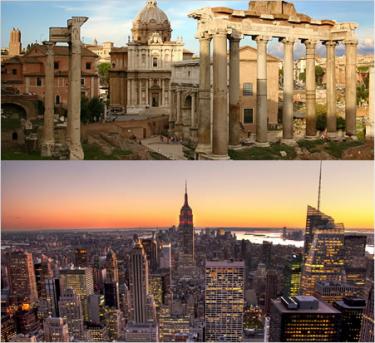
Perceptive historians recognize that great powers go through a cycle of growth, stability, maturity and decline. Where is America in this cycle? Will we learn from the lessons of history?
Source: Wikimedia
For years after the collapse of the Soviet Union in 1991, America seemingly towered over the world as a great giant—economically, culturally and militarily. But now for nearly a decade since the terrorist attacks of Sept. 11, 2001, its armed services have clashed with the forces of Islamic extremism and terrorism in Afghanistan, Iraq and elsewhere in the world.
If that weren't bad enough, the worldwide economic crisis has laid the country low with high unemployment, an immense federal government deficit, rising inflation and depressed home values. Other challenges loom ahead, flowing from the European Union's growing political and economic integration, Russia's increased strength and assertiveness, and China's rapid economic, industrial and military growth.
Will America follow the path of past empires?
Clearly America's present lone-superpower status is being increasingly challenged. Could it be lost completely? While it clings to a general preeminence right now, could America still decline and fall?Didn't that happen to other great empires in the past, such as those of Britain, Spain, Rome, Persia, Babylon and Egypt? Is America' s future more secure than theirs was?
Sir John Bagot Glubb (1897-1987), a highly honored British general and historian better known as Glubb Pasha, wrote about the collapsed empires of the past. In his 1978 book The Fate of Empires and the Search for Survival, he described a common pattern fitting the history of some fallen empires. They went through a cycle of stages as they started, expanded, matured, declined and collapsed.
Does the pattern apply to America today? Has the United States entered this cycle's ending stages? If so, shouldn't Americans critically examine the current state of their culture to see what could be done to prevent the same grim fate?
By knowing history better, we can better project our likely national futures. As the great British Prime Minister and noted historian Winston Churchill observed, "The farther backward you can look, the farther forward you are likely to see."
Seven steps in the life cycles of great powers
Glubb Pasha learned that different empires had similar cultural changes while experiencing a life cycle in a series of stages that could overlap. He generalized about empires having seven stages of development, identifying these successive ages as follows:1. The age of outburst (or pioneers).
2. The age of conquests.
3. The age of commerce.
4. The age of affluence.
5. The age of intellect.
6. The age of decadence.
7. The age of decline and collapse.
Each stage helps progression to the next as the values of the people change over time. Military, political, economic and religious developments all influence an empire's people to act and believe differently over time.
Let's look at these stages in more detail.
The rise of empires
In the first two stages or ages, the warrior's adventuresome and manly values drive an empire to gain power as it conquers land from others.Later on, during the following ages of commerce and affluence, businessmen and merchants—who normally value material success and dislike taking unnecessary risks—take over at the highest levels of society. Their societies downplay the values of the soldier.
According to Glubb, they normally do this not "from motives of conscience, but rather because of the weakening of a sense of duty in citizens, and the increase in selfishness, manifested in the desire for wealth and ease."
During these middle stages, empires stop taking more land and start building walls instead. They switch from the offensive to the defensive. Historical examples include the wall built near the Scottish border by the Roman emperor Hadrian, the Great Wall of China constructed to keep out intrusion by certain nomadic groups, and even 20th-century France's Maginot Line, placed along the German border.
Conquest and (later) business investment promoted by the empire's unity builds the wealth that leads to the age of intellect. Even the brutal Mongol Empire, by bringing most of Asia under its rule, encouraged the caravan trade along Eurasia's famed Silk Road. During this fifth stage, the empire's leaders spent lots of money to establish educational institutions resembling modern universities and high schools.
Sowing the seeds of decline
During the age of intellect, schools may produce skeptical intellectuals who oppose the values and religious beliefs of their empires' early leaders. For example, the medieval Muslim philosophers Avicenna and Averroes, by accepting much of ancient Greek philosophy, weren't orthodox in belief.Scholars also might manage schools that teach the ruling class and/or some of the average people subjects that are either mainly oriented towards financial success or are simply impractical. For example, in the early Roman Republic, students received a basic education that stressed character development and virtue. But in the later Roman Empire, teachers taught rhetoric (the art of speaking) when emotionally persuading assemblies was no longer of political or practical value.
The corrosive effects of material success encourage the upper class and the common people to discard the self-confident, self-disciplined values that helped to create the empire. Then the empire eventually collapses. Perhaps an outside power, such as the so-called barbarians in Rome's case, wipes it out. Or maybe an energetic internal force, such as the pro-capitalist reformers in the Soviet Union, finishes the job instead.
The growth of wealth and comfort clearly can undermine the values of character, such as self-sacrifice and discipline, that led to a given empire's creation. Then the empire so affected by moral decline grows weaker and more vulnerable to destruction by forces arising inside or outside of it.
Not surprisingly, God in the Bible specifically warned the ancient Israelites against departing from worshipping Him once they became materially satisfied after entering the Promised Land (Deuteronomy:8:11-20 [11] Beware that thou forget not the LORD thy God, in not keeping his commandments, and his judgments, and his statutes, which I command thee this day:
[12] Lest when thou hast eaten and art full, and hast built goodly houses, and dwelt therein;
[13] And when thy herds and thy flocks multiply, and thy silver and thy gold is multiplied, and all that thou hast is multiplied;
[14] Then thine heart be lifted up, and thou forget the LORD thy God, which brought thee forth out of the land of Egypt, from the house of bondage;
[15] Who led thee through that great and terrible wilderness, wherein were fiery serpents, and scorpions, and drought, where there was no water; who brought thee forth water out of the rock of flint;
[16] Who fed thee in the wilderness with manna, which thy fathers knew not, that he might humble thee, and that he might prove thee, to do thee good at thy latter end;
[17] And thou say in thine heart, My power and the might of mine hand hath gotten me this wealth.
[18] But thou shalt remember the LORD thy God: for it is he that giveth thee power to get wealth, that he may establish his covenant which he sware unto thy fathers, as it is this day.
[19] And it shall be, if thou do at all forget the LORD thy God, and walk after other gods, and serve them, and worship them, I testify against you this day that ye shall surely perish.
[20] As the nations which the LORD destroyeth before your face, so shall ye perish; because ye would not be obedient unto the voice of the LORD your God.; 31:20). He understood this human tendency.
A society is known by its heroes
Has the United States entered the latter phases of the empire life cycle? True, it's only been independent from Britain for somewhat over two centuries. It's a young country compared to those of Europe or Asia. But does America today have the same values or cultural developments that past empires such as Rome had before they fell?For example, who are the nation's heroes? What does a people's choice of heroes tell us about the people themselves? Today in America the people generally admired above all (and perpetually gossiped about) are celebrities such as sports stars, singers, actors and musicians.
As Glubb explains, the heroes of an empire's people change over time as their values do. Soldiers, builders, pioneers and explorers are admired in the initial stages of the empire life cycle. Then successful businessmen and entrepreneurs are esteemed during the ages of commerce and affluence.
For example, late 19th-century middle-class Americans wanted their children to learn the values of prudence, saving and foresight as found in the stories of author Horatio Alger, whose heroes lead exemplary lives striving to succeed in the face of adversity and poverty. Intellectuals are also increasingly respected during the age of intellect.
During the last stages of decadence and decline, an empire's people often think most highly of and imitate athletes, musicians and actors—despite how corrupt these celebrities' private lives are.
Remarkably, according to Glubb Pasha, in 10th-century Baghdad during the Muslim Abbasid Empire's decline, its writers complained about the singers of love songs having a bad influence on the young people! It seems the old adage is true: The more things change, the more they stay the same (or, perhaps, become the same again).
Because people grow emotionally attached to the music they love, they have a high regard for its singers and want to emulate them. Inevitably, popular music's often spiritually rotten lyrical content—such as foul language, blunt sexual references, glorifying immorality, and even Satanic allusions at times—influences fans. Furthermore, the immoral lifestyles of many musicians, often including drug abuse and promiscuous sex, also have an impact on society.
What are some key signs of decline?
What are some common features of an empire's culture in its declining period? Glubb describes developments like these:1. Rampant sexual immorality, an aversion to marriage in favor of "living together" and an increased divorce rate all combine to undermine family stability. This happened among the upper class in the late Roman Republic and early Empire. The first-century writer Seneca once complained about Roman upper-class women: "They divorce in order to re-marry. They marry in order to divorce."
The birthrate declines, and abortion and infanticide both increase as family size is deliberately limited. The historian W.H. McNeill has referred to the "biological suicide of the Roman upper classes" as one reason for Rome's decline. Homosexuality becomes publicly acceptable and spreads, as was the case among the ancient Greeks before Rome conquered them.
2. Many foreign immigrants settle in the empire's capital and major cities. The mixture of ethnic groups in close proximity in these cosmopolitan places inevitably produces conflicts.
Because of their prominent locations within the empire, their influence greatly exceeds their percentage of the population. Here diversity plainly leads to divisiveness.
We see this today in the growing conflict in European countries such as France and the Netherlands, where large numbers of immigrants are stoking violent cultural clashes. German chancellor Angela Merkel recently made headlines when she stated that attempts to create a multicultural society had "utterly failed" and immigrants must do more to integrate into society.
3. Both irresponsible pleasure-seeking and pessimism increase among the people and their leaders. The spirit described in 1 Corinthians:15:32If after the manner of men I have fought with beasts at Ephesus, what advantageth it me, if the dead rise not? let us eat and drink; for to morrow we die. spreads throughout society: "Let us eat and drink, for tomorrow we die!"
As people cynically give up looking for solutions to the problems of life and society, they drop out of the system. They then turn to mindless entertainment, to luxuries and sexual activity, and to drugs or alcohol.
The astonishingly corrupt and lavish parties of the Roman Empire's elite are a case in point. The Emperor Nero, for instance, would spend the modern equivalent of $500,000 for just the flowers at some banquets.
4. The government provides extensive welfare for the poor. In the case of the city of Rome, which had perhaps 1.2 million people around A.D. 170, government-provided "bread and circuses" (food and entertainment) helped to keep the masses content. About one half of its non-slave population was on the dole at least part of the year.
True, helping the poor shows Christian compassion (Mark:14:7For ye have the poor with you always, and whensoever ye will ye may do them good: but me ye have not always.). But such help also can lead to laziness and dependency (2 Thessalonians:3:10-12 [10] For even when we were with you, this we commanded you, that if any would not work, neither should he eat.
[11] For we hear that there are some which walk among you disorderly, working not at all, but are busybodies.
[12] Now them that are such we command and exhort by our Lord Jesus Christ, that with quietness they work, and eat their own bread.). Such problems are especially likely when the poor believe state-provided charity is a permanent right or entitlement.
Is America on a downward cultural and spiritual spiral?
Considering this list of indicators of an empire's cultural and moral decline, is it reasonable to deny that the United States has entered the stages of decadence and decline?True, the tidal wave of social and cultural decay unleashed by the 1960s in America has ebbed some in recent years. The rates of abortion, divorce, illegitimate births, drug abuse, welfare dependency and violent crime have either declined or gone up much more slowly.
Furthermore, some indicators of decline have good, not just bad, results. For instance, some immigration is helpful. As skilled, educated immigrants arrive, they normally benefit America economically while being a "brain drain" from Third World countries. And, indeed, the United States has historically embraced vast numbers of immigrants.
Nevertheless, the present flood of immigrants, legal or illegal, equals in impact the wave that arrived at America's shores around 1900. Today, they are far more apt to be a divisive force. Why? Unlike a hundred years ago, America's intellectual elite overall has adopted multiculturalism (the promotion of immigrants maintaining their prior distinct cultures) and has rejected assimilation (adopting the existing national culture) as its ideal.
Today multiculturalism is the ideology underlying a potentially ultimate political Balkanization, wherein society is fragmented along ethnic and cultural lines. (For evidence, see the liberal historian Arthur Schlesinger's 1991 book The Disuniting of America ). A lack of cultural unity inevitably leads to conflict in a free society such as in the United States.
Are we paying attention?
How should we react to the historical insights of Sir John Glubb Pasha's The Fate of Empires and the Search for Survival as they relate to America, Britain and other related English-speaking nations?As he notes in his examination of a number of previous empires, the processes of history often repeat themselves. We shouldn't believe that America will automatically avoid the fate of other great empires that declined and fell in the past.
God is ever so merciful, but His patience in the face of our national sins is wearing thin. He has given His true servants a mission to warn the nations of what is coming (Ezekiel:33:1-9 [1] Again the word of the LORD came unto me, saying,
[2] Son of man, speak to the children of thy people, and say unto them, When I bring the sword upon a land, if the people of the land take a man of their coasts, and set him for their watchman:
[3] If when he seeth the sword come upon the land, he blow the trumpet, and warn the people;
[4] Then whosoever heareth the sound of the trumpet, and taketh not warning; if the sword come, and take him away, his blood shall be upon his own head.
[5] He heard the sound of the trumpet, and took not warning; his blood shall be upon him. But he that taketh warning shall deliver his soul.
[6] But if the watchman see the sword come, and blow not the trumpet, and the people be not warned; if the sword come, and take any person from among them, he is taken away in his iniquity; but his blood will I require at the watchman's hand.
[7] So thou, O son of man, I have set thee a watchman unto the house of Israel; therefore thou shalt hear the word at my mouth, and warn them from me.
[8] When I say unto the wicked, O wicked man, thou shalt surely die; if thou dost not speak to warn the wicked from his way, that wicked man shall die in his iniquity; but his blood will I require at thine hand.
[9] Nevertheless, if thou warn the wicked of his way to turn from it; if he do not turn from his way, he shall die in his iniquity; but thou hast delivered thy soul.), and that is one of the purposes of this magazine. We want to help you see how prophecies given long ago are now shaping up before our eyes!
If modern nations repent, as the people of the ancient Assyrian capital of Nineveh did after the prophet Jonah delivered God's warning to them (as described in the book of Jonah), they can avoid the dreadful punishments prophesied to come. But even if only the few of us reading this article repent before the time of tribulation arrives, God will keep us in His care.
Many of God's faithful followers will be protected from the tribulation (Revelation:3:10Because thou hast kept the word of my patience, I also will keep thee from the hour of temptation, which shall come upon all the world, to try them that dwell upon the earth.). And, most importantly, Jesus promises eternal life to all who truly believe, turn from sin and persevere in their faithful obedience: "He who endures to the end shall be saved" (Matthew:24:13But he that shall endure unto the end, the same shall be saved.).
Since we know that the handwriting is on the wall, what will we now choose to do?


 Posts


