Showing posts with label Nuclear weapons. Show all posts

Wednesday, May 25, 2016

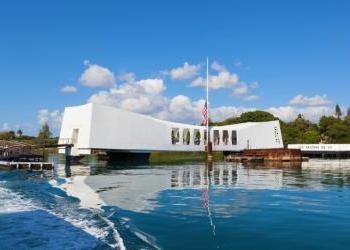
Pearl Harbor Day and the Pearl of Great Price

An interesting article from http://www.ucg.org/ about Pearl Harbor. This follows this post about moral leadership. This follows this post about Facebook and Transgendered people. For a free magazine subscription or to get the books recommended for free click HERE! or call 1-888-886- 8632.


Pearl Harbor Day, 70 years later, December 7, 2011.
December 7, 1941, was the worst day in U.S. military history as a Japanese armada of ships and planes made a devastating surprise attack on Pearl Harbor. This Hawaiian U.S. naval base was a tempting target for the imperialist Japanese since America’s entire Pacific Fleet was headquartered at Pearl. The Japanese met little resistance as their planes bombed and strafed U.S. Navy ships and Army aircraft.
The next day the President Franklin Roosevelt addressed the U.S. Congress and delivered what turned out to be the most famous American political speech of the 20 th century—the “Day of Infamy Speech.” Congress then declared war on Japan, and three days later it declared was on Nazi Germany.
The United States, by being unprepared for this attack, paid a very heavy price:
- 2,388 Americans died in the attack
- 1,178 Americans were wounded
- 21 American ships were sunk or damaged
- 323 American aircraft were destroyed or damaged
The Japanese paid a dear price but not nearly so great:
- 64 Japanese died during the attack, though the number of injuries is unknown
- 5 Japanese ships were destroyed
- 103 Japanese aircraft were destroyed or damaged
The U.S. paid the greater short-term price but Japan paid the greater long-term price. If much more time had gone by without the U.S. getting involved militarily, both the Japanese and the Nazis might have been victorious in their conquests. Quite likely, God allowed the Pearl Harbor bombing to awaken America to join the war against Japan and Germany.

Some inspiring facts

The Japanese failed to accomplish their primary objective when they bombed Pearl Harbor. They wanted to destroy the aircraft carriers, but the three carriers were all at sea away from the port at the time. Those carriers were critically important in the ensuing war against Japan. and at the same time protected the aircraft carriers. Sparing those carriers was also likely an act of Providence.
Lately several websites have posted a message which had also been sent around the world by e-mail. It supposedly is an excerpt from a book titled, “Reflections on Pearl Harbor” by Admiral Chester Nimitz. Although it sounds like it could have been authored by Admiral Nimitz, I have not been able to verify that such a book exists. However, I did verify most of the facts stated. Following is my summary of that message:
“Immediately after the Pearl Harbor attack, President Roosevelt appointed Admiral Chester Nimitz to be the Commander of the Pacific Fleet.
“When Nimitz landed at Pearl Harbor on Christmas Eve, 1941, there was such a spirit of despair, dejection and defeat—you would have thought the Japanese had already won the war. On Christmas Day, 1941, Adm. Nimitz was given a boat tour of the destruction wrought on Pearl Harbor by the Japanese.
“Afterwards, someone asked him, ‘Well Admiral, what do you think after seeing all this destruction?’ Admiral Nimitz's reply shocked everyone: ‘The Japanese made three of the biggest mistakes an attack force could ever make, or God was taking care of America.’
“Nimitz explained:
“Mistake number one: The Japanese attacked on Sunday morning. Nine out of every ten crewmen of those ships were ashore on leave. If those same ships had been lured to sea and been sunk, we would have lost 38,000 men instead of 3,800.
“Mistake number two: When the Japanese saw all those battleships lined in a row, they got so carried away sinking those battleships, they never once bombed our dry docks opposite those ships. If they had destroyed our dry docks, we would have had to tow every one of those ships to America to be repaired. As it is now, the ships are in shallow water and can be raised. One tug can pull them over to the dry docks, and we can have them repaired and at sea by the time we could have towed them to America. And I already have crews ashore anxious to man those ships.
“Mistake number three: Every drop of fuel in the Pacific theater of war is on top of the ground in storage tanks five miles away over that hill. One attack plane could have strafed those tanks and destroyed our fuel supply. That's why I say the Japanese made three of the biggest mistakes an attack force could make, or God was taking care of America.”
Whether or not Admiral Nimitz said those exact words, it’s obvious that this disaster could have been much, much worse.  God has been very merciful to the United States and to freedom-loving people in general.

The “pearl of great price”

Pearl Harbor has a nice name. It originally had a native Hawaiian name which meant “Water of Pearl.” The harbor was teeming with pearl-producing oysters until the late 1800’s.
One of the most famous and popular Bible passages is Matthew 13:45-46, in which Jesus said, “Again, the kingdom of heaven is like a merchant seeking beautiful pearls, who, when he had found one pearl of great price, went and sold all that he had and bought it.”
The naval base at Pearl Harbor has been and still is extremely valuable for the United States. It would have been extremely valuable for the Japanese had they been able to conquer and hold it.
But the combined value of that that harbor, that real estate, the military facilities, the ships and planes, and the strategic location are a tiny pittance compared to the value of life after death—life in the Kingdom of God forever and ever! Every sacrifice that we ever need to make in this life will be a small price to pay for glorious eternal life!
The “good news” is this: All those who died on December 7, 1941—and at all other times and places—will yet have their opportunity to learn God’s truth and to qualify for God’s Kingdom! With Jesus Christ reigning over all the earth, we will at last have peace on earth!
Someday all peoples will have the opportunity to attain “the pearl of great price”!

You might also be interested in...

Tuesday, April 12, 2016

Mumbai Attacks Highlight Threat from Radical Islam

An interesting article from http://www.ucg.org/ about the attack in India. This follows this post about homosexuality. For a free magazine subscription or to get the books recommended for free click HERE! or call 1-888-886- 8632.
 
From WNP Senior Writer Melvin Rhodes:

After the train bombings in the Indian city of Mumbai (formerly Bombay) on July 11th,  there was fairly extensive reporting on the terror attacks in the Lansing State Journal, the daily newspaper that serves the state capital of Michigan.   The chief suspects, according to the Associated Press article, were “Kashmiri separatists”.

Not once were the words “Moslem” or “Islamic” mentioned, in keeping with the tenets of political correctness which still maintain that all religions are equally valid and that Islam is really a religion of peace!  However, Kashmiri separatists are all Moslems, fighting to break away from predominantly Hindu India and unite with the Islamic nation of Pakistan.  At the same time, it should be noted that a number of trains were blown up in Mumbai, all within eleven minutes.  Simultaneous attacks are a trademark of al-Qaeda.  These attacks on the rapid transit system in India's financial capital are very similar to previous attacks in Madrid in 2004 and in London in 2005.

Following the 7/11 attacks, security was heightened in New York, America's financial capital.  It appears increasingly as if al-Qaeda is targeting financial centers in an attempt to bring down the western financial system.  Mumbai, the financial center at the heart of one of the world's fastest growing economies, was the most likely target in India for this reason.  The bombings all took place in the rush hour, again copying those in Madrid and London.  The bombings will likely turn out to be the responsibility of a local al-Qaeda affiliate, as Muslim militants around the world increasingly work together to achieve the common goal of Islamic domination.

The bombings in Mumbai were just one incident that hit the headlines for one day in what is increasingly being called “The Long War”, a conflict seemingly without end.

Increasingly, it appears that the radical followers of Islam are winning against a western world that is more and more divided, both between the various governments and also within the individual countries themselves.

It should be clear to all that the threat from radical Islam is growing.  It should also be noted that the focus of worldwide terrorism does seem to be on financial targets like London, New York and Mumbai, in a clear attempt to destroy confidence, upon which the western economic system is built.

(The remainder of this article will appear in the August WNP)

You might also be interested in...

Wednesday, July 15, 2015

Russia Nervously Eyes the U.S.-Iran Deal

A very interesting post from www.stratfor.com about Russia, the U.S. and Iran. This follows this post about the Islamic State in the U.K. This follows this article about American energy independence and preventing money from going to hostile countries. For more, you can read two very interesting books HERE.
Please follow me here.


Russia Nervously Eyes the U.S.-Iran Deal
By Reva Bhalla
When a group of weary diplomats announced a framework for an Iranian nuclear accord last week in Lausanne, there was one diplomat in the mix whose feigned enthusiasm was hard to miss. Russian Foreign Minister Sergei Lavrov left the talks at their most critical point March 30, much to the annoyance of U.S. Secretary of State John Kerry, who apparently had to call him personally to persuade him to return. Even as Lavrov spoke positively to journalists about the negotiations throughout the week, he still seemed to have better things to do than pull all-nighters for a deal that effectively gives the United States one less problem to worry about in the Middle East and a greater capacity to focus on the Russian periphery.
Russia has no interest in seeing a nuclear-armed Iran in the neighborhood, but the mere threat of an unshackled Iranian nuclear program and a hostile relationship between Washington and Tehran provided just the level of distraction Moscow needed to keep the United States from committing serious attention to Russia's former Soviet sphere.
Russia tried its best to keep the Americans and Iranians apart. Offers to sell Iran advanced air defense systems were designed to poke holes in U.S. threats to bomb Iranian nuclear facilities. Teams of Russian nuclear experts whetted Iran's appetite for civilian nuclear power with offers to build additional power reactors. Russian banks did their part to help Iran circumvent financial sanctions. The Russian plan all along was not to help Iran get the bomb but to use its leverage with a thorny player in the Middle East to get the United States into a negotiation on issues vital to Russia's national security interests. So if Washington wanted to resolve its Iran problem, it would have to pull back on issues like ballistic missile defense in Central Europe, which Moscow saw early on as the first of several U.S. steps to encircle Russia.

Delegates to the Iranian talks in Lausanne from China, France, Germany, the European Union, Iran, Russia, the United Kingdom and the United States speak to the media on April 2. (THOMAS TRUTSCHEL/Contributor via Getty Images)
Things obviously did not work according to the Russian plan. As we anticipated, the United States and Iran ultimately came together in a bilateral negotiation to resolve their main differences. Now the United States and Iran are on a path toward normalization at a time when Russian President Vladimir Putin is trying simultaneously to defend against a U.S.-led military alliance building along Russia's European frontier and to manage an economic crisis and power struggle at home. And the situation does not look any better for Russia on the energy front.

Russia Stands to Lose Energy Revenue

The likelihood of the United States and Iran reaching a deal this summer means that additional barrels of Iranian oil eventually will make their way to the market, further depressing the price of oil, as well as the Russian ruble. To be clear, Iranian oil is not going to flood the market instantaneously with the signing of a deal. Iran is believed to have as much as 35 million barrels of crude in storage that it could offload quickly once export sanctions are terminated by the Europeans and eased by the United States via presidential waiver. But Iran will face complications in trying to bring its mature fields back online. Enhanced recovery techniques to revive mothballed fields take money and infrastructure, which is difficult to apply when oil prices are hovering around $50 per barrel. Under current conditions, Iran can bring some 400,000-500,000 barrels per day back online over the course of a year, but this will be a gradual process as Iran vies for foreign investment in its dilapidated energy sector.
U.S. investors will likely remain shackled by the core Iran Sanctions Act until at least the end of 2016, when the legislation is set to expire. However, European and Asian investors will be among the first to begin repairing Iran's oil fields, as long as Iran does its part in improving contractual terms and the economics make sense for firms already cutting back their capital expenditures.

Europe's New Options

The rehabilitation of Iran's energy sector, however gradual a process that may be, will complicate Russia's uphill battle in trying to maintain its energy leverage over Europe. Russia is a critical supplier of energy to Europe, currently providing about 29 percent and 37 percent of Europe's natural gas and oil needs, respectively. An additional 50 billion cubic meters of natural gas available for export from the United States within the next five years will not be able to compete with Russia on price because of the low operational and transport costs of Russian natural gas. Even so, the United States will still be creating more supply in the natural gas market overall to give Europe the option of paying more for its energy security should the political considerations outweigh the economic cost. The Baltic states are already working toward this option, with Lithuania taking the lead in creating a mini-liquefied natural gas hub for the region to try to reduce, if not eliminate, Baltic dependence on Russia. This year, Poland is debuting its own LNG facility, and the Sabine Pass terminal in Louisiana is scheduled to bring the first LNG exports from the Lower 48 to market, with shipments already contracted for Asia.
In Southern Europe, the picture for Russia is more complicated but still distressing. Aside from the significant issue of cost for energy companies already cutting their capital expenditures, Turkey's veto on the transit of LNG tankers through the Bosporus effectively neutralizes any LNG import facility project on the Black Sea. But Europe is proceeding apace with the much more economically palatable option of building pipeline interconnectors across Southeastern Europe. This does little to dilute Russia's control over energy supply, but it does strip Moscow of its ability to politicize pricing in Europe. Pipeline politics in Europe have allowed Russia to reward — and punish — its Eastern European neighbors through pricing contracts. However, Brussels is more thoroughly examining contracts signed by EU member states for this very reason and in line with one of the main tenets of the EU's Third Energy Package, which seeks to break monopolies by splitting energy production and transmission and to implement fair pricing. Meanwhile, the construction of interconnectors allows member states to influence pricing downstream from Russia.
This gambit has been on display over the past year in Ukraine. Kiev depended heavily on its neighbors in Slovakia, Poland and Hungary for reverse flows of Russian natural gas at discounted rates to stand up to Russia's energy swaggering. Though Russian natural gas will still be flowing primarily through these pipelines, the expansion of interconnectors will open up options for non-Russian natural gas from the North Sea and from LNG terminals in Northern Europe to make their way southward to embattled frontline states such as Ukraine.

Russia thought it would be able to keep a hook in Southern Europe through the construction of South Stream, a mammoth pipeline project with a $30 billion price tag and 63-bcm capacity that sought to cut Ukraine out of the equation by moving natural gas across the Black Sea and through the Balkans and Central Europe. The combination of plunging energy prices and growing EU resistance to another pipeline that would allow Russia to draw political favors sent this project to the graveyard, but Russia had a backup plan. The Turkish Stream pipeline would make landfall in Turkey after crossing the Black Sea, before using the Trans-Adriatic Pipeline and the Trans-Anatolian Pipeline to feed Southern Europe through the web of interconnectors and pipelines already in development. On the surface, Moscow's plan appears quite brilliant: Use the very infrastructure that Europe was already counting on to diversify away from Russia and then, when the political skirmishing over Ukraine eventually settles down, reinsert itself into Europe's energy mix via a willing partner like Turkey.
But the plan remains full of holes. Someone needs to pay for the main pipeline expansion between Russia and Turkey, and both countries will struggle to find private investors in this geopolitical and pricing climate. Moreover, there is no indication that the Europeans will be willing to take additional Russian natural gas from a yet-to-be-built Turkish Stream when a perfectly good pipeline running from Russia to Eastern Europe already exists. Russia does not have the option of refusing natural gas shipments when it is already desperate for those energy revenues. In the end, this is a Russian bluff that the Europeans will not be afraid to call. When Putin agreed to a three-month natural gas deal with Ukraine last week (with a huge discount to boot, at $247.20 per thousand cubic meters), he likely did so realizing that Russia playing hardball with Ukraine on energy would only spur further investment and construction into pipelines and connectors in Southeastern Europe that would accelerate the decline of Russia's energy influence in Europe. The best he can hope for is to slow that timeline down.
Not only will Russia's pricing leverage wane in Europe over the long term, but its influence on Europe's energy supply also will decrease over the longer run. Azerbaijan was the first southern corridor supplier to Europe circumventing Russia and is now expanding that role by bringing natural gas from its Shah Deniz II offshore fields online for export. Turkmenistan is still vulnerable to Russian meddling but has been increasingly willing to host Turkish and European investors looking to build a pipeline across the Caspian to feed Europe. Whether these talks translate into action will depend on the Turkmen government's political will to stand up to Moscow, not to mention legal battles over the Caspian Sea. But while the lengthy courting of Ashgabat by the West continues, a rehabilitated Iran is now the latest addition to the list to join the southern corridor.

Russia's Influence Wanes in the Middle East

Just a day after the Iranian nuclear framework deal was announced, Russia's state-owned RIA Novosti published a story quoting Igor Korotchenko, the head of the Moscow-based Center for Analysis of World Arms Trade, as saying it would be a "perfectly logical development" for Russia to follow through on a sale of S-300 surface-to-air missiles to Iran if the embargo is lifted. Korotchenko noted that specifications to the deal would have to be made as "the United States is watching very closely" to whom Russia sells these weapons. Russian Deputy Foreign Minister Sergei Ryabkov also made a point to say the U.N. arms embargo against Iran should be lifted as part of the nuclear deal. These well-timed statements likely caught Washington's eye but probably did little to impress. The S-300 threat mattered a lot more when the United States needed to maintain a credible military deterrent against Iran. If the United States and Iran reach an understanding that neutralizes that threat through political means, Russian talk of S-300s is mostly hot air.
This was a small yet revealing illustration of Russia's declining position in the Middle East. For many years, the Middle East was a rose garden for the Russians, filled with both sweet-smelling opportunities to lure Washington into negotiations and ample thorns to prick their American adversary when the need arose. Russia's support for the Syrian government is still relevant, and Moscow will continue to court countries in the region with arms deals out of both political and economic necessity. Even so, bringing down the Syrian government is not on Washington's to-do list, and countries like Egypt will still end up prioritizing their relationship with the United States in the end.
Russia's influence in the Middle East is fading rapidly at the same time Europe is starting to wriggle out of Russia's energy grip. And as Russia's options are narrowing, U.S. options are multiplying in both the Middle East and Europe. This is an uncomfortable situation for Putin, to be sure. But a narrow set of options for Russia in its near abroad does not make those options any less concerning for the United States as the standoff between Washington and Moscow continues.
Share

Wednesday, April 8, 2015

2015 - A Year of Triumph or Trial for America?

An interesting article from http://www.ucg.org/ about the U.S. and the Middle East. This follows this post about about religious libery. This follows this post about Iran. For a free magazine subscription or to get the books recommended for free click HERE! or call 1-888-886- 8632.
I am leaving TWITTER SOON. Please continue to follow me here.


2015 - A Year of Triumph or Trial for America?


After years of bad economic news, some think things are looking up for the United States. But are they? What troubling signs are on the horizon?

A man holding an American flag flapping in the wind.
Has America passed, or is it about to pass, that point of no return?

Source: Chandler Erisman/Snapwiresnaps
Millions of Americans have seen reasons to believe that 2015 is on track to being better than recent years. Economic forecasts are up. Crime is down. Lower oil prices translate into hundreds of dollars more per year in consumers’ pockets.
Yet while this is all good, should we also be paying attention to troubling signs on the horizon?
To be sure, some signs do indeed look promising. After the economic crisis of 2008-2009 and several years of sluggish recovery, U.S. economists are nearly unanimous in the estimates of robust economic growth in 2015, with most expecting 3 percent or greater.
This would translate into more good news for the job market. The unemployment rate is expected to continue to decline, with tens of thousands of new jobs created each month. And the gradual tightening of the labor force should give U.S. workers more leverage in wage negotiations, finally driving up wages that have been stagnant for years.
A solid growth rate should also translate into stock and bond market gains, as an improving economy translates into higher earnings for companies. A growing economy would prompt the Federal Reserve to raise interest rates, which would help bond investors.
As mentioned, the nation can take some satisfaction in an improved crime situation. Federal Bureau of Investigation figures show a striking but positive trend: The rate of violent crime has dropped by nearly half since 1993. FBI data shows a decline in violent crime from a rate of 747 incidents per 100,000 in 1993 to 387 incidents per 100,000 in 2012, the most recent year for which complete data has been published.
Nearly every type of violent crime declined over the past 20 years, with homicides down 51 percent, forcible rape down 35 percent and robberies down 56 percent. Property crimes, such as burglary and vandalism, also dropped sharply.
Some U.S. cities are the safest they’ve been in decades. New York City of the 1970s was considered one of the most crime-infested cities in the nation. Since that time, however, the city’s crime rate has plummeted to where it is now considered safer than Dallas or Houston (Justin Wolfers, “Perceptions Haven’t Caught Up to Decline in Crime,” The New York Times , Sept. 16, 2014).
The good news is something to rejoice about. But before we start celebrating too loudly, we should ask ourselves: Are we seeing the complete picture? Or could we be closing our eyes to dangers we’d rather not think about?

Not-so-rosy economic figures

While some economic figures are encouraging, a number of others are highly sobering. For example, a Jan. 13, 2015, report by Jim Clifton, CEO of Gallup, Inc., noted at the Gallup website that over the last six years, 70,000 more businesses have shut their doors than have opened.
He went on to explain: “When new businesses aren’t being born, the free enterprise system and jobs decline . . . Without a growing entrepreneurial economy, there are no new good jobs. That means declining revenues and smaller salaries to tax, followed by declining aid for the elderly and poor and declining funding for the military, for education, for infrastructure—declining revenues for everything.”
Going hand-in-hand with this, a New York Times article last year reported that over the previous decade, “the inflation-adjusted net worth for the typical household” had declined 36 percent (Anna Bernasek, “The Typical Household, Now Worth a Third Less,” July 26, 2014).
A Jan. 16, 2015, Washington Post article noted the following shocking fact: “For the first time in at least 50 years, a majority of U.S. public school students come from low-income families . . . a statistic that has profound implications for the nation”(Lyndsey Layton, “Majority of U.S. Public School Students Are in Poverty”).
Further, a CNSnews.com headline on Dec. 10, 2014, stated, “65 Percent of Children Live in Households on Federal Aid Programs.” The total number, according to U.S. Census Bureau figures, was more than 40 million.
Especially troubling is the skyrocketing U.S. government debt. According to the U.S. Treasury website, as of Jan. 1, 2005, total federal debt was just under $7.6 trillion. A decade later, at the beginning of 2015, debt stood at more than $18 trillion —a staggering increase of almost 140 percent, and more debt than the nation had accumulated in its entire previous history of almost 230 years!
Sadly, such figures are the tip of the iceberg in terms of the nation’s true financial picture. Making matters worse, on Feb. 2 President Obama presented a proposed 2016 fiscal year budget that would add another $1.44 trillion in taxes and another $6 trillion in debt over the next decade.

An island in a sea of turmoil

In spite of its financial problems, America could be likened to an island of relative peace and tranquility in a seething cauldron of worldwide unrest, where violence and hatred seem to be escalating everywhere.
The new year was barely one week old when two French-born Islamic terrorists of Algerian descent, brothers Cherif and Said Quache, stormed into the Paris offices of the French satirical magazine Charlie Hebdo on Jan. 7. Using automatic weapons with military precision, they gunned down 10 journalists and cartoonists, plus two policemen.
As they murdered a wounded Muslim policeman they shouted, “The prophet has been avenged!” Apparently they thought it was their Muslim duty to avenge any insult to the founder of Islam.
The murders had a chilling effect on press freedom, long a core belief of Western democracies. Major news organizations immediately began rethinking their editorial policies. At CNN, senior editorial director Richard Griffiths told staffers worldwide that Charlie Hebdo cartoons were not being shown on any CNN platforms, encouraging them instead to “verbally describe the cartoons in detail” (quoted at Politico, Jan. 7, 2015).
The Islamist terror organization al-Qaeda’s affiliate group in Yemen took responsibility for the Paris killings, which the French now refer to as their 9/11. Al-Qaeda has shown its ability to strike the major Western democracies, with nearly 3,000 killed in the 9/11 attacks on America in 2001 and 52 in England with the 2005 London subway bombings.
The sensational news of the attacks in France overshadowed other terrorist incidents that day—suicide bombings in Iraq that killed 23 people and a car bomb in Yemen that killed 38 and injured more than 60 others. These followed attacks in which an estimated 2,000 people were slaughtered by the Islamist group Boko Haram in northern Nigeria Jan. 3.
Very few realize that the Bible sitting on their bookshelf has something to say about these events. Speaking through Moses, God foretold events that would befall ancient Israel—and its modern-day descendants, particularly the major English-speaking peoples—for national rejection of His law:
“But if you will not listen to Me, and will not do all these commandments, and if you shall despise My statutes, or if your soul hates My judgments . . . I will even appoint terror over you, consumption, and burning fever, consuming the eyes and causing sorrow of heart . . . And I will set My face against you, and you shall be slain before your enemies”(Leviticus:26:14-17, Modern King James Version, emphasis added throughout).
Could it be that we’re seeing these ominous punishments begin to be played out in America today? What do such growing trends portend for the nation’s future?

Failing schools reduce national competitiveness

For the past few decades, America’s failing educational institutions have been an embarrassment to the nation and a blot on its national pride.
A recent Washington Times article described American public schools as “in a free fall,”with U.S. schools now ranking 29th in the world. This from the nation that earlier put man on the moon and has for decades led the world in finding cures for killer diseases.
Slovakia, Russia and Vietnam have joined the ranks of China, India, Singapore, Taiwan and South Korea in the list of nations surpassing U.S. schools in the quality of education and the caliber of its graduates.
And now comes evidence that many American college graduates lack the skills to compete even in an average U.S. work environment. In mid-January, The Wall Street Journal reported that as many as four in ten U.S. graduates lack the reasoning skills to manage white-collar work.
The Collegiate Learning Assessment Plus exam, given to 32,000 college seniors at 169 U.S. colleges and universities, measures reasoning ability needed in typical U.S. managerial environments. It noted that many students start college at a deficit in reasoning, making it that much harder to catch up by the time they graduate.
“‘Even if there is notable growth over four years, many students are starting at such a low point that they may still not be proficient at the point of graduation,’ said Jessalyn James, a program manager at the Council for Aid to Education, which administered the test” (Douglas Belkin , “Test Finds College Graduates Lack Skills for White-Collar Jobs,” The Wall Street Journal , Jan. 16, 2015).
The implications for an America competing in a global economy could be disastrous. As nations such as China and India graduate more trained engineers, scientists, business managers and computer experts, American competitiveness will suffer.

Alarming increase in mental illness

Not well publicized is the dramatic rise of mental illness in America today. No less an authority than Marcia Angell, former editor of The New England Journal of Medicine, had this to say in a June 23, 2011, New York Review of Books piece titled “The Epidemic of Mental Illness: Why?”:
“The tally of those who are so disabled by mental disorders that they qualify for Supplemental Security Income (SSI) or Social Security Disability Insurance (SSDI) increased nearly two and a half times between 1987 and 2007 —from 1 in 184 Americans to 1 in 76. For children, the rise is even more startling— a thirty-five-fold increase in the same two decades.”
Today, young people by the millions are experiencing the onset of clinical depression, among the most debilitating of mental illnesses resulting in thousands of suicides annually. Speaking to the National Press Club in 1998, Martin Seligman, then-president of the American Psychological Association, reported that the average age for the onset of depression had decreased from 29 to 15.
Antidepressant use in the United States has increased nearly 400 percent in the last two decades, according to the U.S. Centers for Disease Control and Prevention (CDC), making antidepressants the most frequently used class of medications by Americans ages 18-44. By 2008, 23 percent of women ages 40-59 were taking antidepressants, the CDC reported.
It seems every other person in the country is on some type of antidepressant these days. What does it portend for America’s future with depression and other mental illnesses on the rise?
And how much of this may be attributed to a sobering prophecy that applies to our time today found in Deuteronomy:28:28? Speaking to the ancient Israelites—and their modern-day descendants—about the consequences of disobedience to His law, God tells them, “The Lord will strike you with blindness and madness and confusion of heart.”

Rising racial tensions creating a divided nation

The election of Barack Obama as the first African-American president brought hope to millions that race relations in America would enter the final stage of healing, marking the start of a new era in the nation.
That optimism soon vanished. Annual Wall Street Journal/ NBC News polls show that positive views of race relations peaked among African Americans at 66 percent in 2010, one year after Obama took office. Then opinions took a steady downturn so that by July 2013 only 38 percent thought race relations were good—worse than the 40 percent in 2007 before Obama.
Perceptions of race relations dropped even lower with the highly publicized 2014 killings of two black men by white police officers, one in Ferguson, Missouri, and the other in New York City, along with grand juries in both cases deciding not to indict the officers. In another Wall Street Journal/ NBC poll in mid-December 2014, only 35 percent of African-American respondents rated race relations as good, while 63 percent rated them as bad.
The change in perceptions among white Americans was even more dramatic, having risen from 59 percent seeing race relations as good in 2007 to a peak of 79 percent considering them so in late 2009 and then plunging to only 40 percent now feeling this way, as of December 2014 (Reid Epstein, “Poll: Views of Race Relations Worse Than Before Obama Took Office,” Washington Wire, blogs.wsj.com, Dec. 17, 2014)
It would seem that America’s long-running racial divisions have not improved nearly as much as we would have expected since the early 1960s civil rights struggles. This does not bode well for the future of the country. As Jesus Christ Himself stated, “Every kingdom divided against itself will be ruined, and every city or household divided against itself will not stand” (Matthew:12:25, New International Version).
Certainly, the U.S. is not the only nation with significant gulfs between racial groups. But we could ask ourselves to what extent will smoldering racial tensions lead to the weakening of the world’s leading democracy?

How much longer?

Some will point out that America has faced crises before. One can’t forget the grim situation the nation faced in the 1930s, when worldwide economic depression crippled the U.S. economy with 25 percent unemployment in 1933. The nation came through a decade later when, roused from isolationist slumber by the Japanese attack on Pearl Harbor, it mobilized its human and material resources to defeat the Axis powers.
But other observers also correctly point out the differences in the character of the American people then compared to today. With the nation’s flagrant disregard for morality and God’s righteous law, does America have what it takes to pull through today’s challenges?
Moses’ warning to ancient Israel is especially relevant to 21st-century America. Read it in Deuteronomy 28, where God promised blessings for obedience and curses for violating His laws. God dealt patiently with ancient Israel, and He will deal patiently with us today—but only to a point. Has America passed, or is it about to pass, that point of no return?
Individually, none of us can change the course of a nation bent on increasingly turning away from God. But each of us can personally heed God’s command given through the prophet Isaiah: “Seek the Lord while He may be found, call upon Him while He is near. Let the wicked forsake his way, and the unrighteous man his thoughts; let him return to the Lord, and He will have mercy on him; and to our God, for He will abundantly pardon” (Isaiah:55:6-7).
May we have the wisdom to turn from our human ways that lead to suffering and death (Proverbs:14:12; Proverbs:16:25) and choose, as we’re told to in Deuteronomy:30:19, the way that leads to blessings and life!

Wednesday, April 1, 2015

The Middle Eastern Balance of Power Matures

A very interesting post from www.stratfor.com about the Sunni and Shi'ite war in the Middle East. This follows this post about Saudi Arabia's problems this year. This follows this article about American energy independence and preventing money from going to hostile countries. For more, you can read two very interesting books HERE.
I am leaving TWITTER SOON. Please continue to follow me here.

The Middle Eastern Balance of Power Matures
By George Friedman
Last week, a coalition of predominantly Sunni Arab countries, primarily from the Arabian Peninsula and organized by Saudi Arabia, launched airstrikes in Yemen that have continued into this week. The airstrikes target Yemeni al-Houthis, a Shiite sect supported by Iran, and their Sunni partners, which include the majority of military forces loyal to former President Ali Abdullah Saleh. What made the strikes particularly interesting was what was lacking: U.S. aircraft. Although the United States provided intelligence and other support, it was a coalition of Arab states that launched the extended air campaign against the al-Houthis.
Three things make this important. First, it shows the United States' new regional strategy in operation. Washington is moving away from the strategy it has followed since the early 2000s — of being the prime military force in regional conflicts — and is shifting the primary burden of fighting to regional powers while playing a secondary role. Second, after years of buying advanced weaponry, the Saudis and the Gulf Cooperation Council countries are capable of carrying out a fairly sophisticated campaign, at least in Yemen. The campaign began by suppressing enemy air defenses — the al-Houthis had acquired surface-to-air missiles from the Yemeni military — and moved on to attacking al-Houthi command-and-control systems. This means that while the regional powers have long been happy to shift the burden of combat to the United States, they are also able to assume the burden if the United States refuses to engage.
Most important, the attacks on the al-Houthis shine the spotlight on a growing situation in the region: a war between the Sunnis and Shiites. In Iraq and Syria, a full-scale war is underway. A battle rages in Tikrit with the Sunni Islamic State and its allies on one side, and a complex combination of the Shiite-dominated Iraqi army, Shiite militias, Sunni Arab tribal groups and Sunni Kurdish forces on the other. In Syria, the battle is between the secular government of President Bashar al Assad — nevertheless dominated by Alawites, a Shiite sect — and Sunni groups. However, Sunnis, Druze and Christians have sided with the regime as well. It is not reasonable to refer to the Syrian opposition as a coalition because there is significant internal hostility. Indeed, there is tension not only between the Shiites and Sunnis, but also within the Shiite and Sunni groups. In Yemen, a local power struggle among warring factions has been branded and elevated into a sectarian conflict for the benefit of the regional players. It is much more complex than simply a Shiite-Sunni war. At the same time, it cannot be understood without the Sunni-Shiite component.

Iran's Strategy and the Saudis' Response

One reason this is so important is that it represents a move by Iran to gain a major sphere of influence in the Arab world. This is not a new strategy. Iran has sought greater influence on the Arabian Peninsula since the rule of the Shah. More recently, it has struggled to create a sphere of influence stretching from Iran to the Mediterranean Sea. The survival of the al Assad government in Syria and the success of a pro-Iranian government in Iraq would create that Iranian sphere of influence, given the strength of Hezbollah in Lebanon and the ability of al Assad's Syria to project its power.
For a while, it appeared that this strategy had been blocked by the near collapse of the al Assad government in 2012 and the creation of an Iraqi government that appeared to be relatively successful and was far from being an Iranian puppet. These developments, coupled with Western sanctions, placed Iran on the defensive, and the idea of an Iranian sphere of influence appeared to have become merely a dream.
However, paradoxically, the rise of the Islamic State has reinvigorated Iranian power in two ways. First, while the propaganda of the Islamic State is horrific and designed to make the group look not only terrifying, but also enormously powerful, the truth is that, although it is not weak, the Islamic State represents merely a fraction of Iraq's Sunni community, and the Sunnis are a minority in Iraq. At the same time, the propaganda has mobilized the Shiite community to resist the Islamic State, allowed Iranian advisers to effectively manage the Shiite militias in Iraq and (to some extent) the Iraqi army, and forced the United States to use its airpower in tandem with Iranian-led ground forces. Given the American strategy of blocking the Islamic State — even if doing so requires cooperation with Iran — while not putting forces on the ground, this means that as the Islamic State's underlying weakness becomes more of a factor, the default winner in Iraq will be Iran.
A somewhat similar situation exists in Syria, though with a different demographic. Iran and Russia have historically supported the al Assad government. The Iranians have been the more important supporters, particularly because they committed their ally, Hezbollah, to the battle. What once appeared to be a lost cause is now far from it. The United States was extremely hostile toward al Assad, but given the current alternatives in Syria, Washington has become at least neutral toward the Syrian government. Al Assad would undoubtedly like to have U.S. neutrality translate into a direct dialogue with Washington. Regardless of the outcome, Iran has the means to maintain its influence in Syria.
When you look at a map and think of the situation in Yemen, you get a sense of why the Saudis and Gulf Cooperation Council countries had to do something. Given what is happening along the northern border of the Arabian Peninsula, the Saudis have to calculate the possibility of an al-Houthi victory establishing a pro-Iranian, Shiite state to its south as well. The Saudis and the Gulf countries would be facing the possibility of a Shiite or Iranian encirclement. These are not the same thing, but they are linked in complex ways. Working in the Saudis' favor is the fact that the al-Houthis are not Shiite proxies like Hezbollah, and Saudi money combined with military operations designed to cut off Iranian supply lines to the al-Houthis could mitigate the threat overall. Either way, the Saudis had to act.
During the Arab Spring, one of the nearly successful attempts to topple a government occurred in Bahrain. The uprising failed primarily because Saudi Arabia intervened and imposed its will on the country. The Saudis showed themselves to be extremely sensitive to the rise of Shiite regimes with close relations with the Iranians on the Arabian Peninsula. The result was unilateral intervention and suppression. Whatever the moral issues, it is clear that the Saudis are frightened by rising Iranian and Shiite power and are willing to use their strength. That is what they have done in Yemen.
In a way, the issue is simple for the Saudis. They represent the center of gravity of the religious Sunni world. As such, they and their allies have embarked on a strategy that is strategically defensive and tactically offensive. Their goal is to block Iranian and Shiite influence, and the means they are implementing is coalition warfare that uses air power to support local forces on the ground. Unless there is a full invasion of Yemen, the Saudis are following the American strategy of the 2000s on a smaller scale.

The U.S. Stance

The American strategy is more complex. As I've written before, the United States has undertaken a strategy focused on maintaining the balance of power. This kind of approach is always messy because the goal is not to support any particular power, but to maintain a balance between multiple powers. Therefore, the United States is providing intelligence and mission planning for the Saudi coalition against the al-Houthis and their Iranian allies. In Iraq, the United States is providing support to Shiites — and by extension, their allies — by bombing Islamic State installations. In Syria, U.S. strategy is so complex that it defies clear explanation. That is the nature of refusing large-scale intervention but being committed to a balance of power. The United States can oppose Iran in one theater and support it in another. The more simplistic models of the Cold War are not relevant here.
All of this is happening at the same time that nuclear negotiations appear to be coming to some sort of closure. The United States is not really concerned about Iran's nuclear weapons. As I have said many times, we have heard since the mid-2000s that Iran was a year or two away from nuclear weapons. Each year, the fateful date was pushed back. Building deliverable nuclear weapons is difficult, and the Iranians have not even carried out a nuclear test, an essential step before a deliverable weapon is created. What was a major issue a few years ago is now part of a constellation of issues where U.S.-Iranian relations interact, support and contradict. Deal or no deal, the United States will bomb the Islamic State, which will help Iran, and support the Saudis in Yemen, which will not.
The real issue now is what it was a few years ago: Iran appears to be building a sphere of influence to the Mediterranean Sea, but this time, that sphere of influence potentially includes Yemen. That, in turn, creates a threat to the Arabian Peninsula from two directions. The Iranians are trying to place a vise around it. The Saudis must react, but the question is whether airstrikes are capable of stopping the al-Houthis. They are a relatively low-cost way to wage war, but they fail frequently. The first question is what the Saudis will do then. The second question is what the Americans will do. The current doctrine requires a balance between Iran and Saudi Arabia, with the United States tilting back and forth. Under this doctrine — and in this military reality — the United States cannot afford full-scale engagement on the ground in Iraq.

Turkey's Role

Relatively silent but absolutely vital to this tale is Turkey. It has the largest economy in the region and has the largest army, although just how good its army is can be debated. Turkey is watching chaos along its southern border, rising tension in the Caucasus, and conflict across the Black Sea. Of all these, Syria and Iraq and the potential rise of Iranian power is the most disturbing. Turkey has said little about Iran of late, but last week Ankara suddenly criticized Tehran and accused Iran of trying to dominate the region. Turkey frequently says things without doing anything, but the development is still noteworthy.
It should be remembered that Turkish President Recep Tayyip Erdogan has hoped to see Turkey as a regional leader and the leader of the Sunni world. With the Saudis taking an active role and the Turks doing little in Syria or Iraq, the moment is passing Turkey by. Such moments come and go, so history is not changed. But Turkey is still the major Sunni power and the third leg of the regional balance involving Saudi Arabia and Iran.
The evolution of Turkey would be the critical step in the emergence of a regional balance of power, in which local powers, not the United Kingdom or the United States, determine the outcome. The American role, like the British role before it, would not be directly waging war in the region but providing aid designed to stabilize the balance of power. That can be seen in Yemen or Iraq. It is extremely complex and not suited for simplistic or ideological analysis. But it is here, it is unfolding and it will represent the next generation of Middle Eastern dynamics. And if the Iranians put aside their theoretical nuclear weapons and focus on this, that will draw in the Turks and round out the balance of power.