Please follow me here for continued posts.
Are the Blood Moons indicating the end of the world?

Are the Blood Moons indicating the end of the world?
The short answer appears to be “No.” While there are many signs that we are in the last days, this does not appear to be one of them.
Several evangelical ministries teach that four upcoming lunar eclipses in 2014-2015 that coincide with biblical festivals—along with two solar eclipses—could signify that important prophetic events are imminent. The idea emerged from thinking that the prophecy in Joel 2:31 Joel 2:31The sun shall be turned into darkness, and the moon into blood, before the great and terrible day of the LORD come.
American King James Version×of the sun being darkened and the moon turning to blood before the end-time Day of the Lord perhaps denoted solar and lunar eclipses.
A lunar eclipse occurs only at the time of the full moon, when the moon's orbit places it on the opposite side of the earth from the sun. Usually the moon at this time is above or a below direct alignment with the earth and sun, but sometimes it is in alignment so that the earth's shadow is cast over the moon, either completely in a total lunar eclipse or only partially. A solar eclipse occurs only at the invisible new moon, when the moon is between the earth and the sun, at times of direct alignment.
In a lunar eclipse, light from the sun passing around the earth is filtered through the earth's atmosphere as it travels toward the moon. Many colors of the light spectrum are more readily filtered out than red. The term “blood moon” comes from the copper- or reddish-colored appearance of the moon during some lunar eclipses. But depending on atmospheric conditions, the eclipsed moon can have a range of colors, so there is no way to really know if any of the upcoming eclipses will be blood moons.
Lunar eclipses are actually rather common. There were 229 in the 20th century—81 of them total eclipses (as recorded at NASA's eclipse site, eclipse.gsfc.nasa.gov ). So in trying to find some significance among them, attention was turned to a relatively rarer occurrence—a lunar tetrad, a series of four total lunar eclipses spanning two years, with six lunar months from one eclipse to the next. And it was noted that, even more rarely, the eclipses in such tetrads at times correspond to the spring feast of Passover and the autumn feast of Tabernacles.
Yet this is perhaps not so remarkable as it sounds. Biblical months begin at the new moon, when solar eclipses can occur. And the festivals of Passover and Tabernacles always occur at the time of the full moon, when lunar eclipses can occur. Indeed, many lunar eclipses fall at the time of Passover and Tabernacles every century. And these feasts are exactly six lunar months apart, just as needed for tetrads to fall (of course, tetrads of eclipses can fall across any months that are six months apart).
In the 20th century there were five lunar tetrads—two coinciding with the biblical feasts. However, some centuries have more or less or even none. Between the years A.D. 1 and 2000, there were 54 tetrads, of which seven corresponded to the feasts. While that might sound extremely rare, 7 out of 54 is about 13 percent—close to what random average would yield.
The seven tetrad periods corresponding to the feasts from years 1 to 2000 were A.D. 162-163, 795-796, 842-843, 860-861, 1493-1494, 1949-1950, 1967-1968. Some have seen a tie-in here to major events in the history of the Jewish people. They note that in 1492 the Jews were expelled from Spain and Columbus discovered the New World, which would later become a haven for them. In 1948 the Jewish state of Israel was born. And in 1967 the Israelis defeated their enemies in the Six-Day War. However, note that the associated tetrads followed these events, sometimes by a year or more. So how did they herald these things?
Moreover, there were no monumental events attached to the first four tetrads. Consider also that the most significant events in Jewish and world history have no tetrads associated with them. From 100 B.C. to A.D. 100 there were no lunar tetrads, feast-related or otherwise, and it was in this period that Jesus Christ lived and died and was resurrected, the New Testament Church began and Jerusalem was destroyed.
We should also note that these feast eclipses don't always exactly correspond to the biblical festivals. Sometimes they fall a day or two off from the festivals as they fall on the Hebrew calculated calendar.
As for the two solar eclipses in 2015, the first, a total one on March 20, is supposed to correspond to the first day of the sacred year, Nisan 1 on the Hebrew calendar. But it actually comes the day before on Adar 29. The second eclipse, a partial one on Sept. 13, comes not on Tishri 1, the Feast of Trumpets, but the day before, Elul 29. This is to be expected since a solar eclipse comes at the exact conjunction of the sun and moon, when the moon is invisible to us because its dark side is facing us, while the new moon or new month on the Hebrew calendar comes shortly after when the first crescent is visible.
The March 20 solar eclipse will be visible in clear skies only in the far North Atlantic and Arctic Oceans, while the Sept. 13 one will be visible only in the area around Antarctica, with the sun not much dimmed because it is not a total eclipse. Neither will be visible from the focal point of Bible prophecy, Jerusalem.
In fact, of the lunar eclipses in the 2014-2015 tetrad, the first three will not be visible from Jerusalem at all. Only the last will be visible from there if the skies are clear—less than half of it as the moon sets on the horizon.
As to Joel 2:31 Joel 2:31The sun shall be turned into darkness, and the moon into blood, before the great and terrible day of the LORD come.
American King James Version×, it mentions the sun being darkened and the moon turned to blood, but nothing about this happening four times in a row. Indeed, the passage must refer to more than mere eclipses. The previous verse mentions “blood and fire and pillars of smoke”—which seems a logical way for the sky to be obscured and the moon to be reddish-colored. Verse 10 shows devastation darkening the sun and moon as well as the stars—the latter of which would not be darkened by eclipses (Joel 2:10 Joel 2:10The earth shall quake before them; the heavens shall tremble: the sun and the moon shall be dark, and the stars shall withdraw their shining:
American King James Version×).
In Matthew 24:29 Matthew 24:29Immediately after the tribulation of those days shall the sun be darkened, and the moon shall not give her light, and the stars shall fall from heaven, and the powers of the heavens shall be shaken:
American King James Version×, Jesus said that these heavenly signs would occur immediately after the Great Tribulation (Matthew 24:22-29 Matthew 24:22-29 22 And except those days should be shortened, there should no flesh be saved: but for the elect’s sake those days shall be shortened. 23 Then if any man shall say to you, See, here is Christ, or there; believe it not. 24 For there shall arise false Christs, and false prophets, and shall show great signs and wonders; so that, if it were possible, they shall deceive the very elect. 25 Behold, I have told you before. 26 Why if they shall say to you, Behold, he is in the desert; go not forth: behold, he is in the secret chambers; believe it not. 27 For as the lightning comes out of the east, and shines even to the west; so shall also the coming of the Son of man be. 28 For wherever the carcass is, there will the eagles be gathered together. 29 Immediately after the tribulation of those days shall the sun be darkened, and the moon shall not give her light, and the stars shall fall from heaven, and the powers of the heavens shall be shaken:
American King James Version×)—and Revelation 6:12-13 Revelation 6:12-13 12 And I beheld when he had opened the sixth seal, and, see, there was a great earthquake; and the sun became black as sackcloth of hair, and the moon became as blood; 13 And the stars of heaven fell to the earth, even as a fig tree casts her untimely figs, when she is shaken of a mighty wind.
American King James Version×shows them following that time of martyrdom of God's people as well (Revelation 6:9-11 Revelation 6:9-11 9 And when he had opened the fifth seal, I saw under the altar the souls of them that were slain for the word of God, and for the testimony which they held: 10 And they cried with a loud voice, saying, How long, O Lord, holy and true, do you not judge and avenge our blood on them that dwell on the earth? 11 And white robes were given to every one of them; and it was said to them, that they should rest yet for a little season, until their fellow servants also and their brothers, that should be killed as they were, should be fulfilled.
American King James Version×) and immediately preceding the Day of the Lord (Revelation 6:17 Revelation 6:17For the great day of his wrath is come; and who shall be able to stand?
American King James Version×). And so the solar eclipses and lunar tetrad of 2014-15 cannot fulfill these prophecies of the sun being darkened and the moon turned to blood—because the Great Tribulation has not even started, much less concluded.
Some, admitting this, still maintain that the tetrad must indicate something big. Yet the first four feast eclipses of those listed above did not seem to indicate anything. And those claimed to be associated with major events concerning the Jewish people came, for the most part, after those events—which in parallel would mean that big events associated with the 2014-15 tetrad would have already happened (though the Six-Day War came between the first two eclipses of the coincident tetrad).
The world is poised for major events, so significant events might well happen in 2014-2015. But there is no way to know what they would be, if anything, on the basis of the lunar tetrad.
For clearer, biblical indicators of the end time, please read the Bible study aid Are We Living in the Time of the End? .
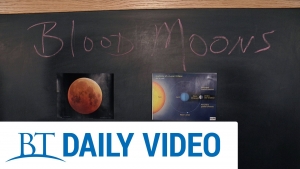
Video: March 21, 2014 — Are the Blood Moons Indicating the End of the World?- There is a lot of interest in blood moons and what that might mean in Bible prophecy. What do you need to know?
Video: April 10, 2014 - Blood Moons and Alignment- The first of the “Blood Moons” is next week. Is there a spiritual alignment we may want to pay close attention to?


 Posts


