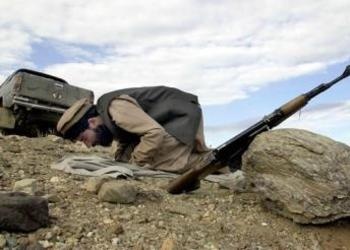
 AFP PHOTO Romeo GACAD
The Koran and Conquest: A Look at Islamic Theology
Is Islam really a peaceful religion, as we are often told?
When the 9/11 hijackers flew planes into the World Trade Center, the Pentagon and a field in Pennsylvania, killing 3,000 Americans and citizens of other countries, did they violate their own faith's teachings?
When Muslim suicide bombers blow themselves up, as hundreds have done in recent years, what motivates them? What reward do they expect now or in the afterlife?
The answers to these questions are crucial if we are to understand what is really going on in the world around us. Otherwise we risk burying our heads in the sand and remaining blind to danger.
Let's begin with a simple question: Could the actions of Muslim terrorist groups have developed logically from their faith's time-honored theology?
Do the traditional interpretations of the Islamic faith's sources of authority—its holy book the Koran (Qur'an), the Hadith (collections of the acts and sayings of Muhammad) and Sharia law—promote violence and war against non-Muslims (infidels)?
The “Arab Spring” has cleared from the world's stage several long-time secular nationalist Arab dictators, with Islamic religious groups lining up to grab a share of power. Further, many Muslims, not least among them Iranian President Mahmoud Ahmadinejad, believe in the imminent arrival of an Islamic messiah known as the Mahdi, or “Guided One,” who will establish Islam as the world's dominant religion.
So it's a good time to carefully examine the theological underpinnings of Islam that are behind so many of today's conflicts and that could lead to the biblically prophesied end-time clash between the Middle Eastern Arab countries and the West.
What do an overwhelming majority of terror attacks in recent years have in common? The perpetrators are Muslim. Why? Certainly many Muslims are peaceful. Not all advocate violence or terrorism. But there is evidently something about Islamic teachings or the conditions of Muslim lands and communities that provoke far more Muslims, proportionately, to resort to violence than equally poor, mistreated and uneducated people of other faiths.
So is it poverty, lack of education, lack of political freedom or lack of opportunity that explains Islamic terrorism? A desire for national independence or a history of suffering under imperialism hardly explains why Muslim terrorist groups presently kill far more people for political and religious reasons than non-Muslims who've suffered similarly.
Such factors as child abuse, alcoholism, “lonely teenage years,” the desire to belong, and personal identity crises were used to explain why the participants became terrorists. But as the article acknowledged, “For some, most notably those who had been involved in Islamist groups, ideology played an important and complex role” (“Violent Extremists: Of Skinheads and Jihadists,” July 2, 2011, p. 51).
Young people may become alienated for many reasons, but why do disaffected Muslims, including second-generation ones born in Europe in circumstances considerably more privileged than their parents, generally commit its worst recent terrorist attacks?
People's levels of poverty and education correlate poorly with people's choice to become terrorists, explain Alan Kreuger and Jitna Maleckova in their Journal of Economic Perspectives article “Education, Poverty, and Terrorism: Is There a Causal Connection?” (Fall 2003, pp. 119-144).
They found that no significant correlation appears between the amount of terrorism and the average levels of either education or national GDP per capita figures (adjusted for the level of civil liberties). Likewise, Claude Berrebi's 2007 study of 285 Palestinian terrorists discovered that they had better educations and came from less poor families.
For example, Al-Qaeda and other Islamist groups blame America's interventions in the Middle East and/or Israel's treatment of the Palestinians for provoking the 9/11 and other terrorist attacks. However, the United States has intervened in Latin America much more and over a longer time, yet has provoked very little terrorism from there compared to the Middle East.
Likewise, China's Communist rulers worry far less about Buddhist Tibetans attacking Beijing than Russia's leaders fear Muslim Chechens striking Moscow (as has happened repeatedly). A desire for national independence, political oppression and/or a history of imperialism hardly explains why Muslim terrorist groups have killed far more people than non-Muslims in similar circumstances.
Since such non-ideological, sociological factors can't account for grossly disproportionate Muslim terrorism, let's look for other explanations.
To understand the mindset behind such actions, secularly minded people need to overcome a skeptical tendency to believe religion never really influences anybody's actions. The fact is, it has and does. History shows that Islamic theology has and will stir up far more religious wars and terrorist actions proportionately than Christianity, Judaism, Hinduism or other religious belief systems.
However, few admit that, because many verses in the Koran contradict other verses, Islamist leaders long ago formulated the principle of naskh, or “abrogation,” which teaches that Allah's later revelations override His earlier ones.
This is even spelled out in Sura 2:106, which says, “If We [Allah] abrogate any verse or cause it to be forgotten, We will replace it by a better verse or one similar. Do you not know that [Allah] has power over all things?”
Muslims believe Allah revealed the Koran to Muhammad over a span of 22 years. Interestingly, almost all of the peaceful, tolerant verses appear in the earlier “Meccan” suras (chapters) of the Koran, but the verses promoting violence and holy war emerge in the later “Medinan” suras.
Naskh isn't some esoteric theory with no practical consequences. Two years before killing 13 people at Fort Hood, Texas, the Muslim U.S. Army Major Nidal Malak Hasan cited this principle in relation to jihad in a presentation explaining Islam that he gave at Walter Reed Hospital.
What are the historical origins of naskh? Muhammad began his religious career in Mecca as a preacher against considerable opposition. But after fleeing to Medina, he became a military commander leading his followers in battle against unbelieving Arabs.
Correspondingly, as his circumstances changed, so too did the supposed revelations of Allah. When he was in the distinct minority in Mecca and trying to establish his new religion, his revelations advocated peace and cooperation with others. But in Medina, as he gained a large following and military and political power, a very different message appeared in his revelations.
Some argue that this is no different from the biblical command to the Israelites to kill the idolatrous Canaanites when they entered the Promised Land. But there are big differences. Whereas the command to Joshua was limited in time and circumstances, the Koran places no similar boundaries on Muslims to wage war against unbelievers.
According to Sura 9:29, Muslims are to “fight against such as those to whom the Scriptures [i.e., the Bible] were given as they believe in neither [Allah] nor the Last Day… until they pay tribute out of hand and are utterly subdued.”
This, in the eyes of Muslim fundamentalists, justifies permanent war against non-Muslims until the entire world is under Islamic rule.
They also cite Sura 8:39, in which, after winning a crucial battle, Muhammad received instruction that permanently authorizes holy wars to spread Islam: “Make war on them until idolatry shall cease and [Allah's] religion [Islam] reigns supreme.”
According to the Koran, Allah gives Muslims a spiritual incentive for joining in jihad, or holy war: too: “Fight for the cause of [Allah]; whether they die or conquer, We shall richly reward them” (Sura 4:74). The reward of those who die in jihad, in Islamic teaching, is to immediately go to Paradise.
Elsewhere the Koran authorizes violent war against unbelievers (see “Does the Koran Promote Peace and Cooperation?”). No clear pacifist verses appear that temper or overrule its warlike teachings. By contrast, in the New Testament, Jesus Christ told His followers to turn the cheek to those who would strike them (Matthew 5:39) and to love and pray for their enemies (verse 44).
After Peter tried to defend Him by attacking someone in a group trying to arrest Him, Jesus responded, “Put your sword in its place, for all who take the sword will perish by the sword” (Matthew 26:52).
While on trial for His life before the Roman governor, Jesus explained that His servants would fight only if His Kingdom were part of this present world (John 18:36). Since it wasn't, they didn't.
Even in the Old Testament, Israel's armies sometimes miraculously won battles without any physical violence. For example, in one night, an angel struck down 185,000 Assyrians besieging Jerusalem (2 Chronicles 32:8, 21; Isaiah 37:36) after righteous King Hezekiah prayed for deliverance.
The most reliable reports among the Hadith and the early legal rulings that compose the core of Sharia law clearly endorse holy wars as well. For example, in one tradition, when asked what was the best good deed a person could do besides becoming a Muslim, Muhammad replied, “To participate in jihad”—holy war.
In another report Muhammad proclaimed, “Paradise is under the shades of swords.”
According to one particularly important Hadith story, Muhammad told Muslims to ask their enemies before starting hostilities to convert to Islam, to surrender to Islamic rule, or to go to war. Restated in one form or another, this standard three-way offer repeatedly reappears historically in Muslims' conflicts with nonbelievers.
Why is it so hard to reform Islamic teachings about jihad? Sunni Muslims, who are in the great majority, uphold the legal theory that open inquiry into the Koran's interpretation ended in the ninth century. Thus, freely interpreting and inquiring into the meaning of the Koran and Hadith to form basic new legal rulings is no longer allowed. As a result, the early medieval jurists' rulings about Allah's will are not to be reconsidered and overturned, including those about jihad.
The four main Muslim legal schools clearly endorse literal jihad. For example, the jurist Al-Qayrawani (who died in A.D. 996) declared: “Jihad is a precept of Divine institution … It is preferable not to begin hostilities with the enemy before inviting the latter to embrace the religion of Allah … They have the alternative of either converting to Islam or paying the poll tax (jizya), short of which war will be declared against them.”
Because orthodox Islam is very legalistic, what these jurists wrote centuries ago still serves as living legal authority for mainstream Muslims. The teachings about jihad of Ibn Taymiyya, who died in 1328, still resonate today as Osama bin Laden and other jihadists fondly quoted him.
Its power and political organization far surpasses any other non-governmental group in Egypt. It boasts chapters in more than 100 countries and an estimated 600,000 members. Since the Arab Spring and the revolution in Egypt has greatly increased the Brotherhood's influence, we should be sure we understand the beliefs of one of its most important past leaders.
According to Qutb in his seminal work Milestones, Islam has an affirmative duty to impose Sharia law on the whole world: “Other societies do not give [Islam] any opportunity to organize its followers according to its own method, and hence it is the duty of Islam to annihilate all such systems” (2005, p. 48, emphasis added).
He went on to explain that the Islamic community “has a God-given right to step forward and take control of the political authority so that it may establish the divine system on earth.”
According to Qutb, Muslims who teach that jihad should only be defensive wars mistakenly ignore the progressive revelation of Allah's will in the Koran: “This is because they regard every verse of the Qur'an as if it were the final principle of this religion” (ibid.). Thus for Qutb, the principle of naskh, or abrogation, for Koranic interpretation allows for aggressive jihads.
So is the idea obsolete? Dr. Douglas McLeod's political research and polling team found that majorities in Egypt, Morocco, Indonesia and Pakistan favor reestablishing the caliphate!
As the Arab Spring produces a power vacuum, with the old secular nationalist dictators pushed aside, the mosque emerges as the most important source of social organization in Arab Muslim countries.
Most importantly, their people's sense of national identity and patriotism is weak compared to their religious and tribal affiliations. Furthermore, even as a small but intensely committed political minority, radical Islamists could take over governments weakened by recent revolutions.
After all, few Russians were Bolsheviks in 1917, but the October Revolution ultimately gave them full control of their war-ravaged nation. Although the Muslim Brotherhood's 1982 Syrian revolt was ruthlessly suppressed, the group could use violence in the future again, and succeed.
For this reason and because Islamists can publicly intimidate the majority of sincere conservative Muslims as “bad Muslims” when they disagree with their policies, public opinion polls in Muslim countries that show Islamist parties lack popularity should not be reassuring.
Further, in the present unsettled conditions of Middle Eastern politics, Islamist parties could easily win elections, much as Hamas did in the Palestinian territories (2006) and the Islamic Salvation Front (FIS) did in Algeria (1991).
Although the brief merger of Egypt and Syria as the United Arab Republic more than 50 years ago (1958-61) proved abortive, a future dynamic leader calling himself the caliph and/or the mahdi could succeed in doing what the Arab nationalist Gamal Abdel Nasser failed to do.
Given the historical background described above, it's not much of a stretch of imagination to think that either a new Muslim caliph or a new Muslim messiah would see it as his duty to expand Islam into Europe by force, or jihad. For decades now, much of the Muslim world, both Sunni and Shiite, has heard such preaching about imminent end-time events, including the coming of an Islamic messiah. And they've long desired to expand Islam into Europe—and indeed, this is a major factor in current Muslim immigration into Europe.
In the years to come, the Bible prophesies that this longtime clash of civilizations between a traditionally Christian Europe and the Islamic Arab world will reach an earth-shaking climax. After the king of the South (i.e., quite possibly a mahdi or caliph to come) attacks, the leader of the new European-centered superpower, called “the king of the North” (and in Revelation “the Beast”) will strike back “like a whirlwind … he shall enter the [Arab] countries [of North Africa], overwhelm them, and pass through” (Daniel 11:40).
The future dictator of a united Europe will successfully invade both Israel and Egypt (verses 41-42; compare Revelation 11:1-2; Luke 21:24).
Being now forewarned by this knowledge of how Islamic theology will likely impact the world's future, what should we do?
First, we must stay alert to world news reports as Europe and the Arab worlds both become more politically unified and increasingly authoritarian as well. The high hopes of the Arab Spring for creating Western-style democracy in the Middle East will ultimately be dashed.
Since the only source of spiritual and even physical protection in the times of deep trouble to come is our great God, we need to prepare ourselves spiritually by turning our lives over to Him through repentance and faith in His Son Jesus Christ, remembering His warning to us in Matthew 24:44: “Therefore you also be ready, for the Son of Man is coming at an hour you do not expect.”
When the 9/11 hijackers flew planes into the World Trade Center, the Pentagon and a field in Pennsylvania, killing 3,000 Americans and citizens of other countries, did they violate their own faith's teachings?
When Muslim suicide bombers blow themselves up, as hundreds have done in recent years, what motivates them? What reward do they expect now or in the afterlife?
The answers to these questions are crucial if we are to understand what is really going on in the world around us. Otherwise we risk burying our heads in the sand and remaining blind to danger.
Let's begin with a simple question: Could the actions of Muslim terrorist groups have developed logically from their faith's time-honored theology?
Do the traditional interpretations of the Islamic faith's sources of authority—its holy book the Koran (Qur'an), the Hadith (collections of the acts and sayings of Muhammad) and Sharia law—promote violence and war against non-Muslims (infidels)?
The “Arab Spring” has cleared from the world's stage several long-time secular nationalist Arab dictators, with Islamic religious groups lining up to grab a share of power. Further, many Muslims, not least among them Iranian President Mahmoud Ahmadinejad, believe in the imminent arrival of an Islamic messiah known as the Mahdi, or “Guided One,” who will establish Islam as the world's dominant religion.
So it's a good time to carefully examine the theological underpinnings of Islam that are behind so many of today's conflicts and that could lead to the biblically prophesied end-time clash between the Middle Eastern Arab countries and the West.
Why is Islam so different?
In the last century, political groups seeking independence from the Western colonial powers or wishing to impose communist ideology on their nations were the main sources of terrorism. But with almost all former colonies having gained independence, and with the fall of the Soviet Union and other Eastern Bloc nations discrediting communism, what is today's largest source of terrorism?What do an overwhelming majority of terror attacks in recent years have in common? The perpetrators are Muslim. Why? Certainly many Muslims are peaceful. Not all advocate violence or terrorism. But there is evidently something about Islamic teachings or the conditions of Muslim lands and communities that provoke far more Muslims, proportionately, to resort to violence than equally poor, mistreated and uneducated people of other faiths.
So is it poverty, lack of education, lack of political freedom or lack of opportunity that explains Islamic terrorism? A desire for national independence or a history of suffering under imperialism hardly explains why Muslim terrorist groups presently kill far more people for political and religious reasons than non-Muslims who've suffered similarly.
Are poverty and lack of education the cause?
According to an article in the British newsmagazine The Economist, a conference in Ireland brought together dozens of former terrorists and political revolutionaries to try to uncover the roots of violent extremism.Such factors as child abuse, alcoholism, “lonely teenage years,” the desire to belong, and personal identity crises were used to explain why the participants became terrorists. But as the article acknowledged, “For some, most notably those who had been involved in Islamist groups, ideology played an important and complex role” (“Violent Extremists: Of Skinheads and Jihadists,” July 2, 2011, p. 51).
Young people may become alienated for many reasons, but why do disaffected Muslims, including second-generation ones born in Europe in circumstances considerably more privileged than their parents, generally commit its worst recent terrorist attacks?
People's levels of poverty and education correlate poorly with people's choice to become terrorists, explain Alan Kreuger and Jitna Maleckova in their Journal of Economic Perspectives article “Education, Poverty, and Terrorism: Is There a Causal Connection?” (Fall 2003, pp. 119-144).
They found that no significant correlation appears between the amount of terrorism and the average levels of either education or national GDP per capita figures (adjusted for the level of civil liberties). Likewise, Claude Berrebi's 2007 study of 285 Palestinian terrorists discovered that they had better educations and came from less poor families.
For example, Al-Qaeda and other Islamist groups blame America's interventions in the Middle East and/or Israel's treatment of the Palestinians for provoking the 9/11 and other terrorist attacks. However, the United States has intervened in Latin America much more and over a longer time, yet has provoked very little terrorism from there compared to the Middle East.
Likewise, China's Communist rulers worry far less about Buddhist Tibetans attacking Beijing than Russia's leaders fear Muslim Chechens striking Moscow (as has happened repeatedly). A desire for national independence, political oppression and/or a history of imperialism hardly explains why Muslim terrorist groups have killed far more people than non-Muslims in similar circumstances.
Since such non-ideological, sociological factors can't account for grossly disproportionate Muslim terrorism, let's look for other explanations.
To understand the mindset behind such actions, secularly minded people need to overcome a skeptical tendency to believe religion never really influences anybody's actions. The fact is, it has and does. History shows that Islamic theology has and will stir up far more religious wars and terrorist actions proportionately than Christianity, Judaism, Hinduism or other religious belief systems.
Some Koranic verses abrogate other verses
Those who claim that Islam is a religion of peace commonly cite verses from the Koran such as Sura 2:256, “There shall be no compulsion in religion,” and Sura 4:90, “Therefore, if they keep away from you and cease their hostility and offer you peace, [Allah] bids you not to harm them” (Dawood translation throughout).However, few admit that, because many verses in the Koran contradict other verses, Islamist leaders long ago formulated the principle of naskh, or “abrogation,” which teaches that Allah's later revelations override His earlier ones.
This is even spelled out in Sura 2:106, which says, “If We [Allah] abrogate any verse or cause it to be forgotten, We will replace it by a better verse or one similar. Do you not know that [Allah] has power over all things?”
Muslims believe Allah revealed the Koran to Muhammad over a span of 22 years. Interestingly, almost all of the peaceful, tolerant verses appear in the earlier “Meccan” suras (chapters) of the Koran, but the verses promoting violence and holy war emerge in the later “Medinan” suras.
Naskh isn't some esoteric theory with no practical consequences. Two years before killing 13 people at Fort Hood, Texas, the Muslim U.S. Army Major Nidal Malak Hasan cited this principle in relation to jihad in a presentation explaining Islam that he gave at Walter Reed Hospital.
What are the historical origins of naskh? Muhammad began his religious career in Mecca as a preacher against considerable opposition. But after fleeing to Medina, he became a military commander leading his followers in battle against unbelieving Arabs.
Correspondingly, as his circumstances changed, so too did the supposed revelations of Allah. When he was in the distinct minority in Mecca and trying to establish his new religion, his revelations advocated peace and cooperation with others. But in Medina, as he gained a large following and military and political power, a very different message appeared in his revelations.
What the Koran clearly states
According to the notorious “verse of the sword” (Sura 9:5), Muhammad was told, “Slay the idolaters wherever you find them. Arrest them, besiege them, and lie in ambush everywhere for them”—unless they convert.Some argue that this is no different from the biblical command to the Israelites to kill the idolatrous Canaanites when they entered the Promised Land. But there are big differences. Whereas the command to Joshua was limited in time and circumstances, the Koran places no similar boundaries on Muslims to wage war against unbelievers.
According to Sura 9:29, Muslims are to “fight against such as those to whom the Scriptures [i.e., the Bible] were given as they believe in neither [Allah] nor the Last Day… until they pay tribute out of hand and are utterly subdued.”
This, in the eyes of Muslim fundamentalists, justifies permanent war against non-Muslims until the entire world is under Islamic rule.
They also cite Sura 8:39, in which, after winning a crucial battle, Muhammad received instruction that permanently authorizes holy wars to spread Islam: “Make war on them until idolatry shall cease and [Allah's] religion [Islam] reigns supreme.”
According to the Koran, Allah gives Muslims a spiritual incentive for joining in jihad, or holy war: too: “Fight for the cause of [Allah]; whether they die or conquer, We shall richly reward them” (Sura 4:74). The reward of those who die in jihad, in Islamic teaching, is to immediately go to Paradise.
Elsewhere the Koran authorizes violent war against unbelievers (see “Does the Koran Promote Peace and Cooperation?”). No clear pacifist verses appear that temper or overrule its warlike teachings. By contrast, in the New Testament, Jesus Christ told His followers to turn the cheek to those who would strike them (Matthew 5:39) and to love and pray for their enemies (verse 44).
After Peter tried to defend Him by attacking someone in a group trying to arrest Him, Jesus responded, “Put your sword in its place, for all who take the sword will perish by the sword” (Matthew 26:52).
While on trial for His life before the Roman governor, Jesus explained that His servants would fight only if His Kingdom were part of this present world (John 18:36). Since it wasn't, they didn't.
Even in the Old Testament, Israel's armies sometimes miraculously won battles without any physical violence. For example, in one night, an angel struck down 185,000 Assyrians besieging Jerusalem (2 Chronicles 32:8, 21; Isaiah 37:36) after righteous King Hezekiah prayed for deliverance.
Following Muhammad's example
Serious Muslims aspire to follow the personal example of Muhammad, whom they regard as the perfect example to emulate. According to his early biographer Ibn Ishaq, Muhammad took part in 27 raids and battles. If he literally waged war to promote Islam, wouldn't that encourage his followers to do the same?The most reliable reports among the Hadith and the early legal rulings that compose the core of Sharia law clearly endorse holy wars as well. For example, in one tradition, when asked what was the best good deed a person could do besides becoming a Muslim, Muhammad replied, “To participate in jihad”—holy war.
In another report Muhammad proclaimed, “Paradise is under the shades of swords.”
According to one particularly important Hadith story, Muhammad told Muslims to ask their enemies before starting hostilities to convert to Islam, to surrender to Islamic rule, or to go to war. Restated in one form or another, this standard three-way offer repeatedly reappears historically in Muslims' conflicts with nonbelievers.
Later Islamic rulings enshrined jihad
The teachings of the Koran and Hadith about jihad aren't ancient dead letters. They remain a live issue because they were codified and frozen into place centuries ago.Why is it so hard to reform Islamic teachings about jihad? Sunni Muslims, who are in the great majority, uphold the legal theory that open inquiry into the Koran's interpretation ended in the ninth century. Thus, freely interpreting and inquiring into the meaning of the Koran and Hadith to form basic new legal rulings is no longer allowed. As a result, the early medieval jurists' rulings about Allah's will are not to be reconsidered and overturned, including those about jihad.
The four main Muslim legal schools clearly endorse literal jihad. For example, the jurist Al-Qayrawani (who died in A.D. 996) declared: “Jihad is a precept of Divine institution … It is preferable not to begin hostilities with the enemy before inviting the latter to embrace the religion of Allah … They have the alternative of either converting to Islam or paying the poll tax (jizya), short of which war will be declared against them.”
Because orthodox Islam is very legalistic, what these jurists wrote centuries ago still serves as living legal authority for mainstream Muslims. The teachings about jihad of Ibn Taymiyya, who died in 1328, still resonate today as Osama bin Laden and other jihadists fondly quoted him.
What about modern Koranic interpretations
To illustrate how traditional Muslim teachings are applied in today's world, consider the beliefs of Sayyid Qutb (1906-66). He was the chief ideologist of the Muslim Brotherhood. Founded in Egypt in 1928 by Hasan Al-Banna, this Islamist organization is the world's most influential Muslim group.Its power and political organization far surpasses any other non-governmental group in Egypt. It boasts chapters in more than 100 countries and an estimated 600,000 members. Since the Arab Spring and the revolution in Egypt has greatly increased the Brotherhood's influence, we should be sure we understand the beliefs of one of its most important past leaders.
According to Qutb in his seminal work Milestones, Islam has an affirmative duty to impose Sharia law on the whole world: “Other societies do not give [Islam] any opportunity to organize its followers according to its own method, and hence it is the duty of Islam to annihilate all such systems” (2005, p. 48, emphasis added).
He went on to explain that the Islamic community “has a God-given right to step forward and take control of the political authority so that it may establish the divine system on earth.”
According to Qutb, Muslims who teach that jihad should only be defensive wars mistakenly ignore the progressive revelation of Allah's will in the Koran: “This is because they regard every verse of the Qur'an as if it were the final principle of this religion” (ibid.). Thus for Qutb, the principle of naskh, or abrogation, for Koranic interpretation allows for aggressive jihads.
Could we see a return of the caliphate?
What about the Islamist teaching that Muslims should have a supranational spiritual leader, or caliph, to lead all Muslims worldwide? The father of modern secular Turkey, Mustafa Kemal Ataturk, formally abolished the caliphate in 1924 after the collapse of the Ottoman Empire following World War I.So is the idea obsolete? Dr. Douglas McLeod's political research and polling team found that majorities in Egypt, Morocco, Indonesia and Pakistan favor reestablishing the caliphate!
As the Arab Spring produces a power vacuum, with the old secular nationalist dictators pushed aside, the mosque emerges as the most important source of social organization in Arab Muslim countries.
Most importantly, their people's sense of national identity and patriotism is weak compared to their religious and tribal affiliations. Furthermore, even as a small but intensely committed political minority, radical Islamists could take over governments weakened by recent revolutions.
After all, few Russians were Bolsheviks in 1917, but the October Revolution ultimately gave them full control of their war-ravaged nation. Although the Muslim Brotherhood's 1982 Syrian revolt was ruthlessly suppressed, the group could use violence in the future again, and succeed.
For this reason and because Islamists can publicly intimidate the majority of sincere conservative Muslims as “bad Muslims” when they disagree with their policies, public opinion polls in Muslim countries that show Islamist parties lack popularity should not be reassuring.
Further, in the present unsettled conditions of Middle Eastern politics, Islamist parties could easily win elections, much as Hamas did in the Palestinian territories (2006) and the Islamic Salvation Front (FIS) did in Algeria (1991).
Although the brief merger of Egypt and Syria as the United Arab Republic more than 50 years ago (1958-61) proved abortive, a future dynamic leader calling himself the caliph and/or the mahdi could succeed in doing what the Arab nationalist Gamal Abdel Nasser failed to do.
Does this play into end-time events?
The biblical prophet Daniel tells us that “at the time of the end” a leader will arise, apparently from the heart of the Muslim world, called “the king of the South.” He will launch an attack of some sort against a new European-centered geopolitical superpower (Daniel 11:40).Given the historical background described above, it's not much of a stretch of imagination to think that either a new Muslim caliph or a new Muslim messiah would see it as his duty to expand Islam into Europe by force, or jihad. For decades now, much of the Muslim world, both Sunni and Shiite, has heard such preaching about imminent end-time events, including the coming of an Islamic messiah. And they've long desired to expand Islam into Europe—and indeed, this is a major factor in current Muslim immigration into Europe.
In the years to come, the Bible prophesies that this longtime clash of civilizations between a traditionally Christian Europe and the Islamic Arab world will reach an earth-shaking climax. After the king of the South (i.e., quite possibly a mahdi or caliph to come) attacks, the leader of the new European-centered superpower, called “the king of the North” (and in Revelation “the Beast”) will strike back “like a whirlwind … he shall enter the [Arab] countries [of North Africa], overwhelm them, and pass through” (Daniel 11:40).
The future dictator of a united Europe will successfully invade both Israel and Egypt (verses 41-42; compare Revelation 11:1-2; Luke 21:24).
Being now forewarned by this knowledge of how Islamic theology will likely impact the world's future, what should we do?
First, we must stay alert to world news reports as Europe and the Arab worlds both become more politically unified and increasingly authoritarian as well. The high hopes of the Arab Spring for creating Western-style democracy in the Middle East will ultimately be dashed.
Since the only source of spiritual and even physical protection in the times of deep trouble to come is our great God, we need to prepare ourselves spiritually by turning our lives over to Him through repentance and faith in His Son Jesus Christ, remembering His warning to us in Matthew 24:44: “Therefore you also be ready, for the Son of Man is coming at an hour you do not expect.”





 Posts


