The Second Annual
“National March for Immigrant Rights” is scheduled to be held on the U.S.-Mexico border on February 2
nd.
Last year, the march was
also held on February 2nd.
What`s going on here? Why February 2
nd?
Answer: February 2
nd is the anniversary of the signing of the
Treaty of Guadalupe Hidalgo. That 1848 treaty officially ended the Mexican War and legally turned over
most of the Southwest to the United States.
The average American
doesn`t know much about the Mexican War and thinks about it less.
But here in Mexico they do think about it—
a lot.
In Mexico,
everybody knows that
“the U.S. took half our national territory.
“
“La Intervención Norteamericana“ has been described—by Mexican writer and Nobel laureate
Octavio Paz—as
“one of the most unjust wars of conquest in history.
“
Not only that, but the loss of Mexico`s northern territories has been used as a reason—an
excuse, really—for the
economic failures of Mexico compared to the economic success of the United States.
According to at least one poll, conducted in 2002 by Zogby in Mexico, 58% of respondents
agreed with the statement that
“the territory of the United States` Southwest rightfully belongs to Mexico”. [
MS Word] Now that`s
definitely a different perspective.
In a lighter vein, some Mexicans jokingly quip that, when the
U.S. took half of Mexico`s territory, we took the half with the
paved roads.
Some Americans are shocked to learn that Mexicans actually have a different historical perspective than we do.
How dare Mexicans say the U.S.
took the Southwest from Mexico? How dare they have a different perspective than us?
It`s time for a reality check. Different nations have
different historical perspectives on the same historical events. That`s one reason they are different nations.
Of course Mexicans say that the U.S. took (or even
“stole”) the Southwest! Why wouldn`t they?
We`ve got to get over this naïve belief that everybody in the world
has the same values, and that everybody wants to be just like us.
Maybe we should have thought twice about importing millions of people from the only country on earth with
an irredentist claim against us—and then encouraging them
not to assimilate!
It`s not that the facts of the war are in dispute. A Mexican
historical text and an American historical text provide the same
facts about the war. It`s just that the
“spin” is
different. (And nowadays, some of the American treatments of the
war are more critical of the war than the Mexican ones.)
Even some of the arguments used on our side are a little lame.
Some try to prove the territory wasn`t conquered. After all, we did pay $15 million dollars for it.
True, but that makes it sound like a garden variety real
estate deal. Mexico was soundly defeated, and as defeated nations
throughout history, had to abide by the terms of defeat.
It was a conquest. And historically there`s nothing unique
about that. Just about every country in the world was
formed by some type of conquest and just about all the real estate in the world has been
conquered and re-conquered, some of it quite a few times.
That includes
Mexico.
The contemporary conventional Mexican view is that the evil
Spaniards conquered Mexico. But when Hernan Cortes arrived in
1519, the present-day country of Mexico did not exist. The Aztec
Empire (itself a product of conquest) only covered about a
quarter of present-day Mexico. After the Spaniards conquered
that empire, they went on conquering numerous other
indigenous entities, including the
Tarascan Empire, enemy of the Aztec Empire, thus assembling the enormous colony of
“Nueva España“,
which was renamed Mexico after independence. Furthermore,
throughout the history of independent Mexico, the government has
repeatedly used force to subdue rebellious tribes and areas and
keep them in Mexico. So yes, Mexico was formed by conquest as
well.
Nor is invading a neighbor country at all rare. In fact, it`s
the most common form of international invasion there is.
And supposing the Mexican War hadn`t started in 1846, it`s
quite probable Mexico would have lost the territories anyway.
The region in question was far from the heartland of Mexico, and sparsely settled. Neither the
Spanish Empire
nor the independent Mexico which succeeded it did much to
develop the area, which was prone to frequent anti-government
uprisings.
In the 1840s, there was speculation that the British, the
French or the Russians might take try to take it.
But the most likely possibility would have been that growing
communities of unassimilated American settlers would have
revolted, seceded from Mexico, and joined the U.S.
It was the Texas dispute that provoked the Mexican War. Americans had settled in Texas, they
didn`t assimilate, they
became the majority, and seceded from Mexico in 1836.
That was not the first time that Mexico lost territory. Upon
independence in 1821, Central America had been part of Mexico,
but Mexico
lost that territory in the 1820s. Funny, I never hear about a Mexican
“reconquista” of
Central America.
The
Republic of Texas
was independent from 1836 to 1845, during which time it was
diplomatically recognized by the U.S., France, Britain, Holland
and Belgium, and Mexico was unable to get it back.
After Texas joined the Union in 1845, the dispute erupted
again. Both countries sent troops into the disputed territory
between the
Rio Grande (which Texas said was the border) and the
Nueces River (which Mexico said was the border). In April 1846, the two armies
clashed in the
Thornton Skirmish, followed by several battles in May of 1846, after which President Polk
asked for and
received a declaration of war from Congress. Three months later the Mexican Congress reciprocated.
Nowadays, of course, the war is seen as the attack of a strong U.S.A. upon a weak and peaceful Mexico.
But at the time, both countries were about equally hawkish and
ready for war. Mexico had a larger full-time military (27,000
Mexican men under arms vs. a U.S. Army of about 7,000 soldiers—a
number which soon swelled when volunteers flocked to join).
Nowadays, the idea of conquest is very unPC. But in 1846,
neither the U.S. nor Mexico was against the idea of conquest in
principle. It`s just that each country wanted to be the conqueror
and not the conquered.
Mexico`s government planned an invasion of the U.S.,
predicting that as Mexico invaded, the slaves would revolt and
the
Mexican flag would fly over the U.S. capitol in Washington. The Mexican government planned to annex parts of the United States, in the
Louisiana/Alabama region. What a plan!
But they didn`t have the chance to do all that, because the
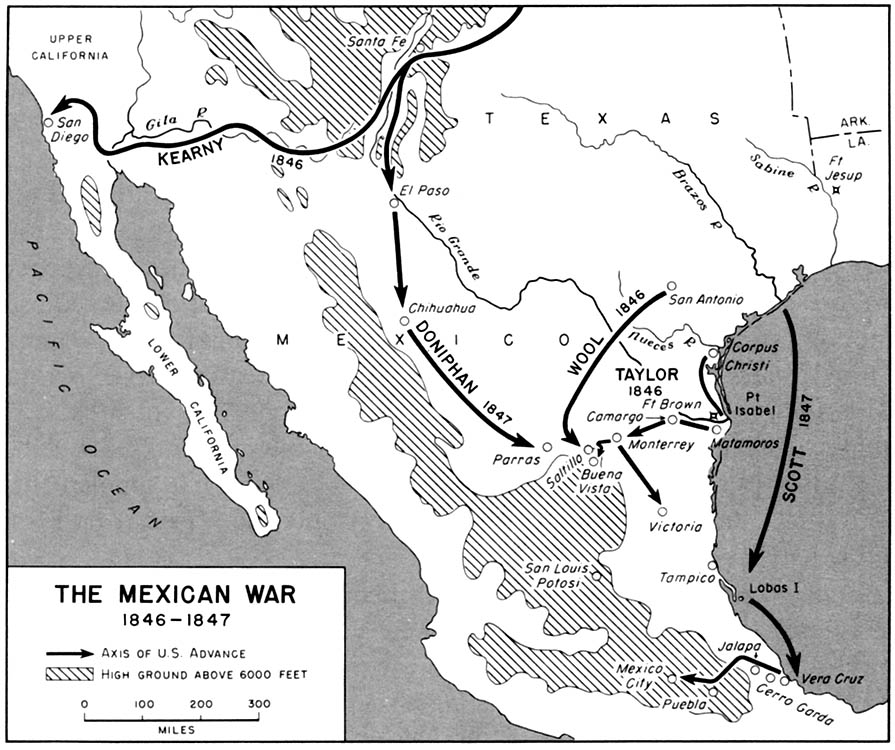
U.S. Army invaded Mexico first. (Maps are available
here and
here.)
Brigadier General Zachary Taylor (
“Old Rough and Ready”) invaded and occupied part of northeastern Mexico, including the
city of Monterrey,
which fell after a fierce battle involving house-to-house
combat, in September of 1846. After the battle of Buena Vista
(February of 1847), conventional war in that theater was over,
though there were guerrilla attacks against U.S. forces.
In another prong of the invasion,
Colonel Stephen Kearny
marched west from Fort Leavenworth, Kansas, taking Santa Fe and
arriving in California. There Kearney linked up with Captain John
C. Fremont and some of those unassimilated American
settlers who had already declared independence from Mexico. On
July 7
th, 1846, the
Navy landed and did its part. By February of 1847 fighting in this theater was over.
Mexico had still refused to surrender. So President Polk sent
an invasion force to take Mexico City. This expeditionary force,
under the command of General Winfield Scott (
“Old Fuss and Feathers”)
landed at Veracruz, on Mexico`s Gulf Coast, and carried out the
largest American amphibious landing up to that time.
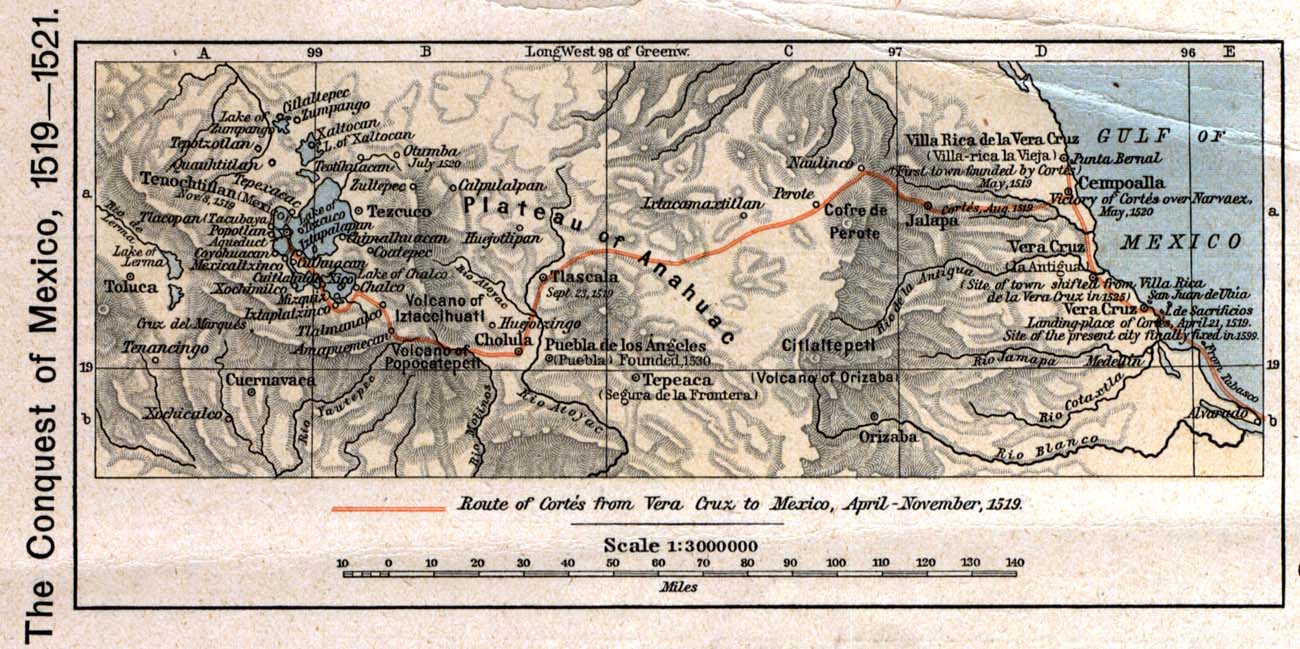
Veracruz was taken in March 1847. Then the U.S. Army fought its way inland to Mexico City, taking the same route [
Map] as Hernan Cortes in 1519.
Among the soldiers who fought under General Scott was a member
of the Indiana Volunteers by the name of Robert Wall—my first
cousin 4 times removed, the first member of my family to go to
Mexico. After returning to Indiana, for the rest of his life my
kinsman was known as
“Mexican Bob”. Mexican Bob had two cousins also named Robert Wall— a funny cousin known as
“Monkey Bob” and a feisty one known as
“Spunky Bob”. Spunky Bob was my great-great-grandfather.
With the fall of
Mexico City in
September of 1847,
major combat operations were over, although in both Taylor`s and
Scott`s occupation zones, there were continued enemy attacks on
U.S. supply convoys—just as in
Iraq today.
Why did the American army defeat the Mexican army?
The American army, composed 100% of men who had volunteered,
was better trained and better equipped, had its own supply
convoys and medical personnel to care for the wounded. The U.S.
Army`s artillery was a decisive factor— each cannon`s crew was
overseen by a seasoned NCO known as
“chief of the piece.” (See
illustration here.)
The Mexican army was mostly composed of draftees, had
Napoleonic-era weapons, and sometimes left its wounded behind,
not a great morale inducer. The classic Mexican history work
México Á Través De Los Siglos points out that, though the Mexican soldiers in the rank and file were brave,
“…the mutual confidence
between the leaders and officers did not exist, the weaponry was
old and defective, the artillery was small and of short range,
the cavalry was mostly useless, the movements were slow and
heavy, and finally, ambulances and supplies of provisions and
everything necessary for the good service of an army on campaign
were lacking.”(
México Á Través De Los Siglos Vicente Riva Palacio, 1880).
Mexico`s loss was also due to internal disunity. In the face
of the American invasion, Mexico`s leaders did not form a
government of national unity and
work together to defend their country.
Instead, Mexican leaders often seemed more concerned with
maneuvering against each other than against the enemy. In
December of 1845, with war imminent, General Mariano Paredes was
sent north with an army to face off against the Americans. But on
the way, he changed his mind and decided instead to return to
Mexico City and overthrow the government.
That`s how the more hawkish Paredes became president,
replacing Jose Joaquin de Herrera, who was willing to compromise
on the Texas issue. In August of 1846, Paredes himself was
deposed by Mariano Salas. The presidency actually changed hands
four times that year and by March of 1847,
Antonio Lopez de Santa Anna was in charge of both the government and the military. He resigned after the Mexico City defeat of 1847.
Also during the war, the Mexicans had an internecine dispute
about church property, an attempt to install a Spanish monarch,
and about 35 uprisings throughout the country. Some Mexican
communities didn`t support the war effort, and had no qualms
about trading with the American enemy. Others were simply
indifferent and stayed out of it.
The Yucatan Peninsula, which had been independent from 1841-1843, declared independence again on January 1
st,
1846 and announced its neutrality during the Mexican
War. But the indigenous Maya revolted against Yucatan`s white
elite in the
“Caste War“,
which broke out in 1847. The whites were forced to retreat into
the walled cities of Merida and Campeche in 1848. After the U.S.
withdrew from Mexico, Yucatan`s leaders rejoined Mexico. It began
a long drawn out reconquest of the Maya territory which didn`t
end until 1901.
The Mexican War had its
contemporary American critics,
mostly among the Whig party. Critics of the war included former
president John Quincy Adams, John C. Calhoun, Ralph Waldo Emerson
and
Henry David Thoreau who
spent a night in jail because he refused to pay a $1 tax in protest.
Abraham Lincoln opposed the use of the Thornton Skirmish as justification for the war, although he still
voted for funds to supply the U.S. Army in Mexico, and later supported Zachary Taylor`s presidential campaign.
Among the 200 junior officers in the war who wound up being generals (
Union and Confederate) in the Civil War, was
future president Ulysses S. Grant, who at some point in his life
decided that the war was
evil.
But whatever Lincoln and Grant thought about the Mexican War,
as president, neither man offered to give the conquered
territories back to Mexico.
When Mexican leaders signed the Treaty of Guadalupe Hidalgo in
1848, they were almost out of money and the country was on the
verge of a revolution. American troops had defeated the Mexican
army, were occupying strategic parts of the country, and
negotiator Nicholas Trist made clear that without a transfer of
the territories, there would be no treaty. So the Mexican
leaders decided to sign the treaty to avoid greater losses. It
was signed on February 2
nd, 1848 and ratified by both
congresses several months later. The U.S. Army withdrew from all
the territory it was occupying except the newly-annexed
territories.
In the treaty of Guadalupe Hidalgo, the U.S. gained
nearly all the Southwest,—all of California, Nevada and Utah, and parts of Colorado, Arizona, New Mexico and Wyoming. (The
area south of the Gila River in the present-day states of Arizona and New Mexico, was purchased from Mexico in the Gadsden Treaty of 1853.)
So the Southwest is part of the U.S. and has been for over 150
years, longer than most present-day national states have been in
existence.
Even the Mexican Constitution doesn`t claim the Southwest!
That`s right. The Mexican Constitution, in articles 42—48 [
Word Document]
spells out the extent of Mexican territory. It mentions Mexican
islands, continental shelf, and airspace, Mexico`s 31 states and
federal district, but it never mentions California, Texas or
Arizona.
So take that, you
reconquistas!
When reflecting upon the Mexican War, some Americans ask why
we didn`t just annex the whole country. And there were actually
people in favor of that—the
“All Mexico” movement. But there were several reasons that didn`t happen.
One was America`s North-South divide, especially the
congressional balance between free states and slave states, with
northerners fearing that Mexico would be divided into slave
states and thus upset the balance.
But
John C. Calhoun and others opposed annexing Mexico for National Question reasons.
In 1848, the U.S. population was about
21 million,
and the population of Mexico about 7 million, a third of ours.
How well could we have assimilated 7 million Mexicans, with all
the racial, cultural, social, nationalistic differences that
would have been involved? Annexing Mexico would have changed
the character of our nation.
Ironically, today`s leaders have no such qualms. Today our leaders apparently see no problem in
merging us with Mexico, despite the
differences between our societies.
They are merging our countries on several levels. At one level
is the mass migration of Mexicans into the U.S. coupled with a
multicultural ideology which encourages non-assimilation and
retention
of their Mexican identity. At another level, inter-governmental
agreements are moving us closer to some sort of
North American Union.
It`s a century and a half after Guadalupe Hidalgo. Who will be the winners in this century?
Will it be the U.S.A., Mexico—or a transnational elite, for
whom all the residents of our continent are just interchangeable
pieces in a vast market?
The next few years will give us the answer.
American citizen Allan Wall (email him)
resides in Mexico, with a legal permit issued him by the Mexican
government. Allan recently returned from a tour of duty in Iraq
with the Texas Army National Guard. His VDARE.COM articles are
archived here; his FRONTPAGEMAG.COM articles are archived here his “Dispatches from Iraq” are archived here his website is here.
 Wikimedia Commons/Metropolitan Museum of Art



 1 comments






 Posts