Showing posts with label #SadiqKahn. Show all posts

Wednesday, July 20, 2016

Muslim cleric says Pokemon Go is un-Islamic

A timely post about from www.jihadwatch.org about Pokemon Go. This follows this post about Theresa May as the Prime Minister of the U.K.  This follows this article about American energy independence and preventing money from going to hostile countries. For more, you can read two very interesting books HERE.You can follow me here.

Muslim cleric says Pokemon Go is un-Islamic

“Allah did not create man so that he could have fun. The aim of creation was for mankind to be put to the test through hardship and prayer. An Islamic regime must be serious in every field. There are no jokes in Islam. There is no humor in Islam. There is no fun in Islam. There can be no fun and joy in whatever is serious.” — Ayatollah Khomeini
Abbas Shuman
“Pokemon Go is ‘un-Islamic’, Muslim cleric says,” by Harry Readhead, Metro.co.uk, July 16, 2016:
A Muslim scholar has suggested that the hugely popular Pokemon go is prohibited by Islam.
Abbas Shuman, who is deputy head of the Al-Azhar Islamic institution, said the game was a ‘harmful mania’ which was similar to drinking alcohol.
Gulf News reports that the Egyptian cleric said the game ‘makes people look like drunkards.’
‘This game makes people look like drunkards in the streets and on the roads while their eyes are glued to the mobile screens leading them to the location of the imaginary Pokemon in the hope of catching it,’ he said.
‘If such a game can deceive youngsters, I do not know where have gone the minds of adults, who can be hit by a car while being busy searching for Pokemon.’
The augmented reality game has already led people to chase Pokemon in Auschwitz and to turn up at the homes of complete strangers.
Mr Shuman asked if people would ‘neglect their work and earnining their living and devote themselves instead to hunting for Pokemon.’
‘Will we find some lunatics walk into mosques, churches, prisons and military units in search of the missing [Pokemon]?’ he added….
Islamic State beheads 4 soccer players after declaring the sport un-Islamic
FacebookTwitterGoogle+LinkedInDiggBlogger PostDeliciousStumbleUponDiasporaEmailPrint

Friday, July 15, 2016

Europe at a Crossroads What Lies Ahead?

An interesting article from http://www.ucg.org/ about Muslims in Europe. This follows this post about officeholders. This follows this post about Religious Freedom. This follows this post about the police.  For a free magazine subscription or to get the books recommended for free click HERE! or call 1-888-886- 8632.

MP3 Audio (23.07 MB)
All over Europe, average citizens seem to be waking up to the reality of their situation far better than the political elites that run their countries.
In Germany, pepper spray has disappeared from stores as buyers worried about waves of migrants emptied the shelves. In Sweden, angry arsonists set fire to 17 existing or planned immigrant housing centers in October and November. In Austria, citizens concerned about the flood of refugees have bought tens of thousands of handguns and rifles in recent months, and stores are running out of shotguns.
Support for anti-immigration political parties is growing more widespread. British voters are so fed up with the European Union’s open borders policy that Britain may soon elect to leave the EU altogether rather than continue to be subject to invasion by thousands of non-European migrants.
Anti-immigrant voters have already replaced governments in Poland and Croatia, and made huge gains in Sweden, France, Denmark and Greece. In Germany, support for Angela Merkel, who opened the nation’s doors to 1.5 million migrants, is plummeting.
Clearly the ground is shifting in Europe. Much like the United States, where voters are increasingly frustrated and turned off by their political leaders, Europeans are looking for alternatives to a political establishment viewed as more and more out of touch with the average man on the street.
These trends were well under way even before nine jihadists using automatic rifles, hand grenades and suicide-bomb vests slaughtered 130 people and wounded hundreds more in Paris restaurants and a concert hall the night of Nov. 13. An attack at a soccer stadium was thwarted; otherwise the casualties would have run far higher. In a particularly callous act, the gunmen singled out and shot disabled people in an area of the concert hall set aside for wheelchair users.
Particularly unsettling are the identities of the killers. Most were French or Belgian citizens born of Muslim-immigrant parents. At least two others were among the waves of immigrants who entered Europe by boat via Greece only six weeks earlier, and two others remain unidentified. Throughout Europe, people are deeply concerned about what these things mean for their lives, their countries and their future. The continent is changing before our eyes.
Where could these trends be heading? Does the Bible give us any indication?

Insights from Bible prophecy and history

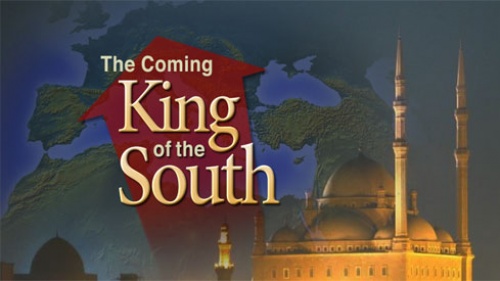
The 11th chapter of the book of Daniel gives a detailed prophecy of events in the Middle East that began in Daniel’s day and continues down to events that take place at the return of Jesus Christ to establish the Kingdom of God on earth. Much of the prophecy concerns individuals called “the king of the North” and “the king of the South.” These denote leaders of geopolitical powers to the north and south of Jerusalem, the focal point of Bible prophecy, but they have a connection to both the Middle East and Europe.
Originally these terms applied to the successors of Alexander the Great, whose vast empire was divided up among his chief generals after his death. The two major resulting kingdoms, centered in Syria to the north of Jerusalem and Egypt to the south, would be the key powers Daniel’s prophecy would center on for the next several centuries.
Most of this prophecy was fulfilled many centuries ago between the time of Alexander the Great and the rise of the Roman Empire. But in verse 40 the prophecy jumps forward to our day, “the time of the end” before the return of Jesus Christ.
What is this verse describing? We need a good grasp of history to understand.
In the 600s and 700s A.D. the new religion of Islam spread from the Arabian Peninsula across much of the Middle East, as well as through Egypt and across North Africa. Over time Muslim conquerors captured Spain and invaded France, and later took over large portions of southeastern Europe. Along the way they also invaded and held portions of Italy, and in A.D. 846 Muslim raiders attacked Rome itself and plundered the original St. Peter’s Basilica, at that time outside Rome’s protective walls.
Another wave of Islamic expansion in the 1100s vastly expanded the territory under Muslim control to include most of the northern third of the African continent, much of the Indian subcontinent, a large swath of southeastern Europe and part of what is today southern Russia and some of the former Soviet republics.
For centuries the Islamic world was ruled by a series of caliphs— an Arabic term meaning “successor,” in this case a religious and political successor of Muhammad, founder of Islam and considered its greatest prophet. The territory over which the caliph ruled was known as a caliphate. This system existed until 1924, when it was abolished in the aftermath of World War I with the fall of the Ottoman Empire, the last embodiment of the caliphate.
Throughout Islam’s history its leaders have desired to see Muslims worldwide unite under a caliphate and establish Islam in what they see as its rightful place as the dominant religion of the world. In recent decades al-Qaeda leader Osama bin Laden called for the reestablishment of a caliphate, as has the Muslim Brotherhood (which spawned al-Qaeda and other terrorist groups).
In June 2014 the Islamic State, formed out of the rubble of the Syrian civil war and the collapse of central authority in Iraq after the withdrawal of American troops, declared itself a new caliphate with Abu Bakr al-Baghdadi as its caliph.
Thousands of Muslims from around the world have flocked to Syria and Iraq in support of this long-held Muslim dream to reestablish the caliphate. (The world also has seen the Islamic State’s vision of a new caliphate as it has instituted Islamic law in the territories it controls and its fighters have butchered any who stand in its way.)
Many Muslims also believe in the imminent coming of an individual they call the mahdi, a messiah-like Islamic figure who will arise in the end time and lead Muslims in ridding the world of evil and converting it to Islam. Some also believe the mahdi will be accompanied by Jesus Christ (called Isa by them), whom they believe to be a Muslim who will forcibly convert Christians to Islam.

Obstacles standing in Islam’s way

But for these goals to succeed, several obstacles must be removed. One is the modern state of Israel, which is why this tiny nation has been the target of unrelenting hostility from the Islamic world ever since its establishment in 1947. This is also why Iran, whose leaders and millions of its citizens believe in the mahdi, calls repeatedly for Israel’s elimination or annihilation.
Another obstacle is the United States, often referred to as “the great Satan” in the Islamic world, and Britain, often called “the little Satan” (along with Israel). This is why Islamic terror groups regularly call for attacks and jihad— “struggle” or holy war—against America.
But another obstacle standing in the way of Islamic conquest is Europe. Perhaps you have been puzzled by Islamic terrorist leaders such as Osama bin Laden and Abu Bakr al-Baghdadi referring to European and American soldiers as “crusaders.” This sounds bizarre to Western ears, but in the Islamists’ view the Crusades of centuries ago never really ended.
As they see it, the recent American-led wars in Iraq and Afghanistan are simply another phase in the Crusades, and this ages-long struggle will not end until Europe—the land from which the Crusades originated—is vanquished and converted to Islam.

Calls for Islamic conquest of Europe

Several Muslim leaders have openly called for such a conquest of Europe and spelled out how this can be accomplished—by force if necessary, but also by Muslim immigrants simply moving in and taking over (through political pressure and high birth rates).
Muammar Gaddafi, leader of Libya before he was overthrown and executed in 2011 by even more radical elements, said this: “There are signs that Allah will grant Islam victory in Europe—without swords, without guns, without conquests. The fifty million Muslims of Europe will turn it into a Muslim continent within a few decades.”
Yunis al-Astal, member of the Palestinian parliament and a Muslim cleric, boasted the following in a sermon aired on Hamas-run Al-Aqsa TV in 2008: “Very soon, Allah willing, Rome will be conquered … as was prophesied by our prophet Muhammad. Today, Rome is the capital of the Catholics, or the Crusader capital, [but it] will be an advanced post for the Islamic conquests, which will spread through Europe in its entirety …”
As recently as Sept. 11, 2015, Muslim imam Sheikh Muhammad Ayed spoke in Jerusalem’s Al-Aqsa Mosque, the third holiest site in Islam, saying: “Soon, we will trample [the Jews and Christians] underfoot, Allah willing … Throughout Europe, all the hearts are infused with hatred toward Muslims … But … we will breed children with them, because we shall conquer their countries—whether you like it or not, oh Germans, oh Americans, oh French, oh Italians, and all those like you. Take the refugees! We shall soon collect them in the name of the coming Caliphate.”
Islam’s holy book, the Quran, praises migration as a way to spread Islam to new lands. Surah 4:100 reads: “He that leaves his home in the cause of [Allah] shall find many a refuge in the land and great abundance” (Dawood translation).
While hundreds of thousands of Muslim refugees have made the arduous and risky journey to seek refuge in Europe, wealthy Muslim nations like Saudi Arabia, Kuwait, Qatar and Oman have accepted only a relative handful. Why? These countries’ leaders fear terrorists among the refugees who could pose trouble for their own regimes as in Syria. And the dirty little secret is that these nations want to see Muslim refugees overwhelm Europe.
Yes, Islamists clearly have designs on taking over Europe, and it’s not something that they see as centuries off in the future. They’re openly talking about it  now.

Conflict between north and south

Now let’s read the prophecy in Daniel 11:40: “And at the time of the end shall the king of the south push at him: and the king of the north shall come against him like a whirlwind, with chariots, and with horsemen, and with many ships; and he shall enter into the countries, and shall overflow and pass over” (Daniel 11:40, emphasis added throughout).
This tells us that “ at the time of the end” a king of the south will “push at” the king of the north. Who are these prophesied figures, and what does this mean?
The king of the South most likely will be a Muslim figure, since the lands to the south of Jerusalem are overwhelmingly Muslim and have been for centuries. As noted earlier, many Muslims desire and expect an Islamic messiah, the mahdi,or a new caliphto arise to unite Muslims in their struggle against the West. Either of these are likely possibilities.
The Arab world also has a history of populist leaders such as Saddam Hussein, Osama bin Laden and Muammar Gaddafi who saw themselves as leaders of the Arab or wider Muslim world.
Any such leader would naturally want to see Islam take over Europe, just as we are seeing now with massive Muslim immigration, high birth rates, and random violence and terror attacks to cow Europeans into submission.

Who is the end-time king of the North?

And who is the king of the North in this prophecy? Again, we need historical background to understand.
Anciently, the lands of the kings of the North were absorbed into the Roman Empire. Other prophecies in Daniel chapters 2 and 7 describe a series of empires beginning in Daniel’s day and lasting until the time of the end of man’s self-rule on earth. History makes it clear that these were, in order, the Babylonian, Persian, Greek and Roman Empires.
These prophecies show that the last of these—the Roman Empire—exists in a resurrected form at the time of Jesus Christ’s return (Daniel 2:42-44; Daniel 7:23-27). While Muslims have dreamed for centuries of a united Islamic world, so too have Europeans longed for a unified European state. Some even describe their goal with the term “United States of Europe.”
In the centuries since the fall of the Roman Empire, various kings, emperors and despots openly proclaimed their desire to rebuild that dream. The current European Union (EU) was born of this desire decades ago, and it is a major economic power by any measure, rivaling America in important respects.
And Bible prophecy also reveals that a new European-centered superpower will become a reality—possibly as an outgrowth of the current European Union, which in its current form appears too politically weak and divided to continue indefinitely under its current pressures.
This new superpower is depicted prophetically in Revelation 17 as a creature with 10 horns representing an alliance of 10 leaders of nations or groups of nations who “give their power and authority” to another leader called “the beast” (Revelation 17:12-13).
The time setting for this is just before Jesus Christ’s return (Revelation 17:14), as this union “will make war with the Lamb.” The leader of this end-time superpower and the king of the North appear to be one and the same, as the king of the North also comes to his end in this same time frame—“the time of the end” (Daniel 11:40, Daniel 11:45).      

Keys trends to watch

To sum up, this prophecy gives us the following keys to look for:
• Efforts to unify the Muslim and/or Arab world under a single caliphate or leader.
• Continued efforts from the Islamic world to take over Europe via violence or migration or both.
• Shifts in European thinking toward anti-immigration leaders and parties, culminating in greater European unity and military and economic power—and ultimately in a coming military invasion of Egypt, Libya and Israel that sets the stage for a new world war that will threaten humanity with extinction.
We live in increasingly dangerous and sobering times. Those of us at Beyond Today are here to help you navigate these troubling waters. Continue reading Beyond Today so you can be better prepared for what lies ahead—and join us in praying to God always, “Your Kingdom come!”

You might also be interested in...

United Church of God Pastor, Beyond Today Managing Editor Scott Ashley is managing editor of Beyond Today magazine, United Church of God booklets and its printed Bible Study Course. He and his wife, Connie, live in Arvada, Colorado, a suburb of Denver.
After graduating first in his high school class, Mr. Ashley attended Ambassador College in Big Sandy, Texas, graduating in 1976 with a theology major and minors in journalism and speech. It was there that he first became interested in publishing, an industry in which he has worked for more than 35 years.

Thursday, July 14, 2016

Theresa May Prime Minister: A Disaster for Brit­ain

A timely post about from www.jihadwatch.org about Theresa May as the Prime Minister of the U.K. This follows this post about the U.S. House of Representatives and terrorism. This follows this article about American energy independence and preventing money from going to hostile countries. For more, you can read two very interesting books HERE.You can follow me here.

Robert Spencer in Epic Times: Theresa May Prime Minister: A Disaster for Brit­ain

Over at Epic Times, I discuss the worst Prime Minister Great Britain could possibly have: its next one.
OPINION – The worst outcome of Britain’s unexpected vote to leave the European Union was the resignation of David Cameron as Prime Minister – not because he was a great leader (he wasn’t), but because his successor is Theresa May, who promises to surpass even her feckless predecessor and become the weakest, most appeasement-minded Prime Minister since Neville Chamberlain.
As I was banned by Theresa May from entering Britain for the crime of correctly noting that Islam has doctrines involving violence against unbelievers, I know firsthand her anxiousness to please forces that do not regard free speech and open debate as positives for society. But there is more. As head of the UK Home Office, May announced a review of Britain’s Sharia courts – then appointed Muslims to oversee it, drawing protests from human rights activists concerned that her review board would be too biased to note the courts’ violations of women’s rights.

Theresa May Has A History Of Oppression

May also disregarded warnings about security risks and scrapped an aerial surveillance program that had been designed to stop migrants from sneaking into Britain. With May heading the Home Office, the British government helped illegal immigrants quash convictions for fraud and other crimes, so that they could stay in the country.
May has claimed counterfactually that the Islamic State’s “actions have absolutely no basis in anything written in the Quran.” She asserted, in the teeth of abundant evidence (including a statement from ISIS saying that jihad attacks would continue in France “as long as they boast about their war against Islam”), that the November 2015 jihad massacre in Paris had “nothing to do with Islam.” This willful ignorance hamstrings intelligence and law enforcement officials’ ability to fight the jihadis: one cannot defeat an enemy while refusing to name or understand it.
But May is on the case. With the jihad threat higher than ever, May vowed to fight all forms of extremism, from “Islamist” to “neo-Nazi.” Does Britain have a big neo-Nazi problem? Did neo-Nazis set off bombs on a London bus and behead a British soldier in the street? Are goosesteppers strutting around in Trafalgar Square? No. By “neo-Nazis,” May means those people who dare to speak out against the immigration and national security policies she has pursued that have brought Britain to the brink of catastrophe.
As Prime Minister, she may get the chance to push Britain off the edge.
A lesson from Ontario, Canada for Sharia law advocate Theresa May
Radio Pakistan falsely claims UNESCO declared Islam the most peaceful religion
FacebookTwitterGoogle+LinkedInDiggBlogger PostDeliciousStumbleUponDiasporaEmailPrint

Thursday, June 23, 2016

First the End of an Empire - Now, the End of Britain?

An interesting article from http://www.ucg.org/ about Great Britain. This follows this post about London's Muslim terror. For a free magazine subscription or to get the books recommended for free click HERE! or call 1-888-886- 8632. 

I can still remember when the news came over the radio. It was a Sunday morning in late January 1965. Sir Winston Churchill had died.

His funeral was the following Saturday. He was only the second commoner in the history of Great Britain to be given a state funeral, normally reserved for royalty. The first had been for the duke of Wellington, the military genius who thwarted Napoleon’s plans for world conquest at the Battle of Waterloo in 1815, thereby ushering in a century of Pax Britannica. Sir Winston had defeated an even greater evil, Hitler’s Third Reich. He didn’t do it single-handedly, of course, but without him the outcome could have been entirely different.

I also well remember the silence after the funeral. It was the only time I can remember all the television and radio stations closing down for a period of silence in honor of the great old man to whom Britons owed so much.

People were truly thankful that Winston Churchill had led them to victory in World War II—at a time when everybody else seemed inclined to compromise with Nazi Germany.

Churchill rejected the honor of a dukedom and turned down the opportunity to be buried in Westminster Abbey along with many other famous Britons.

Churchill’s funeral was, for Britain, the end of an age.

Ironically, his death came at the end of a 20-year period that had seen the nation reject just about everything he stood for.

Postwar Britain

It had started 20 years earlier, shortly after VE Day. With the European war ended, Churchill called an election. Almost everyone thought his Conservative Party would win. People the world over were shocked when the results came in: The Labour (socialist) Party won by a landslide. Although grateful for Churchill’s role as a wartime leader, people had decided they wanted change; they longed for a different world. They didn’t want their young men fighting wars in far-off places they had never heard of, nor did they want them coming home to low-paying jobs or unemployment.

After being universally acclaimed as the British lion that roared in defiance of Hitler and the man who had led Great Britain to victory, Churchill appeared to be headed for victory. But, seemingly, it was time for Britain’s rapid decline to begin. The prophet Daniel reminds us that it is God who “removes kings and raises up kings” (Daniel 2:21). The same God who had given Britain its victory took away the empire He had given to them, the multitude of nations promised to Joseph’s son Ephraim (Genesis 48:19).
The next few years saw massive changes, including the nationalization of key industries (steel, railways, coal mines) and the institution of a government-run medical system. To concentrate on these radical reforms, the country turned its back on an empire that had been built up over the course of 400 years. Britain granted India and Pakistan independence in 1947. By the time of Churchill’s death, all the major colonies were gone. Britain had, to quote American statesman Adlai Stevenson, “lost an empire and not yet found a role.”

It might have been different if Churchill had won that pivotal election. He was an empire loyalist. His love of history taught him that Britain’s security lay with the multitude of nations it had built up gradually since the time of Queen Elizabeth I. Later, after he won the 1951 election as prime minister at the time of the accession of Queen Elizabeth II, he talked of a “new Elizabethan age” that might surpass the first in greatness. But it was not to be.

Britain had embarked on a new course that continues to this day. With the British Empire gone, it was Britain’s turn to be dismantled.

The abolition of Britain

A thought-provoking book on this subject by British writer Peter Hitchens, The Abolition of Britain, contrasts the country at the time of Churchill’s funeral with the nation 32 years later at the funeral of Princess Diana. By his own account, it is as if he is looking at two different countries.

Outside the British Isles many people get confused at exactly what constitutes Great Britain and where England, Scotland, Wales and Ireland fit into the equation. At one time all four nations were separate entities. Their eventual union came about over a long period.

England conquered Wales during the time of Edward I in the 13th century. Edward proclaimed his son the prince of Wales, emphasizing that Wales is a separate principality, but was to be administered as a part of England. For 700 years, the heirs to the British throne have been given the title “prince of Wales.”
Scotland and England (with Wales) united later. When Elizabeth I died in 1603, she left no heirs. Historically, Scotland had often allied itself with France against England. It was time for the two countries to unite so this would not happen again. Upon her death her cousin’s son, James VI of Scotland, became King James I of England. James gave the country its new name, Great Britain (and was instrumental in giving the world the King James Version of the Bible). The new flag was nicknamed the Union Jack after him.

The two kingdoms were still administered separately, but they had the same monarch. A century later (1707) they fully united under one parliament, giving Scots a share in the benefits of the growing empire. Another century later the Irish parliament was abolished, and the United Kingdom of Great Britain and Ireland formed (1801).

Reversal of direction

The dismantling of the kingdom actually began 80 years ago when most of Ireland was given its independence as the Irish Free State, theoretically still subject to the crown. In 1949 the Free State became the Irish Republic, severing its tie with the United Kingdom.

The six counties of Northern Ireland that have remained within the United Kingdom have been strife-torn for more than three decades. Although in recent years strenuous efforts have been made to negotiate a permanent peace, the problem remains virtually insoluble. At some point it is likely that another “reform” government in London will force a change on the province, as British governments since Churchill’s time have eventually given in to terrorists in every disputed territory.
With increasing support for Scottish and Welsh nationalists, the present British government, led by Prime Minister Tony Blair, came to power in 1997 promising “devolution.” The two ancient Celtic peoples would acquire their own parliaments and be responsible for their own internal affairs. London would still conduct foreign policy. Both Scotland and Wales now have their own assemblies with increased calls for full independence.

Some of the English, meanwhile, are resentful of the fact that they do not have their own parliament. Scots, Welsh and Northern Irish members still sit in the House of Commons in London and can vote on legislation that affects the English people, while the English people do not have a say in the internal affairs of the Celtic nations around them.
Meanwhile, the European Union (EU) has been fulfilling its dream of an ever-closer union. The Irish Republic has benefited from its membership in the EU, ironically partly subsidized through Brussels by U.K. taxpayers. This has reduced some fears of Irish unity in the North. The South had always been poor, the North far wealthier, so even Catholics had been somewhat apprehensive of unity with the South. Not any more.

Polls show the English to be increasingly weary of the EU. Scottish nationalists, however, see the EU as increasing the likelihood of Scottish independence. No longer would the five million people of an independent Scotland be unable to make it economically on their own. Within the EU they would prosper, just like Ireland and other small countries. Similar feelings are evident in Wales.

In coming years the English could find themselves outside of a politically unified EU, with the Scots, Welsh and Irish inside. Queen Elizabeth I’s worst nightmare would have come true, four centuries later, of an England surrounded by hostile nations in alliance with the continental powers.

Historians such as Norman Davies think that none of this matters. In his recent book The Isles he reminds readers that England at one time was physically a part of the European landmass. At other times it was a part of Europe. It was the westernmost province of the Roman Empire from A.D. 43 to 410, a span of almost four centuries. The English church was a part of the Roman church for almost 1,000 years. The Plantagenets in the Middle Ages ruled England as well as parts of France, spending most of their time in the bigger and warmer part of their territories.

But Paul Johnson, another British historian, sounded a warning in the pivotal year 1972 (between the British Parliament’s vote to join Europe and Britain’s accession the next January): “Disunity has always proved fatal to the offshore islanders.” (The Offshore Islanders was the title of his book dealing with Britain’s relationship with Europe throughout history.) In other words, the disuniting of the United Kingdom has always proved fatal, enabling hostile powers to invade the country. Why should it be different this time?

Biblical wisdom holds true: “Every kingdom divided against itself is brought to desolation, and every city or house divided against itself will not stand” (Matthew 12:25).

New generation, new outlook

A new generation is in power now.

Mr. Blair, British prime minister, prefers to identify with a new age. He is the first British prime minister who does not remember Winston Churchill. In a speech just before the election that brought him to power, he described himself this way: “I am a modern man. I am a part of the rock and roll generation—the Beatles, colour TV, that’s the generation I come from” (The Abolition of Britain, paperback edition, p. xix).
The current generation is a victim of revisionist history. It’s a history with an emphasis on multiculturalism, which downplays Britain’s role in frequently leading its empire into conflict against despotic European powers that wanted to conquer the world. At the same time, the revised version of history emphasizes the mistakes Britain made, negatively presenting the empire as a shameful era.

It’s also a generation that, as in the United States and other Western countries, has grown up with an emphasis on material values, with little concept of morality and often lacking any knowledge of God.

Writing of “the end of Britain” in Newsweek magazine (July 10, 2000), columnist George Will reminded readers of the late English writer George Orwell’s dismissive comment on English intellectuals: “England is perhaps the only great country whose intellectuals are ashamed of their nationality.” (Orwell died in 1950 before this disease spread to the United States.)

Mr. Will added, “Many Europhiles are English intellectuals of the sort George Orwell despised because they despised their nation.” It’s hard to understand the hatred so many people have for the old values Sir Winston Churchill symbolized. “God, king and country” have no place in the minds of many, including many English intellectuals.

Does this matter to Americans and the rest of the world?

Let George Will have the final say: “What is vanishing, and not slowly, is the nation to which the United States traces much of its political and cultural DNA. Unless this disappearance is resisted, and reversed, soon all that will linger… will be a mocking memory of the nationhood that was the political incarnation of a people who (as has been said), relative to their numbers, contributed more to civilization than any other people since the ancient Greeks and Romans” (ibid.).

Recommended reading

What’s behind the remarkably rapid dissolution of the British Empire? How—and why—did the world’s greatest empire disappear in only a few short decades? Does Bible prophecy give us any indication?

Strange as it may sound, this remarkable turnaround was written well before it happened—in the pages of the Bible almost 3,500 years ago.

The publishers of Virtual Christian Magazine have produced an astounding, eye-opening booklet, The United States and Britain in Bible Prophecy. You’ll be amazed to learn the truth about where these nations appear in Bible prophecy—and what Scripture says will happen to them in the end time.
 

You might also be interested in...

Friday, June 17, 2016

The European Constitution Sneaks in by the Back Door

An interesting article from http://www.ucg.org/ about the reasons for the Brexit from the European Union. This follows this post about the Koran (Quran). This follows this post about the Gay Agenda Blueprint. For a free magazine subscription or to get the books recommended for free click HERE! or call 1-888-886- 8632. 


Longtime British feature writer Simon Jenkins expressed the United Kingdom’s growing frustration with the EU. He wrote: “The European Union is ghastly. It poisons all it touches. Europe sabotaged Margaret Thatcher’s last government. Europe mugged [former Prime Minister] John Major to death. Now Europe has driven Tony Blair [to act unwisely] in Europe. The protectionist cartel is internally corrupt and externally a menace to global trade and peace. Britain’s leaders are humiliated whenever they try to reform it” ( The Sunday Times, emphasis added throughout). That’s calling a spade a spade. The latest British humiliation consists, over a period of seven years, of losing £7 billion (approximately $12 billion) of the rebate that former British Prime Minister Margaret Thatcher had so skillfully negotiated with the EU. Newspapers (right and left) agreed that the United Kingdom got almost nothing in return for this controversial, “last-minute” concession. At the end of the day, France gave no real ground on the enormous agricultural subsidy payments French farmers regularly receive from the EU. An unexpected development No EU budget deal was expected at the end of Britain’s six-month’s presidency of the European Union. It appeared effectively blocked. But due to the last-minute U.K. rebate “surrender” (apparently without the knowledge of British Chancellor Gordon Brown, who was in Washington, D.C., at the time), a surprise agreement was produced. However, the biggest surprise of the recent summit among all the leaders of EU member nations was Angela Merkel, the new German chancellor. Some EU politicians hailed her as “Europe’s new power broker” as she got the lion’s share of the credit for breaking the budget deadlock. Angela Merkel’s first month at the seat of German power has generally been judged a very good one in both foreign and domestic affairs. The German upper house of parliament just approved a number of tax reforms that will help reduce the budget deficit. Interestingly enough, “She talks passionately about how a coherent and integrated EU is an essential part of making Europe more competitive with the rising economies of Asia” ( Financial Times ). However, this is not the way in which many Britons view the activities of the EU. Progress by stealth Christopher Booker continued his article on the steady loss of British sovereignty to the European Union. “In recent months … the EU has continued stealthily to take over so many of the powers of our government and Parliament from behind the scenes—with full permission and even encouragement from our ministers … “Far from being some kind of setback, the rejection of the new constitution has turned out to be a trigger for one of the EU’s biggest power grabs for decades, across a whole range of policy areas, from defence, immigration and taxation, to the way we run our police, our courts and our judicial system” ( Daily Mail ). For instance, the EU is rapidly forming its own police force. The newly constructed “Europe Police College” is now in position to train senior officers all over Europe—with an outpost already pretty much in place in Hampshire County, England. As well, according to The Daily Express, the European Union is apparently planning a direct tax of 3.5 pence on the pound proposed by current European Commission President, Jose Manuel Barroso. That eventuality will set “the cat among the pigeons.” Also, according to a report in The Sunday Telegraph, the European Commission “effectively insists that the provisions of the Charter [of Fundamental Rights] be enshrined in all new EU legislation.” Reacting swiftly to this turn of events, Chris Heaton-Harris (Conservative member of the European Parliament from Britain) stated: “This shows that the Commission has no intention of taking any notice of the voters in France and the Netherlands, who decisively rejected their blueprint for a federal superstate.” Brussels bureaucrats were further accused of cherry-picking certain parts of the proposed constitution and sending them through the back door. Liam Fox, Conservative British shadow foreign secretary, firmly stated: “I have repeatedly made clear my fear that the EU is determined to ignore the results of the two referenda and instead press ahead with the implementation of many elements of the constitution treaty.” This is not how true democracies (or a genuine democratic union) are supposed to function. But it is exactly how some bureaucracies tend to further their agendas. The Bible and the European Union World News and Prophecy has focused a great deal on the political affairs of Western and Central Europe. The reason is that there exists a prophetic connection between the politics of today’s Europe and catastrophic future occurrences surrounding the existence of what the Bible defines as a “beast” power at the end of this age (Revelation 13). We are apparently in a transition period that will ultimately end with the glorious presence of the Kingdom of God on this earth. So an integral part of biblical prophecy deals with a latter-day revival of the Holy Roman Empire, predicted extensively in the Old Testament book of Daniel and the New Testament book of Revelation. The Hebrew prophet Daniel spoke of a series of “kingdoms” to arise on the world scene (Daniel 2). Comparing the Bible with secular history, the first of these was the Babylonian Empire (Daniel 2:38). It was followed by three others clearly identified as the Medo-Persian, Greco-Macedonian and Roman empires (verses 39-40). The Roman Empire at the time of the end The fourth and final kingdom, the Roman Empire, was to be stronger than all the others (verse 40). Its reign would last for centuries. Then in connection with this final world empire, the Bible predicts that a group of 10 kings or leaders of nations, through alliances or other political arrangements, will ultimately give rise to a final union that will astound and astonish the whole world (see Revelation 17:12-14). It is on record that the idea of beginning a new Roman Empire was on the minds of the founders of the organization (the European Economic Community or EEC) that eventually gave rise to the present European Union. In spite of some setbacks over the decades, Europe has continued to prosper as barriers to integration (such as national sovereignty) continue to tumble and considerable progress is made in economic and, to some degree, political unity. It is interesting to note that one secular writer recently referred to the general geographical region as “a Holy Roman Empire of Franco-German bureaucracy.” What eventually became the expanded European Union began as the EEC (or Common Market) of six nations on March 25, 1957. The 50-year anniversary is only a little over a year from now. Where will we be by then in the fulfillment of Bible prophecy in Europe? Will some astonishing push forward occur at this anniversary time? To understand the essential biblical and historical background of events in Central and Western Europe, please request our two free booklets The Book of Revelation Unveiled and You Can Understand Bible Prophecy. WNP

You might also be interested in...


Friday, May 20, 2016

A Closer Look at Egypt's Muslim Brotherhood

An interesting article from http://www.ucg.org/ about Egypt and the Muslim Brotherhood. This follows this post about corrupt governments. This follows this post about Facebook and Transgendered people. For a free magazine subscription or to get the books recommended for free click HERE! or call 1-888-886- 8632.

“However,” notes Steven Simpson in the Canada Free Press, “if one looks for reality and clarity (unlike the current American administration which foolishly engages the Brotherhood and views it as 'moderate'), it will be seen that the Brotherhood is a violent fascist movement that seeks global Islamic domination. Indeed, it is the phalanx and aegis for all Islamist groups that have emerged throughout the Muslim world. Bluntly put, it is nothing short of an Islamic hydra, and an implacable enemy of the West, Israel, and all non-Muslims” (“Why the Arab Spring Will Descend Into an Islamic Ice Age,” April 16, 2012).
The Muslim Brotherhood was founded in Egypt in 1928 by a schoolteacher and imam named Hassan al-Banna, who desired the revival of the Islamic caliphate. The caliphate—the international community of Muslim believers led by a caliph, a successor to Muhammad—had fallen with the end of the Ottoman Empire at the conclusion of World War I and the modernizing influence of Kemal Ataturk, who with great difficulty transformed Turkey into a secular state.
Al-Banna was killed in 1949, and the Brotherhood was banned in Egypt just before, but it would continue to operate—soon guided by al-Banna's principal disciple Sayyid Qutb, who had been a bureaucrat in Egypt's education department.
In the words of former U.S. Attorney General Michael Mukasey: “Qutb caused enough trouble in Egypt to get himself awarded a traveling fellowship in 1948 … Regrettably for us, Qutb chose to travel to Greeley, Colorado. And although it would be hard to imagine a more inoffensive place than post–World War II Greeley, Colorado, for a man like Qutb it was Sodom and Gomorrah. He hated everything he saw: American haircuts, enthusiasm for sports, jazz, and what he called the 'animal-like mixing of the sexes,' even in church.
“His conclusion was that Americans were 'numb to faith in art, faith in religion, and faith in spiritual values altogether,' and that Muslims must regard 'the white man, whether European or American … [as] our first enemy' … [He later] continued to write and agitate for Islam and against Western civilization, particularly against Jews, whom he blamed for atheistic materialism and considered the worst enemies of Muslims” (“Executive Power in Wartime,” Imprimis, October 2011).
Qutb later became the leading member of the Muslim Brotherhood and was eventually hanged in Egypt in 1966. But his brother Muhammad Qutb fled with other Brotherhood members to Saudi Arabia and eventually taught Sayyid's ideology to then-obscure figures Osama bin Laden and his eventual right-hand man Ayman al-Zawahiri, the leader of al-Qaeda since Bin Laden's death. These al-Qaeda figures and their followers are sometimes referred to as Qutbists.
Another follower of Sayyid Qutb's writings was Omar Abdel-Rahman, often called “the Blind Sheik,” spiritual advisor to the 1993 World Trade Center bombers who is currently serving a U.S. sentence of life imprisonment. Bin Laden and al-Zawahiri called for his release before the al-Qaeda attack on the U.S.S. Cole in Yemen in 2000. And they relied on Abdel-Rahman's fatwa calling for the mass-murder of Americans in perpetrating the horror of 9/11 the next year.
The Blind Sheikh remains a hero among Islamists, so it should perhaps come as no surprise that the major calls for his release of late have come not from al-Qaeda but from the current Muslim Brotherhood leadership of Egypt—the so-called moderates.

You might also be interested in...