Showing posts with label World Cup. Show all posts

Monday, June 23, 2014

Editorial: The World Cup Diversion

Editorial


Is the World Cup of Soccer (football) a diversion while refuges and transvestites invade the U.S.?

Thursday, June 12, 2014

How to Effectively Help Our Brethren in Developing Countries

An interesting article from http://www.ucg.org/ about assisting foreign countries. This follows this post about immigration in Western countries.  For a free magazine subscription or to get the books recommended for free click HERE! or call 1-888-886- 8632. You can follow me at blogspot here and at twitter here https://twitter.com/brianleesblog. Please consider following both in case one goes down!


How to Effectively Help Our Brethren in Developing Countries


Printer-friendly version


Jesus said His disciples should care for the needy. Yet how does one go about doing this in a world literally filled with needy people? It can be done!

"Come, you blessed of My Father, inherit the kingdom prepared for you from the foundation of the world." We all want to hear these words from Jesus Christ upon His return.
The parable continues: "I was hungry and you gave Me food; I was thirsty and you gave Me drink; I was a stranger and you took Me in; I was naked and you clothed Me... Assuredly, I say to you, inasmuch as you did it to one of the least of these My brethren, you did it to Me" (Matthew:25:34-36, 40).
This powerful lesson applies in spiritual ways, but I want to focus upon the physical application. The hearts of all Christians grieve over the terrible plight of millions of people, and we want to help. Faced with statistics like 600 children dying every hour due to hunger or 15 million AIDS orphans in Africa, we might think that the world is just a black hole of endless needs. Understandably, we can feel overwhelmed as to where to start.
Taking a cue from Christ's parable, we should consider our own brethren in the developing world. Some of our own spiritual brothers are without jobs and must support large families. And some have an extended family that also requires their attention.
Paul admonished Christians, "As we have opportunity, let us do good to all, especially to those who are of the household of faith" (Galatians:6:10).
I'm not talking only about financial assistance. Helping with money is an obvious way to assist, but it is only one of many possibilities within the grasp of the wealthy Western world.
Life-Changing Experience
In the June 2001 issue of United News, I wrote of my life-changing experience that resulted in my learning how to help the victims of Chernobyl's 1986 nuclear accident. (See "Caring for Our Needy Brethren in Developing Areas," www.ucg.org/un/un0106/caring.html .)
I learned about a U.S. State Department program that paid for the shipping of 10- and 20-ton sea containers and found many volunteers willing to help fill them. I found that, using the same program, it was possible to send similar containers for free to the Sabbatarians with whom we had worked in western Ukraine. We sent a total of 30 tons of aid before the end of 1996 that again provided large quantities of food, medicine and clothing.
Then I began asking, what can we do directly for our own brethren in the United Church of God?
The same article explained how we collected 20 tons of goods and shipped them to our brethren in Malawi. Tons of food were donated by various businesses. Thrift stores freely gave us hundreds of boxes of unsold clothing. Morton Salt gave us two tons of salt for iodine-deficient Malawi in the interior of south-central Africa.
This awareness brought to life 1 John:3:17: "But whoever has this world's goods, and sees his brother in need, and shuts up his heart from him, how does the love of God abide in him?" We started looking for other opportunities among our own brethren.
I explained in the United News article that I learned a number of members' homes in Central America were in need of improvement. The most often voiced request was to pour concrete floors for people living on dirt. Dirt bred worms and disease. Over the next two years we supplied the funds to pour 16 floors in Guatemala. In addition, we helped add extra rooms to overcrowded dwellings, in one case where nine people lived in one room.
Then we were asked to supply white shirts and blouses for our children in Guatemala and El Salvador. Why? A white top is the proper uniform for schoolchildren. You cannot go to school unless you have this uniform. But for many large families that live on $100 to $140 a month (if they work at all), to supply this uniform is just too expensive. So we began collecting white shirts and blouses and alleviated a big burden. We were learning to listen very closely for true needs and then target specific ways to start meeting them.
Scholarships
In the tough economies of El Salvador, Guatemala, Peru, Colombia and Mexico, it is prohibitive for many of our young people to seek higher education. With some economies having a 75 percent unemployment rate, going to university provides a distinct advantage in the job market.
We started helping with scholarships in El Salvador where we were able to send 21 young adults to university for $450 per year apiece. They studied accounting, computer science, architecture, dentistry and other professions. What a great value and investment in the future!
We've continued to develop this program to where we now help about 50 students in developing areas. Since the inception of a Developing Nations Scholarship Fund in 2001 we have received many letters of appreciation from both the young recipients and UCG pastors stating how their educations have transformed their lives and have made them more productive members of the Church.
Medicine and Water Wells
In Malawi and Zambia our own brethren were going without medicines that many of us take for granted. Every year a number of the children of our brethren died during the rainy season in Zambia because there was no medicine for treatable malaria. As of this writing, partially because of our sending medicine to our brethren who live in the remote settlements of Mumbwa, there have been no children's deaths during the past three rainy seasons.
For the past six years we have provided the only medicines for two clinics that are owned and operated by UCG members in Malawi. We supply large quantities of medicine to Africa (about $100,000 per year) through incredible sources for which we pay as low as 2 cents on the dollar wholesale. In other words, we can send over $100 worth of drugs for $2.
Water is a precious resource in many parts of the world. People walk for miles with five-gallon jugs on their heads to bring home their daily supply. Last year the Akron, Ohio, UCG congregation raised the money to drill a well on a member's property to provide drinking water and irrigation not only for himself, but also to almost 60 other people in the vicinity. Our brethren in Malawi were able to negotiate for the best prices and had the well dug at about half the going rate through a government well driller.
Network and Leverage
One of the most valuable lessons I have learned is the importance of networking.
I discovered other organizations that collect medical supplies and equipment that are more than willing to share what they have, if they are confident that what they give will be properly delivered and used. In central Indiana we are blessed with a number of sources that offer more items than we could even use. FAME (Fellowship of Associates of Medical Evangelism) in Indianapolis has provided us everything from hospital beds to wheelchairs to furniture—all free for the asking.
Last summer a UCG youth camp in Ghana needed toothpaste, toothbrushes and floss for a dental hygiene class. No problem. We ask; they provide. Becky Hornor, wife of UCG elder Noel Hornor, works for a dental supply company. She is able occasionally to send us boxes of medical supplies for distribution overseas. I have an arrangement with a number of Indianapolis dentists who have a standing offer to supply hundreds of sample items of dental hygiene products for overseas outreach projects.
The Lighthouse Mission in downtown Indianapolis has been a help too. When we come across items we cannot use, we pass them to the mission. For example, we received a donation of several thousand new but mislabeled uniforms through a member in the Nashville, Tennessee, congregation. The Lighthouse, in turn, has given us hundreds of pounds of meat and personal products for our Terre Haute, Indiana, congregation's outreach to an abused girls' shelter, as well as to our outreach to our brethren overseas. Our cost with all this has been zero.
We have ample sources for all the wheelchairs and eyeglasses and linens that we use.
Through this process, we learned the value of networking. It does not need to cost an arm and a leg nor take away from resources to preach the gospel. These are definitely ways of responding to the direction given in Galatians:6:10.

And these things are truly making a difference. In the last four years, we have provided $1,800,000 in overseas aid, most of it either benefiting brethren or being used by the brethren to benefit others. We calculate that for every dollar donated, we have provided $20 in benefits.
Grants, Matching Donations and Passionate Volunteers
With more ambitious projects, such as building clinics in Malawi, we learned of foundations that will give grants to missions that fit their giving philosophy. We have received grants that have helped us complete our clinics successfully. It takes time and patience, but it's so rewarding when the grants finally come through.
Our largest grant was a recent award from Rotary Foundation for $44,884 to purchase two ambulances, one for each of the two clinics built in Malawi and owned by UCG members. We have found, too, that there are employers who will match their employees' donations to charity to a certain limit. We regularly receive matching donations from banks, credit unions, insurance companies and other businesses.
Support attracts support. When people see that a project effectively helps people, they want to become part of it and identify with it. The volunteers come out of the woodwork when they see a worthwhile mission going to unplowed ground, enriching and changing peoples' lives.
Big Bang for the Buck
A lot can be done for very little. Labor costs are low and it's often quite reasonable to set up small entrepreneurships in developing areas. For example, setting up a small grocery store in Guatemala City cost about $300. A widow with children was able to run a flourishing business right from home and sustain her household. She previously worked at a factory for substandard wages.
In other instances we were able to build community bread ovens, also for about $300 each, providing a livelihood for entire families. We have also been able to buy commercial sewing machines and set up self-sustaining cottage businesses.

In the Philippines, for $100 per family, we have been able to set up self-sustaining goat-raising, fishing and cocoa bean businesses that have kept entire families from being dependent on others. This project also helps give them dignity.
Lessons Learned
• There must be a genuine need demonstrated before aid is given.

• Provide only the kind of assistance that will result in self-sufficiency and not dependency.

• Aid must be distributed in a fair and equitable manner.

• Recipients must be accountable for the aid received. There must be a reason for the aid to be given and, when given, it must be used for exactly that reason.

• Those receiving aid must be open to learning how to better themselves—they must do their part. We want the lives of people to be transformed. It is not asking too much to insist on education that will lead to success and minimize disasters.

• Give what is really needed. Sometimes we think that people need certain things without asking what is really of value.

• Whatever you send, make sure it works, is clean and in good condition.

• Always treat the people you help with the highest dignity and respect. Just because someone is making one fiftieth the money you are, does not mean that he is one fiftieth the person.

• Be sure to deliver what you promise.
Helping care for the needs of people is a most rewarding activity if effectively done. This is not our primary mission as a church; preaching the gospel is. But remember that when we help a brother or sister of Christ, He considers it a deed done directly for Him. How valuable is that? UN


Friday, December 6, 2013

How not to talk about Brazilian soccer beheadings

A timely post about from http://isteve.blogspot.com about beheadings in Brazil in the run-up to the World Cup. This follows this post about the GOP & the nuclear option.  In the meantime, you can get more involved if you like here and read an interesting book HERE.


Grantland: How not to talk about Brazilian soccer beheadings
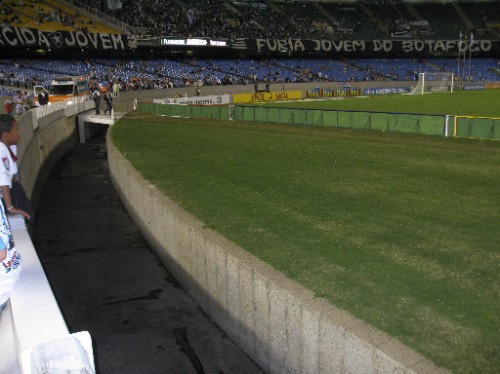
In 1978, my father and I went to a soccer game at Rio de Janeiro's Maracana Stadium, which I knew about from the Guinness Book of World Records because 199,854 paying spectators had crowded in to watch Brazil lose the 1950 World Cup final match to Uruguay. (Maracana has been upgraded at vast expense to host the World Cup final next year.)

The Maracana Moat, RIP
Neither my father nor I had paid much attention to the threat of crime. We'd been traipsing all over Rio that day, walking through a favela in the early morning, taking city buses all over. When we wound up in the Maracana neighborhood, I suggested seeing if there was a soccer game at the famous stadium. Sure enough, Santos (Pele's old team) was visiting from Sao Paulo and their late afternoon game was just about to start. We paid $0.55 each, which got us below-field standing room next to the deep moat that discouraged spectators from expressing their disenchantment by storming the field and lynching the ref.

The sun went down while we were watching the game, so as a rare gesture toward prudence, we decided to take a cab back to our hotel at the beach. But, when we came out we found that there were no cabs around. Cabbies weren't crazy enough to go to the Maracana neighborhood after dark in 1978.

I was starting to get a little concerned, when a four-foot tall bodybuilder walked up and told us that American tourists shouldn't be wandering around here after dark. The short but extremely muscular Brazilian said he was a tour guide for a large group of Germans and we should ride back to Copacabana Beach on his bus. So, we got on with all his German clients.

On the bus ride, our rescuer asked where we were from and when we said Los Angeles, he said, "You'll probably think me a freak, but I've always wanted to visit Muscle Beach in Venice." This was 1978 when the ideal had been for several years to look like Bruce Dern. I was going to tell him that my impression was that in L.A. weightlifting was becoming big, very big, but I never said it -- maybe I got tripped up trying to remember how to pronounce the name of that guy, you know, the one with all the muscles and all the consonants in his name, S, w, z, n, r, etc. -- and ever since, I've felt bad that I couldn't reassure this very nice fellow that he wasn't a weirdo, he was on the cusp of the Next Big Thing.

A lot of things have changed since 1978, and I'm sure that when Maracana hosts the 2014 World Cup final, Steps Will Have Been Taken to make sure that tourists are perfectly safe. But what about all the other cities in Brazil where matches will be held?

But, don't even think about it. Thinking is bad.

ESPN gave sportswriter Bill Simmons his own magazine, Grantland, because Simmons, as one of my commenters once said, is a master at reproducing in text the feel of what a really good discussion about sports with your college buddies is like.  

But, Grantland publishes a lot of non-Simmons articles that sound like they were written by authors whom nobody would want to be buddies with. For example,
A Yellow Card 
As the 2014 World Cup looms, how should we talk about the problems in Brazil? 
By Brian Phillips 

So far in Brazil in 2013, there have been two soccer-related decapitations, which apparently might remind people that Brazil will host the World Cup next year, and the movie City of God was filmed in Rio, and, oh, yeah, there's a lot of crime in Brazil.

But, remember, Noticing Is Bad.
... How do you feel, hearing these stories? I don't mean how do you think you're supposed to feel; I mean how do you feel, in fact? Are you intrigued? Disturbed? Sad? Curious? Titillated, in the way that horrifying real-life stories can sometimes leave you titillated? You don't have to answer. Just think about it. 
Two points make a trend. Here are two gruesome stories about soccer-related beheadings in Brazil. On the surface, they have little in common. One is — best guess — about gangs sending a message. The other is about a local conflict that warped into mass insanity. But, well, 2014 is a World Cup year, and Brazil, you might have heard, will be hosting. The second decapitation story had barely hit the wire before a portion of the Western media lined up the horrors and drew the only logical conclusion: Tourists must be in danger. 
Of course, they couldn't just come out and say so. There's an art to these things. "Beheadings raise concern of violence in Brazil," USA Today announced in a headline.1 CNN declared that "experts say" (they don't quote any) that the concerns thus raised "might make fans think twice about bringing their families to Brazil." Bleacher Report furthered the mystery experts' speculations on the raised concerns, arguing that the violence "may" affect "the type of tourist that decides to come to Brazil to witness football's greatest tournament, with families unlikely to take young children." "How will this affect the World Cup?" was the golden thematic arch bridging countless articles about a story that's only indirectly tied to the World Cup at all, and after reading enough of them, you could almost appreciate the dead-soul directness of this Buzzfeedy link bait–shriek from PolicyMic, posted after the Pio XII decapitation: "This Horrific Video Will Completely Change Your View of the 2014 World Cup in Brazil."2 
This is all, of course, code language, and it's not especially subtle code language. 
It's a code that pops up again and again when a developing or newly industrialized country hosts the World Cup. The code works on three, possibly four, levels, and it makes me want to throw my desk through a brick wall, so I'll try to be as precise as possible about the various sleights of late-colonialist hand I think I can trace here. 
Take the following sentence; it's from USA Today, because of course it is, but it could be from anywhere. It goes: "The news of a second decapitation this year in Brazil has raised questions about whether such heinous crimes may deter foreign visitors considering a trip for next summer's FIFA World Cup." What is this sentence trying to do, apart from draw the brightest, straightest line between "the news of a second decapitation" and "next summer's FIFA World Cup"? Is it really aiming to tell you that Questions have been Raised about World Cup attendance? 
3 Maybe; but I submit that in this instance, the surface level of the code — "questions raised" — is just slippery journalistic-ethics-ese for "Hey, if you go to the World Cup you might get your head chopped off." That's the second level, the primal fear bit. It's not safe down there. Those people are crazy. And note that we've been led to this level by a turn of phrase insinuating the possibility of a World Cup disaster — ostensibly because of attendance problems ("deter foreign visitors"), but what you're actually imagining at this point is a bloodbath ("heinous crimes"). You're being invited to construct a fantasy in which several hundred thousand tourists less well-advised than USA Today readers like you make the trip down to Brazil and are slaughtered in their replica kits. That's the third level. Blood-spattered Wayne Rooney jerseys strewn throughout the streets.4 
And I'm sorry, but that's not the only fantasy you're being invited to construct.
The top level of the code is the one in which you feel yourself to exist within a protective bubble of law and security, outside which all is madness. Here in this Holiday Inn Express in Lincoln, Nebraska, you are safe; in South America, life is cheap. That is not simply a fleeting implication, my friends, that is a media strategy and a worldview, and it is not one in which you are encouraged to regard all your fellow humans as equals. 
Sidebar here: Murders involving decapitation are vanishingly rare in the United States (they are vanishingly rare everywhere), but they happen. In 2012, a New Jersey woman cut off her son's head and put it in the freezer before stabbing herself to death. In 2013, a 49-year-old school nurse was found headless in a South Florida sugar cane field. Two points make a trend. Concerns have been broached about whether Germans will still come to Disney World.

Of course, foreigners interested in visiting America destinations other than Disney World are concerned about crime Here's the Washington Post's summary of the French government's warnings to their nationals about where to avoid in the U.S.: "16 American cities foreign governments warn their citizens about," including this alert for visitors to Washington DC: "Le quartier Anacostia n’est pas recommandable de jour comme de nuit."

Second, two points do suggest which way the probability distribution might be shifted. The fact that this guy can't find two beheadings in the U.S. in this decade that are tied together thematically the way Brazil's soccer decapitations are suggests that decapitations aren't really a Thing in contemporary America, the way beheadings are a Thing are in, say, contemporary Mexico. (Of course, in Brazil, everything is related to soccer.)

The reality of course is that all these lectures about "How to Talk" aren't going to change the fact that, according to Wikipedia's list of the 50 cities in the world with the worst murder rates, Brazil has 13 of them. To put that in perspective, the U.S. holds down four positions in the Top 50, and if I gave you six or seven guesses, you'd probably get all four right: New Orleans, Detroit, St. Louis, and Baltimore. (Talk about stereotypes ...)

Tuesday, August 7, 2012

Brazil Beats Mexico 2 Goals to 1 (This is Not Soccer)

A very interesting post from www.Stratfor.com about Mexico losing a trade war with Brazil. This follows this post about Mexico meddling in U.S. immigration enforcement.  This follows this article about American energy independence and preventing money from going to hostile countries such as Iran and Venezuela. For more that you can do to get involved click HERE and read this very interesting book HERE!


Brazil Beats Mexico 2 Goals to 1


--------------------------------------------------------------------------------


By Luis Miguel González, Editorial Director at El Economista (Mexico)


Some will say that the end result is not important because the most important matter to achieve was that the Mexican national team continued on the field.


The scoreboard reads 2-1 against the Aztecan teams. Brazil got the two things for which it came to negotiate: Mexico will drastically reduce its auto exports and national content of the parts will increase from 30 to 40 percent.


Mexico was able to score a small goal. It managed to save the Economic Complementation Agreement (ECA). To do this, Mexico accepts more than a 30 percent reduction in sales to Brazil. Mexico sold US$ 1.4 bln to Brazil in 2011. The former will have a limit of US$ 1.45 bln in 2012, US$ 1.56 bln in 2013 and US$ 1.64 bln in 2014.


Some will say that the end result is not important because the most important matter was to achievement that the Mexican national team continued on the field. The risk was real: Brasilia was ready to break the ECA 55 in the event that Mexico did not accept the terms proposed by the South American giant. That was clear in the diplomatic letter sent March 9.


Mexico is weak and Brazil is strong? That is the impression we are left with. Brazil imposed the main terms of the agreement; Mexico could only affirms its position in the details. Brazil’s initial position was to set limits to Mexican exports based on the average of the last five years (US$ 1.15 bln). Also on the table was the aspiration of 50 percent Brazilian content.


The Mexican delegation failed to get the category of car parts included. There is not evidence that it had tried. Brazil has a surplus there and, probably, does not want to put it up for negotiation but until the Mexican industry gets a balance in its favor. Weakness or strength are relative and depend on the color of the crystal through which one views the situation. In any case, here we are talking about intra-firm trade: Nissan, Volkswagon, Ford, Honda and General Motors are the protagonists in Brazil and Mexico’s automotive trade. For these international corporations, the important thing is to maintain their world factories operation. The rupture of bi-national trade was not an option. By whatever means, it is worth posing the question: Are the subsidiaries of carmakers in Brazil closer to the government than the subsidiaries of said carmakers in Mexico?


Brazil 2, Mexico 1. The scoreboard generates a lot doubt for the future. There are no guarantees that the Brazilians will abstain from pressuring on other matters in the event that they feel they can obtain new concessions. The bilateral trade balance with Brazil annually totals about US$ 9 bln. The automotive trade represents 45 percent of it.


It is not clear if it is worth trying to forge a Free Trade Agreement with Brazil or, on the contrary, it is a signal that Mexico has to look somewhere else. Mexico would fair well with a diversification of its foreign trade. With 79% depending on the United States, this is not healthy, as demonstrated by the outbreak of the 2008 subprime crisis. We continue receiving pneumonia when Uncle Sam gets the flue. Brazil is a tough nut to crack but it is also a partner to consider in the future: it has a grand domestic market and high prospects for growth in the future. Oil is a natural area for collaboration, as is looking for solutions to a green economy.


Mexico 2, Brazil 1. This scoreboard is desirable and possible to the extent that Mexico goes one step forward in the next negotiation. Chess players know, the one who plays with white pieces has a slight advantage.


--------------------------------------------------------------------------------

.


Read more: Brazil Beats Mexico 2 Goals to 1
Stratfor