Showing posts with label France. Show all posts

Wednesday, July 27, 2016

Democrats never mentioned ISIS, jihad, or terrorism

A timely post about from www.jihadwatch.org about appeasement towards terrorism. This follows this post about Pokemon Go. This follows this article about American energy independence and preventing money from going to hostile countries. For more, you can read two very interesting books HERE.You can follow me here.

Democrats never mentioned ISIS, jihad, or terrorism on Day One of DNC

Politifact is not really a fact-checking site; it’s just another propaganda arm of the far-Left. So if even they are saying this, the problem is acute and clear. For the Democrats, jihad terror is just not a priority. The fact that there was no mention of it whatsoever on the first day of their convention is abundant illustration of that, whatever they might say on the second or third day. They’re much more interested in climate change and pandering to their various interest groups. Meanwhile, Germany and France are on fire, and because of policies still endorsed by the Democrats and numerous influential Republicans, that fire is coming here.
Michelle Obama DNC
“Politifact: Democrats never mentioned terrorism on Day One of DNC,” by Tyler Pager, Politico, July 26, 2016:
Republicans’ claim that Democrats did not mention terrorism or ISIL on the first night of the Democratic National Convention is correct, Politifact said Tuesday morning.
Following Monday night’s speeches, Republicans blasted the Democrats for a lack of focus on terrorism from the 61 speakers.
“Based on our searches of C-SPAN closed-captioning text, Congressional Quarterly transcripts and other video archiving services, we couldn’t find any speaker who mentioned “ISIS,” “Islamic” “terror,” “terrorist,” or “terrorism” during the first day of the convention,” Politifact wrote.
The fact-checking website did add the caveat that the Democrats still have three days to discuss terrorism at the convention and the first day of the convention was not meant to focus on foreign policy. Additionally, Hillary Clinton on Monday called for action against ISIL at a rally in Charlotte, North Carolina.
“We need to lead other countries in stopping ISIS, Al Qaeda, and other radical jihadist groups,” she said. “We shouldn’t leave that to the rest of the world to figure out on their own. That won’t keep us safe.”
Germany: Sharia patrol threatens nude bathers with "extermination"
France: Church where priest was beheaded was on jihadi hit list of Catholic churches
FacebookTwitterGoogle+LinkedInDiggBlogger PostDeliciousStumbleUponDiasporaEmailPrint

Tuesday, July 19, 2016

Erdogan's Grand Vision for Turkey and the Arab World

An interesting article from http://www.ucg.org/ about Turkey's leader, Erdogan. This follows this post about Muslims in Europe. This follows this post about the police.  For a free magazine subscription or to get the books recommended for free click HERE! or call 1-888-886- 8632.

It began with a dramatic scene at the World Economic Forum in Davos, Switzerland, in January 2009. During a panel discussion on the Israeli intervention in Gaza, Turkish Prime Minister Recep Erdogan walked off the stage when he was refused extra time to speak. Immediately prior to his departure, he angrily told Israeli President Shimon Peres that “when it comes to killing, you [Israelis] know well how to kill.”
At first, some observers thought Erdogan's harsh criticism of Israel's intervention in Gaza was merely a momentary lapse of diplomatic restraint. The following 12 months, however, showed that Erdogan's outburst reflects what appears to be a radical change in Turkey's foreign policy toward Israel. The inflammatory language continued when the Turkish leader promised a retaliatory air strike “like an earthquake” if Israel were to violate Turkey's air space in attacking Iran. He also predicted that “Allah's revenge” would come on Israel.
One year after the angry remark in Davos, the Turkish government threatened to recall its ambassador from Tel Aviv. According to Erdogan, such retaliation was appropriate after Israel's deputy foreign minister Danny Ayalon delivered a protest to Turkey's ambassador Ahmet Oguz Celikkol in a humiliating manner—refusing to shake his hand and having him sit in a lower position. Israel's complaint was about the popular Turkish television series Valley of the Wolves, which, among other offenses, depicted Israeli intelligence operatives kidnapping children to convert them to Judaism.
Even in averting the diplomatic crisis, the war of words continued. Ayalon did not retract his criticism of Turkey, though he did declare his intention to be more careful in the future. Israeli Prime Minister Benjamin Netanyahu then said he was satisfied with Ayalon's statement but emphasized that the criticism of Turkey was justified. The Turkish foreign ministry in the capital of Ankara responded by emphasizing its historic responsibility to warn and criticize Israel.
Prior to the Davos incident, Turkey and Israel had long enjoyed close diplomatic relations and had even conducted small-scale joint military maneuvers. Turkey also had an important function as a potential mediator in any future peace negotiations between Israel and Syria. Why would Turkey change its approach toward Israel? And what does this mean for the future of the Middle East?
Turkey's uncertain future in Europe
Since World War II, Turkey has been a loyal supporter of the West. Turkish troops fought alongside U.S. forces in the Korean War; and as a member of NATO, Turkey was home to military installations monitoring Soviet activities. America supports Turkey's bid to join the European Union. Turkey has had “associated status” since 1963 (then with EU predecessor the European Economic Community), and it first applied for full membership in 1987. When negotiations began in 2005, Erdogan emphasized that his country would settle for nothing less than full membership.
Progress on negotiations has been slow, with the EU expecting Turkey to amend its constitution to prevent intervention in state affairs by the military, to improve human rights and to give greater rights to its ethnic minorities. Since 2005, only 11 out of 35 “negotiating chapters” on admission to the EU have been opened for discussion, and only one has been “provisionally completed” so far.
The main point of contention between Turkey and the European Union is Turkey's intransigence on the issue of Cyprus. The Turks control the northern part of this island country and reject the sovereignty of the Republic of Cyprus (or Greek Cyprus), which rules over the southern part of the island—and the Republic of Cyprus is an EU member.
In a diplomatic note signed in Ankara in July 2005, Turkey had recognized the EU customs union as including Cyprus. That agreement was the last obstacle removed in paving the way for the start of official negotiations on Turkish EU membership. Yet after official negotiations began in October 2005, Turkey continued its blockade of all ships and planes originating from southern Cyprus. This stance violates the basic EU principle that all member states recognize each other and impose no trade barriers.
If Turkey's position on Cyprus remains unchanged, then acceptance of Turkey into full EU membership would require sacrificing basic principles. And that does not appear likely in this case.
Even if negotiations are completed successfully, all it would take for Turkey's bid for EU membership to fail is for one EU member to block approval for admission. With national referendums a possibility in more than one country—notably France and the Netherlands—final approval is by no means a certainty.
This prospect is what observers see as the catalyst behind Turkey's shift in foreign policy. Last summer even U.S. President Barack Obama warned that Turkey might align itself outside the West if negotiations on its bid for EU membership remain inconclusive.
Obama told Italian newspaper Corriere della Serra that he did “not think the slow pace or European reluctance is the only or predominant factor at the root of some changes in the orientation recently observed in the Turkish attitude. But it is inevitably destined to play a role in how the Turkish people see Europe … if they do not feel themselves part of the European family, it is natural that they should end up looking elsewhere for alliances and affiliations” (quoted by Reuters, July 8, 2010).
Turkey's courtship of the Islamic Arab world
With future EU membership uncertain, Turkey has begun courting its historic realm of influence: the Islamic Arab world, much of which was once under Ottoman Turkish rule for hundreds of years. Erdogan's visit to the Persian Gulf region in January 2011 makes President Obama's comments seem prophetic. Speaking on Jan. 11 at the Turkish-Arab Relations Conference in Kuwait, Erdogan reminded his listeners that Muslim Turks and Arabs had resisted Christian crusaders together. And he urged Arabs and Turks of today to forge their own union and determine the fate of the Middle East:
“The Arabs are our brothers and sisters. We are their brothers and sisters … Regardless of what some say, we will continue to develop brotherhood and cooperation with our Arab brothers and sisters … We will not turn our back to regions with which we have been sharing friendship and brotherhood for centuries. Our union is political, economic, commercial and cultural. We are members of the same civilization. We share a common history. We wrote our joint history together …
“Through solidarity, we can overcome the Palestine problem and end the pain in Iraq and Afghanistan. We do not have to apply at others to help us. Yet, at foremost, we need to establish our own union. We can strengthen stability in Lebanon and prevent terror acts in Egypt. Through solidarity, we can overcome poverty in the region” (“We Will Determine Our Own Foreign Policy, Turkish Premier Says,” The Journal of Turkish Weekly, Jan. 11, 2011, emphasis added).
With Turkey's open criticism of Israel's treatment of the Palestinians, Erdogan and his government are increasingly popular among the Arab populations of the Middle East. “When children in Gaza were massacred,” he said, “we felt their pain as if our own children went through a massacre. Jerusalem's problem is our problem. Gaza's problem is our problem” (ibid.).
In fact, analysts see Turkey's shift in foreign policy toward Israel as a move calculated to legitimize any future leadership role for Turkey in the region. The shift appears to be paying off, with Erdogan in 2010 being awarded the Arab world's equivalent of the Nobel Prize, the King Faisal International Prize for Service to Islam.
Turkey and a future Islamic confederation
Turkey's independent foreign policy appears to be shifting in a direction that was warned of in Bible prophecy millennia ago. Psalm 83 contains an intriguing prophecy of many Middle Eastern nations that, while it may have applied in part to events of ancient times, appears to be as yet unfulfilled and to possibly tie in with end-time events. If so, it foretells a confederation of Arab nations and Turkey determined to eliminate Israel.
“They have taken crafty counsel against Your people, and consulted together against Your sheltered ones. They have said, 'Come, and let us cut them off from being a nation, that the name of Israel may be remembered no more.' For they have consulted together with one consent; they form a confederacy against You: The tents of Edom and the Ishmaelites; Moab and the Hagrites; Gebal, Ammon, and Amalek; Philistia with the inhabitants of Tyre; Assyria also has joined with them; they have helped the children of Lot” (verses 3-8).
These biblical names are significant when we understand the areas and peoples to which this prophecy refers. Edom includes the Palestinians and some of the Turks. The Ishmaelites, descendants of Ishmael, are many of the Arab peoples throughout the Middle East and North Africa. Moab is the area of central Jordan. The Hagrites appears to be other descendants of Hagar, mother of Ishmael.
Gebal, meaning “mountain” or “boundary,” is commonly equated with the Phoenician city of Byblos, modern Jubayl in Lebanon. Ammon refers to northern Jordan around Amman, the capital (which gets its name from Ammon). Amalek appears to refer to a branch of Edomite Palestinians. Philistia is the area around what is today known as the Gaza Strip. Anciently, Tyre was a major city-state in southern Lebanon along the Mediterranean coast. The children of Lot refers to Moab and Ammon—again, regions of modern-day Jordan.
Arab unity has long been elusive, but slowly a common purpose is bringing the different peoples of the Arab world together. This common purpose is the desire to destroy the nation of Israel and its chief backer, the United States of America, along with the West's liberal culture, long perceived as a threat to the Muslim way of life. Edom, which includes modern-day Turkey, is mentioned first in the prophecy of Psalm 83 and therefore seems to play a prominent role in this development.
Turkey and the European Union
Another nation listed in Psalm 83 is Assyria. While in a historic/geographic sense that could refer to what is now northern Iraq, the reference could be an ethnic one to inhabitants of Central Europe, whose ancestors “migrated into Europe from the Caucasus and the countries around the Black and Caspian Seas” ( Smith's Smaller Classical Dictionary, 1910, reprinted 1940, p. 226).
Hundreds of years before Christ, the Hebrew prophet Daniel foretold future occurrences in the Middle East and the world at large, including Europe. His prophecies were later complemented and fleshed out in the book of Revelation, revealed to the apostle John near the end of the first century.
The prophecies these men delivered show that a European-centered superpower will rise to dominate the world in the end time, just before Jesus Christ returns to establish the Kingdom of God on earth. As revealed to John, this superpower will be a union of 10 rulers of nations or groups of nations (Revelation 17:12-14). By all appearances, this final superpower may not be that long in coming. The foundation is being built before our eyes, and prophecy seems to show cooperation with Middle Eastern peoples in opposing Israel.
But what if Turkey's bid to join the European Union is unsuccessful? Would that negate prophetic indications of cooperation? Not necessarily. There is always the possibility of a strategic alliance based on a “privileged partnership.”
Gündüz Aktan, who had held several diplomatic posts for Ankara and helped write Turkey's application for membership to the European Union, wondered before negotiations had even started whether full membership would be the best course for his country: “Negotiations could last 20 years, but a 'privileged partnership' could be decided upon immediately, and Turkey would not be required to give up full membership at a later date. Turkey would be given a vote in the committee of European defense ministers. As a 'privileged partner' Turkey would receive nearly as much financial assistance as a full member without being forced to accept many EU standards which would result in higher [domestic] prices” (translated from Die Welt , June 8, 2005).
Aktan did not mention the most important aspect of all: Since Turkey has announced that it will not accept anything other than full membership in the EU, a “privileged partnership” offered by the EU as an alternative to full membership would be rejected. The result would be strained relations between the EU and Turkey, lasting years. If, on the other hand, Turkey were to withdraw its bid for membership unilaterally—possibly to save face because of the likelihood that its bid for membership will be rejected—it could accept the “privileged partnership” and retain cordial relations with Europe.
Despite tensions that might exist now over the question of Turkish EU membership, it appears Turkey will remain affiliated with Europe. This is a country that straddles both Europe and Muslim Asia—forming a bridge both geographically and culturally between East and West. And, as a possible key player in a future confederation with the Arabs, it seems that Turkey will also provide a link between the Arab Islamic Middle East and Europe.  WNP

You might also be interested in...

Friday, July 15, 2016

Europe at a Crossroads What Lies Ahead?

An interesting article from http://www.ucg.org/ about Muslims in Europe. This follows this post about officeholders. This follows this post about Religious Freedom. This follows this post about the police.  For a free magazine subscription or to get the books recommended for free click HERE! or call 1-888-886- 8632.

MP3 Audio (23.07 MB)
All over Europe, average citizens seem to be waking up to the reality of their situation far better than the political elites that run their countries.
In Germany, pepper spray has disappeared from stores as buyers worried about waves of migrants emptied the shelves. In Sweden, angry arsonists set fire to 17 existing or planned immigrant housing centers in October and November. In Austria, citizens concerned about the flood of refugees have bought tens of thousands of handguns and rifles in recent months, and stores are running out of shotguns.
Support for anti-immigration political parties is growing more widespread. British voters are so fed up with the European Union’s open borders policy that Britain may soon elect to leave the EU altogether rather than continue to be subject to invasion by thousands of non-European migrants.
Anti-immigrant voters have already replaced governments in Poland and Croatia, and made huge gains in Sweden, France, Denmark and Greece. In Germany, support for Angela Merkel, who opened the nation’s doors to 1.5 million migrants, is plummeting.
Clearly the ground is shifting in Europe. Much like the United States, where voters are increasingly frustrated and turned off by their political leaders, Europeans are looking for alternatives to a political establishment viewed as more and more out of touch with the average man on the street.
These trends were well under way even before nine jihadists using automatic rifles, hand grenades and suicide-bomb vests slaughtered 130 people and wounded hundreds more in Paris restaurants and a concert hall the night of Nov. 13. An attack at a soccer stadium was thwarted; otherwise the casualties would have run far higher. In a particularly callous act, the gunmen singled out and shot disabled people in an area of the concert hall set aside for wheelchair users.
Particularly unsettling are the identities of the killers. Most were French or Belgian citizens born of Muslim-immigrant parents. At least two others were among the waves of immigrants who entered Europe by boat via Greece only six weeks earlier, and two others remain unidentified. Throughout Europe, people are deeply concerned about what these things mean for their lives, their countries and their future. The continent is changing before our eyes.
Where could these trends be heading? Does the Bible give us any indication?

Insights from Bible prophecy and history

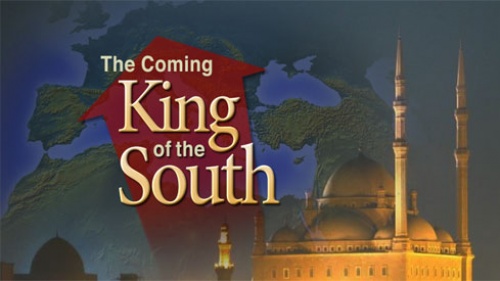
The 11th chapter of the book of Daniel gives a detailed prophecy of events in the Middle East that began in Daniel’s day and continues down to events that take place at the return of Jesus Christ to establish the Kingdom of God on earth. Much of the prophecy concerns individuals called “the king of the North” and “the king of the South.” These denote leaders of geopolitical powers to the north and south of Jerusalem, the focal point of Bible prophecy, but they have a connection to both the Middle East and Europe.
Originally these terms applied to the successors of Alexander the Great, whose vast empire was divided up among his chief generals after his death. The two major resulting kingdoms, centered in Syria to the north of Jerusalem and Egypt to the south, would be the key powers Daniel’s prophecy would center on for the next several centuries.
Most of this prophecy was fulfilled many centuries ago between the time of Alexander the Great and the rise of the Roman Empire. But in verse 40 the prophecy jumps forward to our day, “the time of the end” before the return of Jesus Christ.
What is this verse describing? We need a good grasp of history to understand.
In the 600s and 700s A.D. the new religion of Islam spread from the Arabian Peninsula across much of the Middle East, as well as through Egypt and across North Africa. Over time Muslim conquerors captured Spain and invaded France, and later took over large portions of southeastern Europe. Along the way they also invaded and held portions of Italy, and in A.D. 846 Muslim raiders attacked Rome itself and plundered the original St. Peter’s Basilica, at that time outside Rome’s protective walls.
Another wave of Islamic expansion in the 1100s vastly expanded the territory under Muslim control to include most of the northern third of the African continent, much of the Indian subcontinent, a large swath of southeastern Europe and part of what is today southern Russia and some of the former Soviet republics.
For centuries the Islamic world was ruled by a series of caliphs— an Arabic term meaning “successor,” in this case a religious and political successor of Muhammad, founder of Islam and considered its greatest prophet. The territory over which the caliph ruled was known as a caliphate. This system existed until 1924, when it was abolished in the aftermath of World War I with the fall of the Ottoman Empire, the last embodiment of the caliphate.
Throughout Islam’s history its leaders have desired to see Muslims worldwide unite under a caliphate and establish Islam in what they see as its rightful place as the dominant religion of the world. In recent decades al-Qaeda leader Osama bin Laden called for the reestablishment of a caliphate, as has the Muslim Brotherhood (which spawned al-Qaeda and other terrorist groups).
In June 2014 the Islamic State, formed out of the rubble of the Syrian civil war and the collapse of central authority in Iraq after the withdrawal of American troops, declared itself a new caliphate with Abu Bakr al-Baghdadi as its caliph.
Thousands of Muslims from around the world have flocked to Syria and Iraq in support of this long-held Muslim dream to reestablish the caliphate. (The world also has seen the Islamic State’s vision of a new caliphate as it has instituted Islamic law in the territories it controls and its fighters have butchered any who stand in its way.)
Many Muslims also believe in the imminent coming of an individual they call the mahdi, a messiah-like Islamic figure who will arise in the end time and lead Muslims in ridding the world of evil and converting it to Islam. Some also believe the mahdi will be accompanied by Jesus Christ (called Isa by them), whom they believe to be a Muslim who will forcibly convert Christians to Islam.

Obstacles standing in Islam’s way

But for these goals to succeed, several obstacles must be removed. One is the modern state of Israel, which is why this tiny nation has been the target of unrelenting hostility from the Islamic world ever since its establishment in 1947. This is also why Iran, whose leaders and millions of its citizens believe in the mahdi, calls repeatedly for Israel’s elimination or annihilation.
Another obstacle is the United States, often referred to as “the great Satan” in the Islamic world, and Britain, often called “the little Satan” (along with Israel). This is why Islamic terror groups regularly call for attacks and jihad— “struggle” or holy war—against America.
But another obstacle standing in the way of Islamic conquest is Europe. Perhaps you have been puzzled by Islamic terrorist leaders such as Osama bin Laden and Abu Bakr al-Baghdadi referring to European and American soldiers as “crusaders.” This sounds bizarre to Western ears, but in the Islamists’ view the Crusades of centuries ago never really ended.
As they see it, the recent American-led wars in Iraq and Afghanistan are simply another phase in the Crusades, and this ages-long struggle will not end until Europe—the land from which the Crusades originated—is vanquished and converted to Islam.

Calls for Islamic conquest of Europe

Several Muslim leaders have openly called for such a conquest of Europe and spelled out how this can be accomplished—by force if necessary, but also by Muslim immigrants simply moving in and taking over (through political pressure and high birth rates).
Muammar Gaddafi, leader of Libya before he was overthrown and executed in 2011 by even more radical elements, said this: “There are signs that Allah will grant Islam victory in Europe—without swords, without guns, without conquests. The fifty million Muslims of Europe will turn it into a Muslim continent within a few decades.”
Yunis al-Astal, member of the Palestinian parliament and a Muslim cleric, boasted the following in a sermon aired on Hamas-run Al-Aqsa TV in 2008: “Very soon, Allah willing, Rome will be conquered … as was prophesied by our prophet Muhammad. Today, Rome is the capital of the Catholics, or the Crusader capital, [but it] will be an advanced post for the Islamic conquests, which will spread through Europe in its entirety …”
As recently as Sept. 11, 2015, Muslim imam Sheikh Muhammad Ayed spoke in Jerusalem’s Al-Aqsa Mosque, the third holiest site in Islam, saying: “Soon, we will trample [the Jews and Christians] underfoot, Allah willing … Throughout Europe, all the hearts are infused with hatred toward Muslims … But … we will breed children with them, because we shall conquer their countries—whether you like it or not, oh Germans, oh Americans, oh French, oh Italians, and all those like you. Take the refugees! We shall soon collect them in the name of the coming Caliphate.”
Islam’s holy book, the Quran, praises migration as a way to spread Islam to new lands. Surah 4:100 reads: “He that leaves his home in the cause of [Allah] shall find many a refuge in the land and great abundance” (Dawood translation).
While hundreds of thousands of Muslim refugees have made the arduous and risky journey to seek refuge in Europe, wealthy Muslim nations like Saudi Arabia, Kuwait, Qatar and Oman have accepted only a relative handful. Why? These countries’ leaders fear terrorists among the refugees who could pose trouble for their own regimes as in Syria. And the dirty little secret is that these nations want to see Muslim refugees overwhelm Europe.
Yes, Islamists clearly have designs on taking over Europe, and it’s not something that they see as centuries off in the future. They’re openly talking about it  now.

Conflict between north and south

Now let’s read the prophecy in Daniel 11:40: “And at the time of the end shall the king of the south push at him: and the king of the north shall come against him like a whirlwind, with chariots, and with horsemen, and with many ships; and he shall enter into the countries, and shall overflow and pass over” (Daniel 11:40, emphasis added throughout).
This tells us that “ at the time of the end” a king of the south will “push at” the king of the north. Who are these prophesied figures, and what does this mean?
The king of the South most likely will be a Muslim figure, since the lands to the south of Jerusalem are overwhelmingly Muslim and have been for centuries. As noted earlier, many Muslims desire and expect an Islamic messiah, the mahdi,or a new caliphto arise to unite Muslims in their struggle against the West. Either of these are likely possibilities.
The Arab world also has a history of populist leaders such as Saddam Hussein, Osama bin Laden and Muammar Gaddafi who saw themselves as leaders of the Arab or wider Muslim world.
Any such leader would naturally want to see Islam take over Europe, just as we are seeing now with massive Muslim immigration, high birth rates, and random violence and terror attacks to cow Europeans into submission.

Who is the end-time king of the North?

And who is the king of the North in this prophecy? Again, we need historical background to understand.
Anciently, the lands of the kings of the North were absorbed into the Roman Empire. Other prophecies in Daniel chapters 2 and 7 describe a series of empires beginning in Daniel’s day and lasting until the time of the end of man’s self-rule on earth. History makes it clear that these were, in order, the Babylonian, Persian, Greek and Roman Empires.
These prophecies show that the last of these—the Roman Empire—exists in a resurrected form at the time of Jesus Christ’s return (Daniel 2:42-44; Daniel 7:23-27). While Muslims have dreamed for centuries of a united Islamic world, so too have Europeans longed for a unified European state. Some even describe their goal with the term “United States of Europe.”
In the centuries since the fall of the Roman Empire, various kings, emperors and despots openly proclaimed their desire to rebuild that dream. The current European Union (EU) was born of this desire decades ago, and it is a major economic power by any measure, rivaling America in important respects.
And Bible prophecy also reveals that a new European-centered superpower will become a reality—possibly as an outgrowth of the current European Union, which in its current form appears too politically weak and divided to continue indefinitely under its current pressures.
This new superpower is depicted prophetically in Revelation 17 as a creature with 10 horns representing an alliance of 10 leaders of nations or groups of nations who “give their power and authority” to another leader called “the beast” (Revelation 17:12-13).
The time setting for this is just before Jesus Christ’s return (Revelation 17:14), as this union “will make war with the Lamb.” The leader of this end-time superpower and the king of the North appear to be one and the same, as the king of the North also comes to his end in this same time frame—“the time of the end” (Daniel 11:40, Daniel 11:45).      

Keys trends to watch

To sum up, this prophecy gives us the following keys to look for:
• Efforts to unify the Muslim and/or Arab world under a single caliphate or leader.
• Continued efforts from the Islamic world to take over Europe via violence or migration or both.
• Shifts in European thinking toward anti-immigration leaders and parties, culminating in greater European unity and military and economic power—and ultimately in a coming military invasion of Egypt, Libya and Israel that sets the stage for a new world war that will threaten humanity with extinction.
We live in increasingly dangerous and sobering times. Those of us at Beyond Today are here to help you navigate these troubling waters. Continue reading Beyond Today so you can be better prepared for what lies ahead—and join us in praying to God always, “Your Kingdom come!”

You might also be interested in...

United Church of God Pastor, Beyond Today Managing Editor Scott Ashley is managing editor of Beyond Today magazine, United Church of God booklets and its printed Bible Study Course. He and his wife, Connie, live in Arvada, Colorado, a suburb of Denver.
After graduating first in his high school class, Mr. Ashley attended Ambassador College in Big Sandy, Texas, graduating in 1976 with a theology major and minors in journalism and speech. It was there that he first became interested in publishing, an industry in which he has worked for more than 35 years.

Friday, May 20, 2016

A Closer Look at Egypt's Muslim Brotherhood

An interesting article from http://www.ucg.org/ about Egypt and the Muslim Brotherhood. This follows this post about corrupt governments. This follows this post about Facebook and Transgendered people. For a free magazine subscription or to get the books recommended for free click HERE! or call 1-888-886- 8632.

“However,” notes Steven Simpson in the Canada Free Press, “if one looks for reality and clarity (unlike the current American administration which foolishly engages the Brotherhood and views it as 'moderate'), it will be seen that the Brotherhood is a violent fascist movement that seeks global Islamic domination. Indeed, it is the phalanx and aegis for all Islamist groups that have emerged throughout the Muslim world. Bluntly put, it is nothing short of an Islamic hydra, and an implacable enemy of the West, Israel, and all non-Muslims” (“Why the Arab Spring Will Descend Into an Islamic Ice Age,” April 16, 2012).
The Muslim Brotherhood was founded in Egypt in 1928 by a schoolteacher and imam named Hassan al-Banna, who desired the revival of the Islamic caliphate. The caliphate—the international community of Muslim believers led by a caliph, a successor to Muhammad—had fallen with the end of the Ottoman Empire at the conclusion of World War I and the modernizing influence of Kemal Ataturk, who with great difficulty transformed Turkey into a secular state.
Al-Banna was killed in 1949, and the Brotherhood was banned in Egypt just before, but it would continue to operate—soon guided by al-Banna's principal disciple Sayyid Qutb, who had been a bureaucrat in Egypt's education department.
In the words of former U.S. Attorney General Michael Mukasey: “Qutb caused enough trouble in Egypt to get himself awarded a traveling fellowship in 1948 … Regrettably for us, Qutb chose to travel to Greeley, Colorado. And although it would be hard to imagine a more inoffensive place than post–World War II Greeley, Colorado, for a man like Qutb it was Sodom and Gomorrah. He hated everything he saw: American haircuts, enthusiasm for sports, jazz, and what he called the 'animal-like mixing of the sexes,' even in church.
“His conclusion was that Americans were 'numb to faith in art, faith in religion, and faith in spiritual values altogether,' and that Muslims must regard 'the white man, whether European or American … [as] our first enemy' … [He later] continued to write and agitate for Islam and against Western civilization, particularly against Jews, whom he blamed for atheistic materialism and considered the worst enemies of Muslims” (“Executive Power in Wartime,” Imprimis, October 2011).
Qutb later became the leading member of the Muslim Brotherhood and was eventually hanged in Egypt in 1966. But his brother Muhammad Qutb fled with other Brotherhood members to Saudi Arabia and eventually taught Sayyid's ideology to then-obscure figures Osama bin Laden and his eventual right-hand man Ayman al-Zawahiri, the leader of al-Qaeda since Bin Laden's death. These al-Qaeda figures and their followers are sometimes referred to as Qutbists.
Another follower of Sayyid Qutb's writings was Omar Abdel-Rahman, often called “the Blind Sheik,” spiritual advisor to the 1993 World Trade Center bombers who is currently serving a U.S. sentence of life imprisonment. Bin Laden and al-Zawahiri called for his release before the al-Qaeda attack on the U.S.S. Cole in Yemen in 2000. And they relied on Abdel-Rahman's fatwa calling for the mass-murder of Americans in perpetrating the horror of 9/11 the next year.
The Blind Sheikh remains a hero among Islamists, so it should perhaps come as no surprise that the major calls for his release of late have come not from al-Qaeda but from the current Muslim Brotherhood leadership of Egypt—the so-called moderates.

You might also be interested in...


Thursday, May 19, 2016

Corruption and Despotism Cry Out

An interesting article from http://www.ucg.org/ about corrupt governments. This follows this post about American greatness. This follows this post about Facebook and Transgendered people. For a free magazine subscription or to get the books recommended for free click HERE! or call 1-888-886- 8632.

As someone not born and raised in the United States, I've sometimes been asked who I think was the greatest American president.
My answer has always been George Washington.
The answer often surprises people since Washington led the Continental Army during the Revolutionary War against the British—and I was born and grew up in Great Britain.
But Washington was great for a different reason. The man who became the country's first president set an incredible example for his successors.
At a time when the world was governed mostly by monarchs who ruled for life, Washington retired after two four-year terms in office, thereby setting a precedent for other presidents. Only Franklin Roosevelt broke tradition by standing for election (and winning) four times. After that, the U.S. Constitution was amended to prevent anyone from being elected president more than twice (or once if the person finished out another president's term for two years), limiting the number of years anyone can hold that office.
With America's preeminence in the world during most of the last century, many countries have tried to copy the American system of government. While the United States was the first country to have a presidential form of government, today most countries have a president as head of state.  But few have successfully adopted the U.S. system, and none has been able to copy it successfully for very long. The reason for this goes right back to George Washington.
Whereas Washington retired to his farm after eight years, few presidents around the world seem capable of letting go of the reins of power. Inevitably this leads to dictatorship, frequently accompanied by the title “president for life.” Even if there is no such official title, it is at least understood that the man at the top is there until he dies.
These “presidents for life” surround themselves with sycophants and grow increasingly out of touch with reality. With those close to them constantly praising them, the presidents come to think the people love them—so when opposition arises, they mistakenly assume it's only a minority and use massive force to crush all dissent.
All of this could be avoided if only they would follow Washington's example and retire after eight years!

Arab revolts and dynastic leaders

We've seen a number of these dictator-presidents in the news recently. Demonstrations precipitated by food inflation, high unemployment and corruption have spread across North Africa and the Middle East as people have demanded that their leaders go. Whether these uprisings, dubbed the “Arab Spring,” will result in greater democracy is still a question. Too often, culture limits the potential for a truly democratic system, which requires tolerance and respect for the rule of law.
The first leader to fall in the Arab Spring was Tunisia's President Zine El Abidine Ben Ali, who held his position for 23 years, followed by President Hosni Mubarak of Egypt, overthrown after 30 years in power.
It remains to be seen what will happen to leaders of other countries confronted by revolutionary fervor. One conclusion drawn from the overthrow of Ben Ali and Mubarak is that they reacted to demonstrations with weakness—so the others are doing everything possible to suppress all dissent.
The others include three more beleaguered Arab leaders: Libya's Colonel Gaddafi (42 years), Yemen's Ali Abdullah Saleh (33 years) and Syria's Bashar al-Assad (11 years). Assad succeeded his father, the two of them having ruled the country for 40 years. Although a republic like all other nations with a president, the country has a de facto dynasty. Mubarak and Gaddafi were also grooming their sons for succession.
Many expressed confidence in Syria's president after he succeeded his father in 2000. The son had spent many years in England studying optometry and then working as an optometrist. He even married an English woman of Syrian descent. Many hoped that those years in a liberal democracy like England would have changed him, turning him into a typical, tolerant Englishman. However, once back in his native culture, he reverted to type and has turned out to be every bit as ruthless as his father.
Dynastic successions are not confined to Middle Eastern leaders. North Korea (a self-proclaimed “Peoples' Republic”) is expected to soon get its third hereditary leader. The only other country still espousing traditional communism is Cuba, where founder Fidel Castro's brother Raul has recently been put in charge. These countries should more accurately be called “communist monarchies,” with their very own hereditary family dynasties.
Romania was another communist country set on establishing a ruling dynasty—until the people overthrew and executed their communist monarch, President Nicolae Ceausescu, in 1989.

Corruption a major factor

All of these men have made a fortune out of governing their countries. Dictators of poverty-plagued Third World nations often rank among the wealthiest people in the world—not legally, of course, but through bribes and corruption. This is one reason why so many dictators cannot hand power over to somebody else—they are afraid that the next man in charge might prosecute them on charges of corruption.
This happened in Zambia in 2009 when former president Frederick Chiluba was tried on corruption charges. A common joke in Africa is that, whatever country you're in, you don't ask if the president is corrupt. Instead you ask: How corrupt is he? It's commonly believed that all presidents on the African continent are corrupt. The lesson that many of them will have learned from Zambia is to never surrender power!
Many such leaders will do anything to retain their office. In one African nation there are 2.5 million dead voters. These dead people naturally all “vote” for the president whenever there's an election, thereby giving the incumbent a built-in majority!
This prompts the question: Why bother with elections?
Some presidents like to keep up a level of respectability and acceptance if only to get foreign aid (which often goes straight into their pockets). Membership in multinational organizations like the (British) Commonwealth requires at least the appearance of a democratic system, even though some Commonwealth members have often had periods of military rule.
Ghana, where I once lived, set the pattern. When the British gave the country independence in 1957, it had a system of government modeled on Britain's. Two years after independence, the prime minister, Kwame Nkrumah, called for a change to a presidential system. It wasn't long after that he was proclaimed “president for life.” Then he abolished the parliament, making himself an absolute dictator.
Ghana's early post-colonial experience also showed that the only way to remove a president for life is to forcibly overthrow him, which the military did in 1966. In 1979, a later military government was overthrown by another branch of the military, and all former heads of state were sentenced to death for corruption—for effectively stealing the country blind.
Corruption is a way of life throughout Africa. A recent article in The Economist highlighted corruption in Africa, showing that so many people have a vested interest in corruption that it's doubtful any progress can be made in dealing with it.
Titled “Briefing: Nigeria's Prospects,” the article states: “To change the system, [Nigerian President Goodluck] Jonathan would have to break with his backers. That is difficult, perhaps even dangerous. For instance, a mafia that embezzles vast fuel subsidies is said to be a big contributor to his campaign. The government spends more than $4 billion a year to sell fuel at less than half the already low American price.
“The president's backers routinely falsify bills of lading, inflating the amount of fuel imported fivefold, then collect the government subsidy on all of it, and finally smuggle the fuel to a neighboring country to sell at double or triple the price. Mr. Jonathan, of course, did not personally take their money. But if he goes after them their cronies may stop cooperating” (May 28, 2011).
Even in India, the world's biggest democracy, corruption is endemic and threatens the stability of the country. One of the inevitable consequences of corruption is the growing gap between the rich (often corrupt) and the poor. And as the gap widens there is an increased likelihood of civil disturbance or even revolution. That's what's happened across the Arab world.
But, knowing this, leaders all over the world line their own pockets while the people go hungry!

The example of Equatorial Guinea

One of the worst examples of corruption in Africa is Equatorial Guinea, whose dictatorial president Teodoro Obiang Nguema Mbasogo seized power in 1979 from his uncle, Macias Nguema, who had murdered an estimated one third of his own people. His nephew has been less bloodthirsty but has pocketed much of the nation's oil wealth during his 32-year rule. The country has a population of only 650,000. With oil, every single citizen should have a high standard of living—but that is not the reality.
“Energy revenues have flowed into the pockets of the country's elite, but virtually none has trickled down to the poor majority; since the oil boom began, the country has rocketed to one of the world's highest per capita incomes—and one of its lowest standards of living. Nearly four-fifths of its people live in abject poverty; child mortality has increased to the point that today some 15 percent of Equatorial Guinea's children die before reaching age 5, making it one of the deadliest places on the planet to be young” (“Teodorin's World,” Foreign Policy, March/April 2011).
Ironically, many of the leaders mentioned in these articles claim to be religious men. It would appear that none has read what Jesus Christ had to say on governance.

Jesus Christ's example of governance

Jesus told His disciples that they must be different from the rulers of this world. At the time, the Jews in the land of Israel were living under Roman rule. Rome's leaders in Christ's time were despotic and cruel, lording it over the people, wielding their authority.
What did Christ tell His followers? “Jesus called them [His disciples] together and said, ‘You know that the rulers of the Gentiles lord it over them, and their high officials exercise authority over them. Not so with you. Instead, whoever wants to become great among you must be your servant, and whoever wants to be first must be your slave—just as the Son of Man did not come to be served, but to serve, and to give his life as a ransom for many” (Matthew 20:25-28, New International Version).
Most people in the world live in difficult or even depressing circumstances, under governments that are dictatorial and exploitative. But the good news is that these worldly systems of government and dictatorial styles of leadership will come to an end when Jesus Christ returns to the earth to establish the Kingdom of God over all nations. He will then rule the world with righteousness.
As Isaiah's famous prophecy foretells: “For to us a child is born, to us a son is given, and the government will be on his shoulders. And he will be called Wonderful Counselor, Mighty God, Everlasting Father, Prince of Peace. Of the increase of his government and peace there will be no end. He will reign on David's throne and over his kingdom, establishing and upholding it with justice and righteousness from that time on and forever. The zeal of the Lord Almighty will accomplish this” (Isaiah 9:6-7, NIV).
Another of Isaiah's prophecies reads: “He will delight in the fear of the Lord. He will not judge by what he sees with his eyes, or decide by what he hears with his ears; but with righteousness he will judge the needy, with justice he will give decisions for the poor of the earth” (Isaiah 11:3-4).
With the Kingdom of God, government will finally truly be for the people. With Jesus Christ as the chief public servant, Christlike service will prevail right on down through every level of administration. Righteousness will govern the land—all lands, all nations around the world!

You might also be interested in...