Showing posts with label al-Qaeda. Show all posts

Friday, September 9, 2016

Don’t let the Left abuse 9/11

A timely post from http://www.yaf.org about the 9/11 anniversary. This follows this post about Donald Trump's immigration speech. This follows this post about rap songs referencing Donald Trump.
You can follow me here.


Don’t let the Left abuse 9/11

Don’t let the Left use the 15th remembrance of the terror attacks of September 11, 2001, to promote its politically correct, multicultural agenda. Young America’s Foundation launched the 9/11: Never Forget Project in 2003 when we noticed that most college and high school campuses were doing little, if anything, to remember those murdered by radical islamists. September 11 impacted and forever changed our entire country, yet liberals and the Obama administration have tried to sanitize the anniversary by turning it into another day of “national service.”
1-_HEROS_OF_USA_9-11
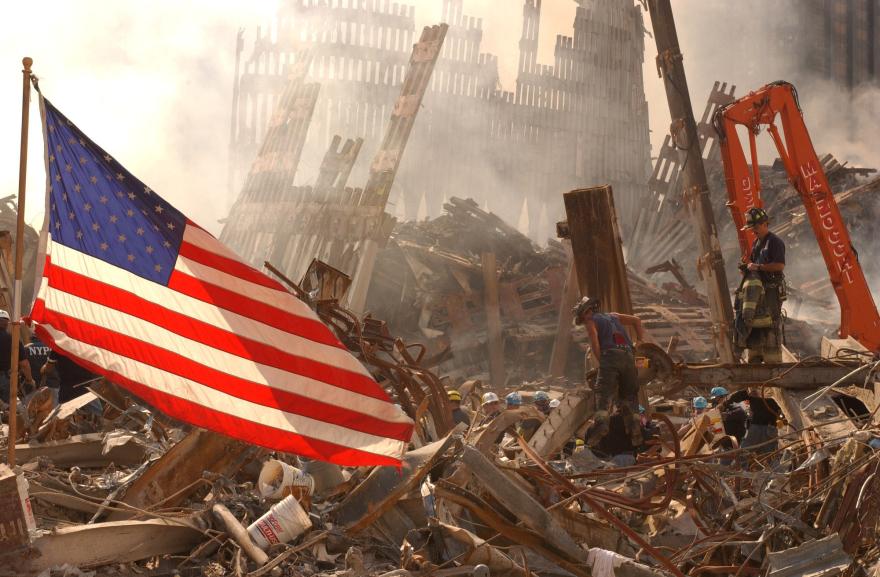
Those who lost family members and loved ones are aghast that there are those in this country who want to remove all meaning from the anniversary. Vincent Forras, a firefighter at the World Trade Center who was buried under rubble for two hours and survived, expressed why it is so important that young people are reminded of what took place on that day. “I believe that there is so much piled up against us at our nation’s schools and it is through organizations such as [YAF] and experiences such as mine…that we can succeed in leveling the playing field. My story is one of both the Greatest Tragedy and the most blessed and wonderful outcome which we can choose to cultivate after such a disaster. The story brings folks of all religions, parties, ages, and beliefs together for a brief moment in time, similar to what was experienced in America immediately after the 9/11 attacks. Remember that time? I do, and it is up to folks like us to tell this story over and over again in a way that wins over those who…had preconceived notions about who we are and perhaps not only get them to join us but to promote us through their peers and more.”
Untitled design
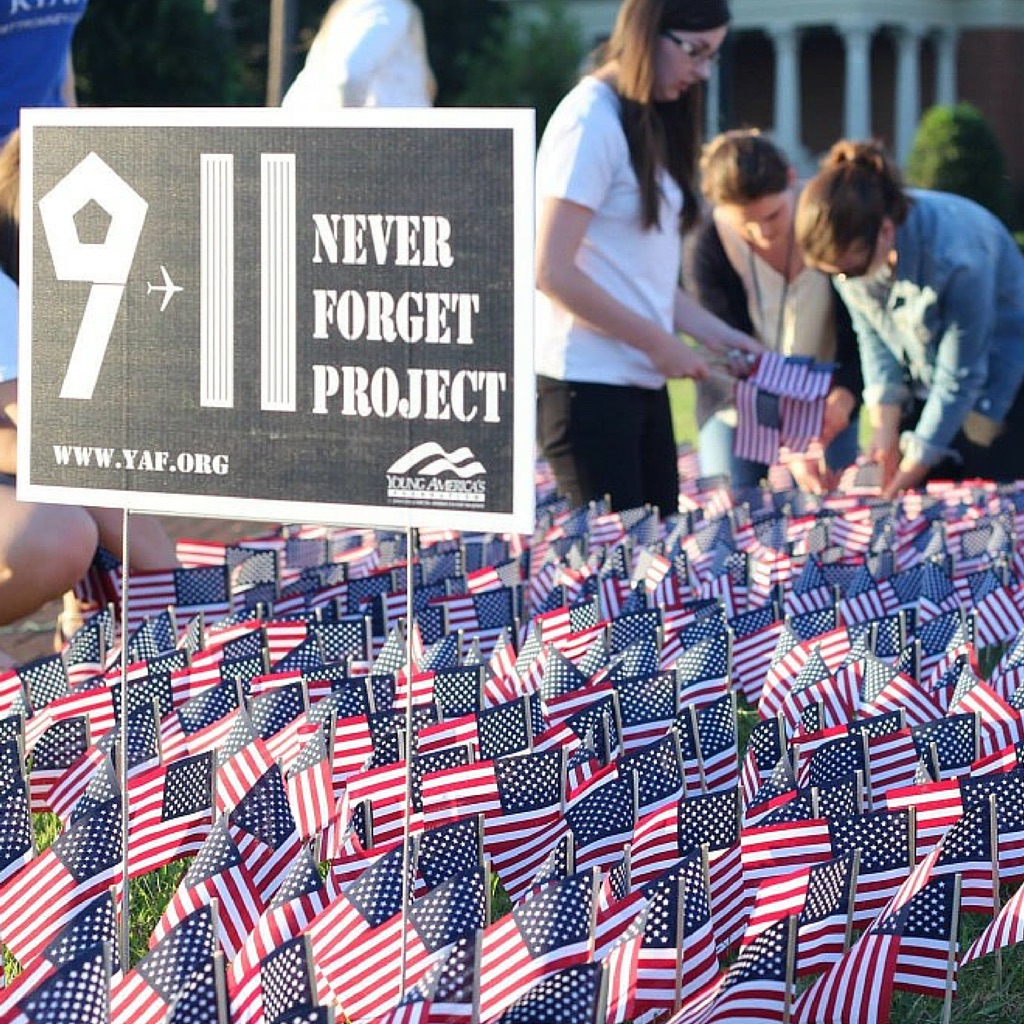
You can unite your campus community to properly remember the victims of the terrorist attacks by taking part in Young America’s Foundation’s 9/11: Never Forget Project. We have found a strong program on 9/11 brings positive coverage for clubs and can lead to additional members as well.
The following are activities you can plan to properly commemorate those who were murdered by jihadists on September 11. If the anniversary falls on a weekend (like this year), we recommend scheduling the display on the Friday before the anniversary, or if possible, in conjunction with your school’s football game over the weekend of the anniversary.
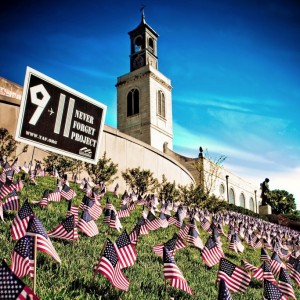
We urge you to prepare an American flag memorial for the anniversary of September 11. Your club will incur relatively minor costs, but the visual impact will leave a lasting impression on all who witness the display.
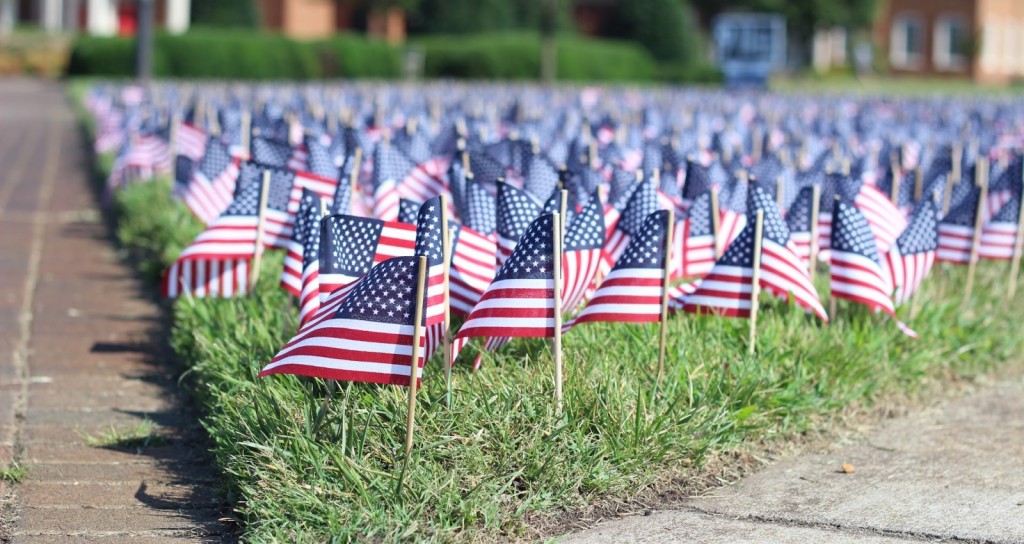
photo-3-1600x850

NeverForget 2Make It Happen

Arrange a display of 2,977 American flags to be placed in the ground of your campus, with each flag representing an individual murdered in the terrorist attacks.
Allot several hours the night before or very early on the day you plan to set up your flag memorial. Enlist enough club members to help with set-up and tear-down.
Select a high traffic area near the student union building, campus quad, or other area frequently visited by students. You will most likely need to attain permission for the display from your student activities or campus life office.
You should reserve a table near the display for your members to distribute Never Forget buttons and stickers as well as other resources provided by Young America’s Foundation, and to answer questions about the display and monitor the flags.
Proper flag etiquette requires that the American flag be lit at night. If the display is in a high traffic area, lighting should be sufficient. If not, you can purchase outdoor flood lights at a hardware store for minimal cost. You should also do your best to ensure the flags do not touch the ground.
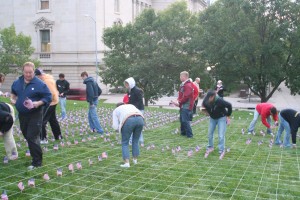
Students use string to create parallel rows of flags, maximizing the visual impact of their display.

Maximize Your Display’s Impact

Consider the following suggestions and ideas to maximize the impact of your display before moving ahead with your memorial.
Pick a field or area on campus that will emphasize, not diminish, the visual impact of your display. Attempting to stretch small flags across a large field reduces the visual impact of your display. It is much better to group the flags close together or select a smaller field that will appropriately hold all of the flags within its borders. Of course, it is also important to pick a high traffic area.
Use twine or thread to help align the flags in parallel lines. Jagged or uneven lines will have a less-impressive visual impact. If the ground is hard, flat-head screwdrivers can be used to dig holes for the flags.
eed16830-ada1-4376-9188-84368659182aOther Ideas To Consider

When preparing your 9/11: Never Forget Project activities, consider incorporating existing infrastructure on campus and in your community to enhance your event, such as a clock tower that could mark a moment of silence at 9:11 a.m. or fountains on your campus that could be used to symbolize the Twin Towers.
Recruit and work with other campus groups and community leaders including local churches, synagogues or even mosques, your campus chaplain or campus ministries office, ROTC, Cru, or local police and fire departments.
You can read aloud the names of all those from your area who died in the attacks on 9/11, or see if any community members or students lost family members in the attacks and ask them to participate, and request that flags be lowered to half-staff on campus.


If you don’t act, students will encounter bizarre alternatives. Your work to establish a memorial to those lost on 9/11 will ensure that your school doesn’t forget what happened on 9/11, or the 2,977 lives that were lost.
See the list of school’s already confirmed to participate in the 2016 9/11: Never Forget Project here, and if your school IS participating but isn’t on the list, add it here.
View Comments

Thursday, September 8, 2016

Resettlement Orgs Ask Obama for 100% Increase in FY17 Refugee/Related Admissions

An interesting article from www.numbersusa.com about jihad and refugees. This follows this post about the displacement of American workers. Remember, “Amnesty” means ANY non-enforcement of existing immigration laws! This follows this comment and this post about how to Report Illegal Immigrants! Also, you can read two very interesting books HERE.
Please follow me here.

 Resettlement Orgs Ask Obama for 100% Increase in FY17 Refugee/Related Admissions 

 https://www.numbersusa.com/sendfax

A group of 41 “non-governmental organizations” that assist refugees worldwide, including four directly involved in U.S. refugee resettlement, urged President Obama to commit to accepting 200,000 refugee and humanitarian admissions in fiscal year (FY) 2017 – a 100 percent increase over the projected FY17 level he established last year. While the president has the authority to establish the yearly refugee target, Congress must decide whether to provide funds to resettle that or an alternative number.
On September 19th the UN General Assembly will host a summit to address the record-level worldwide movement of refugees and migrants, with the aim of developing a coordinated approach. Then on September 20th President Obama will host a Leaders’ Summit on Refugees at which governments will announce new commitments on refugee aid and resettlement. The 41 organizations wrote Obama to influence his policies going into these meetings.
The organizations urge Obama to:
o Offer more humanitarian funding at the U.N. summit;
o Accept 200,000 refugee and humanitarian admissions in FY17, including at least 140,000 through traditional refugee resettlement and 60,000 through expansions of family-based, employment, and student visas; and
o Bolster refugee self-reliance through access to jobs.
Four of the nine non-governmental agencies that settle refugees in states signed the letter – Church World Service, HIAS, International Rescue Committee and U.S. Committee for Refugees and Immigrants. The 1980 Refugees Act, which authorizes the president to make a “determination” of refugee resettlement levels for the upcoming year, also established a massive federal program that pays private organizations to resettle each refugee. This eventually created a resettlement industry with large bureaucracies dependent on annual appropriations. Self-interest induces these organizations to push for ever higher refugee numbers, irrespective of whether that is in the public’s best interest.
President Obama set the refugee target at 85,000 for FY16, including 10,000 Syrian refugees, and projected a level of 100,000 for FY17. Media reports suggest Obama plans to dramatically increase his FY17 determination, but the number won’t likely be made public before the September 20 meeting.
Congress’ discussion of Obama’s FY16 target and, in particular, the disposition of Syrian and Iraqi refugees was sidelined as Members rushed to pass a continuing resolution (CR) to keep the government running on October 1, 2015, the beginning of FY16. The CR maintained FY15 assistance spending levels through mid-December.
In early November 2015 leaders reached a deal on emergency funding for Syrian and Iraqi refugees but started over when ISIS-led attacks on November 13th killed 130 people in Paris and injured hundreds of others. Some Republicans advocated freezing refugee intake from terrorist-producing countries but the omnibus spending bill Congress passed in December excluded the freeze and ended up provided $605 million more than the President’s request for Migration and Refugee Assistance
When Congress returns from summer recess next week, Members will again rush to keep the government running before FY17 begins. And since the likely vehicle is another CR, congressional debate over the president’s FY17 refugee numbers will have to wait until Member take up a longer term spending bill after the election.
refugees
National Security

Wednesday, April 20, 2016

Saudi involvement in 9/11 “deliberately covered up at highest levels” of US government

A timely post about from www.jihadwatch.org  about Saudi Arabia and 9/11. This follows this post about Pakistan and Nigeria. This follows this post about Islamophobia. This follows this article about American energy independence and preventing money from going to hostile countries. For more, you can read two very interesting books HERE.You can follow me here.


Saudi involvement in 9/11 “deliberately covered up at highest levels” of US government

What has the U.S. gained by doing the Saudis’ bidding all these years? Has global jihad terrorism abated? Have the Saudis stopped spreading their violent and virulent Wahhabi ideology around the world? Have the Saudis stopped the rise of the Islamic State? In fact, the whole “alliance” has been a disaster that has severely weakened the United States.
Bush-and-Abdullah
“How US covered up Saudi role in 9/11,” by Paul Sperry, New York Post, April 17, 2016:
In its report on the still-censored “28 pages” implicating the Saudi government in 9/11, “60 Minutes” last weekend said the Saudi role in the attacks has been “soft-pedaled” to protect America’s delicate alliance with the oil-rich kingdom.
That’s quite an understatement.
Actually, the kingdom’s involvement was deliberately covered up at the highest levels of our government. And the coverup goes beyond locking up 28 pages of the Saudi report in a vault in the US Capitol basement. Investigations were throttled. Co-conspirators were let off the hook.
Case agents I’ve interviewed at the Joint Terrorism Task Forces in Washington and San Diego, the forward operating base for some of the Saudi hijackers, as well as detectives at the Fairfax County (Va.) Police Department who also investigated several 9/11 leads, say virtually every road led back to the Saudi Embassy in Washington, as well as the Saudi Consulate in Los Angeles.
Yet time and time again, they were called off from pursuing leads. A common excuse was “diplomatic immunity.”
Those sources say the pages missing from the 9/11 congressional inquiry report — which comprise the entire final chapter dealing with “foreign support for the September 11 hijackers” — details “incontrovertible evidence” gathered from both CIA and FBI case files of official Saudi assistance for at least two of the Saudi hijackers who settled in San Diego.
Some information has leaked from the redacted section, including a flurry of pre-9/11 phone calls between one of the hijackers’ Saudi handlers in San Diego and the Saudi Embassy, and the transfer of some $130,000 from then-Saudi Ambassador Prince Bandar’s family checking account to yet another of the hijackers’ Saudi handlers in San Diego.
An investigator who worked with the JTTF in Washington complained that instead of investigating Bandar, the US government protected him — literally. He said the State Department assigned a security detail to help guard Bandar not only at the embassy, but also at his McLean, Va., mansion.
The source added that the task force wanted to jail a number of embassy employees, “but the embassy complained to the US attorney” and their diplomatic visas were revoked as a compromise.
Former FBI agent John Guandolo, who worked 9/11 and related al Qaeda cases out of the bureau’s Washington field office, says Bandar should have been a key suspect in the 9/11 probe.
“The Saudi ambassador funded two of the 9/11 hijackers through a third party,” Guandolo said. “He should be treated as a terrorist suspect, as should other members of the Saudi elite class who the US government knows are currently funding the global jihad.”
But Bandar held sway over the FBI.
After he met on Sept. 13, 2001, with President Bush in the White House, where the two old family friends shared cigars on the Truman Balcony, the FBI evacuated dozens of Saudi officials from multiple cities, including at least one Osama bin Laden family member on the terror watch list. Instead of interrogating the Saudis, FBI agents acted as security escorts for them, even though it was known at the time that 15 of the 19 hijackers were Saudi citizens.
“The FBI was thwarted from interviewing the Saudis we wanted to interview by the White House,” said former FBI agent Mark Rossini, who was involved in the investigation of al Qaeda and the hijackers. The White House “let them off the hook.”
What’s more, Rossini said the bureau was told no subpoenas could be served to produce evidence tying departing Saudi suspects to 9/11. The FBI, in turn, iced local investigations that led back to the Saudis….
"Palestinian" tried to stab Israelis so he could "marry virgins in Paradise"
UK: Muslim "anti-radicalization expert" says murdered Ahmadi "not real Muslim"
FacebookTwitterLinkedInDiggBlogger PostDeliciousEmailPinterestRedditStumbleUponPrint

Thursday, March 31, 2016

Crisis In Kosovo A Mixture of Iron and Clay

An interesting article from http://www.ucg.org/ about Kosovo. This follows this post about India and Pakistan. This follows this post about former Muslims in America. For a free magazine subscription or to get the books recommended for free click HERE! or call 1-888-886- 8632.

A broader perspective of the Balkans is needed than what the electronic news media typically provides. Much information about this “campaign” cum war is presented in the form of fast moving video clips and short sound bites. A more valuable insight can be gained in part from history, and in part from holding current events up against the backdrop of biblical prophecy.
Population statistics for the Kosovo of early 1999 indicate there were between one and two million people, 90 percent of which were ethnic Albanians. In the mid-60s the population of Kosovo was roughly 75 percent Albanian and 25 percent Serb. A quarter century before that it was about 65 percent Albanian descent and 35 percent Serb. But as recently as 1918, the ethnic Serbs and Albanians were relatively equal in size in Kosovo. What happened to the Serbs that used to live in Kosovo? That's a long and complex story that has much to do with recent events. They were forced out in part by the knives and guns of Albanian militia, in part by the troops of Mussolini, in part by the governing policies of Marshall Tito, and in part by economic forces.
Yugoslavia, meaning “Southern Slavs,” was literally created by the Allied Powers after World War I. From its inception it was an unstable, bitterly divided kingdom in which its various ethnic groups feuded with each other. Marshall Josip Broz Tito governed Yugoslavia from 1953-1980, and did much to create the present situation. It was in his best interest to encourage various rival ethnic groups to dominate different parts of the country. In line with that strategy, he refused to allow Serbs to return to Kosovo after WWII and encouraged immigration by and growth of the ethnic Albanians. A one-percent payroll tax was imposed upon all of Yugoslavia to subsidize the development of Kosovo along Tito's design. He established an autonomous government in the region (Serbs who live in Kosovo, from that day up to the present time, are required by law to study the Albanian language from the 7th to the 12th grades).
Religious and Nationalist Roots
These are not the only reasons why President Milosevic has been able to arouse such nationalistic fervor among Serbs in recent years. Religion is also a major, albeit little mentioned factor. The western third of the province of Kosovo was established as a direct dominion of the Serbian Orthodox Church in the Middle Ages and still has many areas that Serbs consider holy to their faith. The Serbs are Orthodox, having their own Patriarch and their own faith separate and distinct from the Eastern Orthodox Church. By contrast (a primary component in the current crisis), the Kosovar Albanians (as of early 1999), were approximately 90 percent Muslim.
Serbs first migrated to the Balkans in the sixth century A.D. and by the 1300s had established a powerful empire with its heartland in Kosovo. They fought a bitter battle against the Turks in the late 14th century on the plains of Kosovo. Awareness of the battle is intricately woven into the Serb national consciousness. Serbs were brutally dominated by the Turks for over four centuries, before gaining their independence in a 20-plus year war in the early 19th century.
The meaning of Kosovo to the Serb is compared to the meaning of Jerusalem to the Jew. So deep is the Serb passion for this land that one government official is quoted as saying recently that Serbs would fight until the last man to preserve Kosovo as part of Serbia. Serbian Deputy Prime Minister Draskovitch (labeled a moderate) said, “Our faith was born there, as was our language, our nationhood, our pride. It is incumbent upon us to defend Kosovo even if we die.” Asked by an American reporter if he does not want his hungry country to become part of the West and share in its wealth, he replied, “Not if the price is Kosovo.”
But the roots of the ethnic Albanians are, if anything, even deeper than those of the Serbs in Europe. Believed to be descendants of the ancient Illyrians, their forefathers settled the Balkan Peninsula hundreds of years B.C.! Albanian is one of Europe's oldest spoken languages. Parallel to the Serb action against Turkish rule was an Albanian resurgence of nationalism that led to the freedom of Albania from the Turks. Kosovar Albanians led that drive for independence, imprinting the Albanian people with their own nationalist feelings for Kosovo. Migrations of Serbs forced the Albanians into present-day Albania, Kosovo, Macedonia, and Montenegro.
A little less than a hundred years later, during the 1912-1913 Balkan Wars, Serbia defeated the Turks once again, seized Macedonia, and was awarded control of Kosovo. Serbs conducted the first ethnic cleansing of Albanians and other Muslims at that time, killing or expelling about 100,000 (including the family of Mother Teresa).
Leading up to World War II, Serb Nazi academics advocated the total “ethnic purification” of “inferior” Muslims and Albanians from Yugoslavia. During 1945-1947, another 100,000 Albanians were killed or expelled from Kosovo. In turn, Mussolini's troops drove back the Serbs, encouraging ethnic Albanians to pour into Kosovo. Back and forth the angry, bitter ethnic fighting went. As stated above, Tito would not allow Serbs back into Kosovo after Mussolini's purge.
Yugoslavia started to unravel after Tito's death in 1980 with a re-igniting of ethnic and religious conflicts. Kosovo, the poorest region of the country, was not an attractive home for Serbs who could move elsewhere. Serb emigration, coupled with a much higher birth rate among the Albanians and illegal immigration (one Internet report says that there are at least 500,000 illegal aliens among the Kosovar Albanians!), resulted in an 80 percent Albanian population in Kosovo by the early 1980s.
Old Wounds Reopened
Milosevic rose to power on anti-Albanian rhetoric, promising to restore a Serb majority to Kosovo. Drawing upon unsavory memories, he referred to ethnic Albanians as “Turks.” Age-old animosities were on the rise once again. Over the next decade, Milosevic attempted to make good his promises through three wars, involving Slovenia, Croatia, and Bosnia. Although a democratically elected president, Milosevic is a former communist who has encircled himself with criminal elements, including men who are both anti-Muslim and anti-Catholic. He has exercised a combination of skill and ruthlessness to inspire nationalism as well as generate fear, ensconcing himself in power.
Now we need to look at the Kosovo Liberation Army (KLA), the military force that is perceived by many in the West to represent the interests of the ethnic Albanians in Kosovo. The KLA wants to take over the existing infrastructure of Kosovo completely, an infrastructure that the Serbs, ethnic Albanians, (and over two dozen other ethnic groups), have built up over the years. A March 24, 1999 CNN report called the KLA an unlikely catalyst for NATO's first attack on a sovereign nation in its 50-year history.” Even a year ago it was a tiny, militant splinter group that was pushing for complete independence of Kosovo. The U.S. State Department listed the KLA as a terrorist group and some reports assert that the KLA was initially set up and financed by none other than Muslim radical Osama bin Laden. KLA militia has killed numerous ethnic Albanians in Kosovo attempting to force its leadership upon the Kosovars. It is well known that the KLA funds itself through the sale of drugs.
Nationalist rhetoric by President Milosevic, coupled with his 1989 repeal of Kosovo's autonomy and its financial subsidy, provided the political environment for the KLA to spawn. Serb police and the Yugoslav army took actions to purge the KLA and its drug operations from Kosovo. Sporadic murders of Serb policemen and Serb farmers in Kosovo by the KLA brought on reprisals by Milosevic's army-actions that in turn inflamed the KLA further. So much has happened in recent months-now in recent days -with all sides suffering anguished wounds that serve only to inflame their passions and their causes even more. Responding to the current crisis, men of Albanian descent are streaming from all parts of the world into Albania on a daily basis-volunteers to join the KLA. No immediate, truly peaceful solution is in sight.
Extremists on Both Sides of a Complex Situation
Prince Tomislav, fifth in line to the exiled Yugoslav throne, is anguished over the destruction of his homeland by NATO bombs and missiles. His wife is the daughter of an American father who flew for the RAF in the Second World War and a British mother who was also in the military. The Princess said, “It is shocking to think the Americans and British are driving this bombardment. If people knew the real truth about the Balkans the British public would never have given its support. There are extremists on both sides . I pray to God for an early end to this madness but I cannot see how it will happen” ( The London Times , emphasis added).
“There are extremists on both sides” offers a poignant summary of the entire tragedy.
Macedonia is a former province of Yugoslavia, slightly larger in size than the state of Vermont, bordering Kosovo. Possessing a sense of its size can help us appreciate the choking problem of a sudden influx of tens of thousands of refugees. Just to illustrate the ethnic mixing in the area, the country is 65 percent Macedonian, 22 percent Albanian, 4 percent Turk, and 2 percent Serb. Its principal religion, the religion of the majority, is Eastern Orthodox. Politically, it sympathizes with Serbia. Like its former sisters in the Yugoslavia of Tito, it's a transshipment point for Southwest Asian heroin and hashish. Unemployment, running at approximately 30 percent, is arguably a major factor for unrest.
Serbia, including Kosovo, is slightly larger than the state of Maine. Recent population statistics show it to be 63 percent Serb, 14 percent Albanian, 6 percent Montenegrin, and that the primary religion is [Serbian] Orthodox (65 percent), followed by Muslim (19 percent). Unemployment is estimated at over 35 percent and the country is poor.
Such a diverse ethnic makeup is indicative of many of the countries of Europe. For another example, Vojvodina province of Hungary, located along Serbia's northern boundary, has a majority Serb population and an autonomous government. This factor of great ethnic diversity represents a profound concern to the many nations of Europe, as they watch to see how NATO will resolve the crisis in Kosovo. A newly created independent country for the Kosovar Albanians—a long—stated objective of the KLA-could well fuel independent movements in ethnic minorities in numerous nations of Europe.
Different Focus-Different Picture
Mr. Herbert Armstrong often related that focus was all-important in understanding. “Like taking a photograph,” he would say, “everything depends on where you situate your camera.” Looking at a subject with even a slightly different focus can radically change “the picture” that you see. It is revealing to use the focus of today's events in Europe to look again at familiar prophecies of the Bible.
The life of the prophet Daniel was once threatened by a rash and impetuous decision by Babylonian Emperor Nebuchadnezzar. The background of this crisis in Daniel's life is explained in Daniel 2. Nebuchadnezzar had a terrifying dream that he could not recall or understand. He threatened to execute all of his advisors if they would not tell him the dream and its meaning. The Empire went from relative peace one day to an impossible stalemate the next that threatened to wipe out the entire senior staff (here we find an example, similar to recent events in Europe, of how unforeseen circumstances can bring sudden change)! The advisors couldn't be certain that this was not a trick and dare not “invent” a dream to satisfy the king. And Nebuchadnezzar's pride would not allow him to back down and lose face from this impossible demand he had made of his senior staff. This seemingly brutal threat from Nebuchadnezzar illustrates the different mentality of different cultures and peoples. Violence and bloodletting were routine “tools” of governing.
The catalyst for this unexpected and unforeseen crisis was a dream given by God ! He has reserved the prerogative to change the course of human affairs. “He changes the times and seasons,” said Daniel (Daniel 2:21). Political and military strategists can predict with some accuracy the likely actions of leaders and nations. But there are unseen factors that they cannot predict. Not only does God plant thoughts in the minds of men, He also brings or allows various men to come into positions of power and influence at key times. In Daniel's words, God “removes kings and raises up kings” (Daniel 2:21). Arguably, whoever is in power at a given point or place in history has a profound effect on the course of human events. Consider but a few of the personalities that helped to shape the current Balkan crisis: Marshall Tito, Pope John Paul II, Presidents Clinton and Milosevic-perhaps even the terrorist Osama bin Laden! Unique factors formed and shaped these men, and their influence at a given time has changed history.
Iron Mixed with Clay
Nebuchadnezzar's dream, interpreted by Daniel, was a prophetic overview of world history in advance, from Babylon's days up to the return of Christ. Shortly before His coming the world will be dominated by a confederation of nations characterized in the prophecy as “iron mixed with ceramic clay” (Daniel 2:33, 41-42).
The prophecy provides its own commentary in verse 43: “As you saw iron mixed with ceramic clay, they will mingle with the seed of men ; but they will not adhere to one another, just as iron does not mix with clay.” Different “ethnic groups” that would not normally coalesce as a unit are “baked” in the heat of crisis into a temporary union. “Ethnic” comes from the Greek word ethnos that is translated as “nations” in the Bible.
Carry that thought of the unexpected and the unpredictable to Revelation 13. A modern version of ancient Babylon, combining the old empire's speed, brute force, and powerful voice, controls the world at the crisis at the close of the age. Note that this “beast” comes out of nowhere, its “birth” is unexpected and unpredictable , dependent upon supernatural action from God [according to Daniel's prophecy] and the unseen influence of Satan [according to John's prophecy]. One sharp refresher lesson of the Balkan war, the crisis in Kosovo, is that world politics can spin or turn with appalling suddenness.
Note that a second beast, a super-religion in contradistinction to the political super power that is the first beast, comes into power at about the same time (verse 11). In a marriage of convenience the persuasive capacities of religion will bond with the political power of government (this fact is verified in a prophecy of one beast eventually destroying the other; Revelation 17:16). The political power of government wields the legal, financial, and military authority of a constituted superpower government (verse 12). In return, the religion uses its “pulpits”—literally—to excite and incite the world to align itself behind the political superpower entity. In a symbiotic relationship, they bring each other to their mutual pinnacles of power— suddenly .
Speaking to the same subject, chapter 17 of Revelation confirms that this end time outline includes a hastily achieved alignment of previously unknown nations and leaders. “The ten horns which you saw are ten kings who have received no kingdom as yet, but they receive authority for one hour as kings with the beast” (verse 12). Remember again the lessons of the current picture of the Balkans where nations and leaders have come out of what was Yugoslavia to form completely new entities.
Clearly fingering the Roman Empire as the precursor of the final confederation of states (verse 9), John thereby identifies Europe as the setting for the final world government. The Balkan crisis shouts “iron and clay!” What elements make it unlikely that Europe's ethnic groups will join together? Religion, economy, history (today's crisis, WWII, or all the way back to the 14th century!), nationalism, racism, conflicting governing philosophies (democracies, fascist dictatorships, communism, socialism-all in various forms).
Finally, Revelation 17:17 reminds us of the element of the unknown and the unpredictable-“God has put it into their hearts to fulfill His purpose.” As Daniel recorded, God reserves to Himself the prerogative to change the course of human affairs. We have the broad outline of prophesied events, but there are other facets to that outline-personalities, catalytic events, and their timeline—that God will trigger or allow according to His will. In the meantime, we watch—and we pray. WNP

You might also be interested in...

Tuesday, March 29, 2016

In Brief... Consequences of an Indian-Pakistani Nuclear Exchange

An interesting article from http://www.ucg.org/ about a potential war. This follows this post about Easter. This follows this post about former Muslims in America. For a free magazine subscription or to get the books recommended for free click HERE! or call 1-888-886- 8632.
 
What would happen if a nuclear weapon such as those in the arsenals of India and Pakistan were detonated? Perhaps 122,000 people would die per detonation. So if the two nations exchanged only one weapon each, nearly a quarter of a million casualties would result immediately.
Additionally, anyone within 100 miles who looks at the detonation would be instantly blinded. Of course, radiation continues to kill beyond those destroyed in the initial blast. The “kill zone” of the type of nuclear weapons these nations have is 2,500 square miles. That's why Britain and the United States warned their citizens to leave both countries at the height of the tension. Clearly, some military personnel who are fighting the War on Terror would be in the kill zone of radiation fallout.
How far would the radiation fallout extend? According to Dr. Garner, it would definitely reach the U.S. mainland. How damaging it would be at that point is anyone's guess and might be difficult to measure. Consequences would present themselves in increased cancer rates—something that might be difficult to attribute to a single cause.
Back to India and Pakistan, there is an additional and frightening result of radiation poisoning beyond the kill zone. Radiation is known to lower the immune system of those exposed to it. People outside of the kill zone would suffer enough radiation poisoning to seriously lower their immune system, resulting in the eruption of diseases that haven't been serious problems for decades. And new diseases will arise.
Regardless of what radiation fallout does in other parts of the world, the diseases that spring from radiation poisoning in the war theater will spread around the world, warned Dr. Garner. He cited how difficult it is to contain disease in this world of regular international travel.
Thankfully, it appears that India and Pakistan have moved back from the brink of a nuclear exchange. But the rhetoric between these long-time antagonists leaves one with little confidence that the threat has disappeared.
Jesus warned that as mankind approaches the end of this age, we would hear of “wars and rumors of wars” (Matthew 24:6). Modern technology has raised the ante in this no-win game, so that “rumors of wars” are exceedingly disturbing. Christ went on to encourage His followers to remain calm, assuring them that this bad news is necessary just before the close of the darkest time of human history. And, with the close of this evil age will come the dawning of the wonderful world of peace under the management of God's Kingdom.

You might also be interested in...


Tuesday, January 5, 2016

Shi'ite or Sunni: Who Will Dominate the Middle East?

An interesting article from http://www.ucg.org/ about the Sunni-Shi'ite conflict. This follows this post about Armageddon. This follows this post about Star Wars. For a free magazine subscription or to get the books recommended for free click HERE! or call 1-888-886- 8632.
 
 
With the shifting sands of the Middle East and North Africa, the United States appears to be losing its ability to shape events in the region. Things are certainly looking bad for the state of Israel. In fact, with so many contending over this region, things are looking bleaker and more dangerous for everyone.
Last year's so-called “Arab Spring” saw dissident groups of vastly different overall aims coming together to remove dictatorial regimes. But that temporary unity based on sharing a common enemy is already beginning to unravel.
Where are the geopolitical changes in the region headed? Let's consider five factors underlying the major power shifts underway.

Islamists dominate newly elected parliaments

Post-uprising elections have swept political Islamists into office. These have garnered the vast majority of seats in parliaments in Tunisia, Egypt, Morocco and Kuwait.
The same will likely occur in the up-coming Libyan elections, where Islamist strains run through almost all parties. And Yemen's new Muslim president will likely be joined by Islamists coming to power in parliamentary elections.
Egypt's presidential elections scheduled for May 23 and 24 may see the Islamists' newfound political power in parliament at work as kingmakers push for their selected candidate. Furthermore, Islamists in parliament are determined to curtail the president's powers in the next constitution, giving more say in the running of the country to the legislature they now dominate.
(The interim caretaker prime minister and cabinet the military rulers installed are expected to relinquish power this summer. But the diminishing of the military's power in dominating the government is expected to be a gradual process.)
In Egypt and elsewhere Islamists are winning because they have the most organized networks to mobilize voters, are the most trusted public or political groups, and have a track record of challenging oppressive or autocratic regimes.
Muslim Brotherhood offshoots in Libya and Syria, where they have suffered persecution from the government for decades, recently established political parties in anticipation of future elections.
Cairo-based journalist John Bradley, authorof After the Arab Spring: How Islamists Hijacked the Middle East Revolutions (2012), argues that the Islamist groups that have taken power in the Middle East are here to stay—with dire prospects for liberal democracy anywhere in the region. Asked in Zócalo Public Square online magazine whether some Islamist groups have already peaked, giving room for secular agendas to grow in the future, he responded:
“The opposite is true. It's secularism and liberalism that have peaked in the Arab world. Remember, [Iraq's] Saddam Hussein was a secularist, as was [Yemen's] Ali Abdullah Saleh, [Egypt's] Hosni Mubarak, [Libya's] Colonel Gaddafi, and [Tunisia's] Ben Ali. It's therefore not difficult to understand why most Arabs now associate secularism and liberalism with corruption, torture, tyranny, poverty, and a lack of dignity … That's the vacuum now being filled by political Islam. What will happen in the long-term nobody can predict. But the medium-term belongs to the Islamists” (“What Moderate Islamism?” March 4, 2012).
This does not bode well for the West in general and Israel in particular. Islamists in general are more hostile than secularists to peace with Israel and are supportive of Hamas, the terror organization now governing the Gaza Strip.

Sunni Crescent vs. Shiite Crescent

Regional geopolitics pit the powerful “Sunni Crescent” led by Turkey, Saudi Arabia, Qatar and the United Arab Emirates against the beleaguered “Shiite Crescent” states—Iran, Iraq and Lebanon.
Barry Rubin, director of global research in the International Affairs Center in Israel, sizes up the strategic battle for influence in The Jerusalem Post: “The new Middle East strategic battle is heating up, and this is only the start. It has nothing to do with Israel and everything to do with two more serious lines of battle: Arabs versus Persians [of Iran] and Sunni versus Shia Muslims …
“The real struggle is over who will control each Muslim majority country and who is going to lead the Middle East … The Sunni Arab position was stated very clearly by Amr Moussa, a veteran Arab nationalist and candidate for Egypt's presidency: '(The) Arab Middle East will not be run by Iran or Turkey'” (“The Region: The New Middle East's Internal Divisions,” March 4, 2012).
Rubin later clarifies what is emerging: “What we are seeing again, for the first time in three decades … is an Egyptian bid to lead the Arabic-speaking world and even the whole region. On this point, Egyptian leftists, nationalists and Islamists are united.
“And in the first round, the battle over control of the Palestinian Islamist group Hamas, which rules the Gaza Strip, Egypt won and Iran lost.” (See “Hamas' Shifting Allegiance Reflects New Mideast Dynamics”)
Egypt is the largest Arab country, with a population of 83 million, and has long had a major influence on the region. Now that Islamists have won 72 percent of the seats in the lower house and nearly as many in the upper, this fundamentalist orientation will likely be a major influence on the growing number of Islamic governments in the region.

Regional geopolitical jockeying

As Hamas and Egypt push for regional influence, other regional players are doing the same. In its annual forecast, the global intelligence service Stratfor (Strategic Forecasting) pointed out that Iran, Turkey and Saudi Arabia are involved in a dance for dominance in the shifting political sands of the region:
“Iran's efforts to expand its influence will be the primary issue for the Middle East in 2012. The U.S. military withdrawal from Iraq has rendered Iran the pre-eminent military power in the Persian Gulf … Turkey, Iran's natural regional counterweight, is rising steadily, albeit slowly” (“Annual Forecast 2012,” Jan. 20, 2012).
Turkey, the report states, will continue to face significant challenges to its regional ascendency due to instability near its borders. It continues its efforts to mold an opposition in Syria, counterbalance Iranian sway in Iraq and influence the rise of political Islamists, particularly in Egypt and Syria. But analysts don't see it making much headway.
Stratfor also explains how Iran affects Saudi Arabia's push for regional dominance: “Iran's regional expansion will be felt most deeply by Saudi Arabia. The Saudi royals now doubt that the United States has the ability or the willingness to fully guarantee Riyadh's interests. Adding to Saudi Arabia's vulnerabilities, the Gulf Cooperation Council states fear that if Iran is not contained within Iraq, it will exploit continued Shiite unrest in Bahrain and in Saudi Arabia's Shia-concentrated, oil-rich Eastern Province.”
Saudi Arabia is leading efforts to shore up and consolidate the defenses of Gulf Cooperation Council members to try to ward off the threat posed by Iran. But those efforts will not be a sufficient replacement for America's role as a security guarantor.
Stratfor goes on to examine the tug-of-war underway in Iraq and Syria: “The effects of Iran's expansion efforts will be most visible in Iraq and Syria. In Iraq, Iran's main challenge is to consolidate Shiite power among several competing groups.
“As Iraq's fractured Shiite leadership tries to solidify its influence with Iranian support, Iraq's Sunni and Kurdish factions increasingly will be put on the defensive. This ethno-sectarian struggle and the security vacuum created by the U.S. withdrawal will degrade Iraq's overall security conditions.
“Meanwhile, Turkey will attempt to contain the spread of Iranian influence in northern Iraq by building up political, economic, military and intelligence assets.”
The fight in Syria is really two contests in one. It's a struggle between Syrians over the nature of their government and society, but it's also a regional rivalry between Iran and its adversaries, as Stratfor explains:
“In Syria, the ultimate goal of Saudi Arabia, Turkey and the United States will be to disrupt Iran's Shiite arc of influence by trying to crack Syrian President Bashar al Assad's regime. However, without direct foreign military intervention, the Syrian regime is unlikely to collapse.”
Even the normally feeble 22 nations of the Arab League took unprecedented actions in calling for the Assad regime to leave and hosted a “Friends of Syria” meeting to try to gain support for boycotts and possible military assistance.
The League pushed hard for a resolution from the United Nations Security Council calling on Assad to step aside, but even a watered-down version calling for a cease-fire and talks was blocked by Russia and China.
Also, Turkey, Saudi Arabia and Jordan are all calling on Assad to go. But as of this writing they remain ambivalent about direct military action, although Saudi Arabia is providing some arms to the rebels.
Syria's ties to Iran complicate its status in the Middle East's power balance. The two countries are commercial partners, have signed a mutual defense agreement and in the past have supported the terror groups Hezbollah and Hamas, which act against Israel. As pointed to above, the tie to Iran is undoubtedly a major factor in the Arab states calling for Assad's departure.
Unlike the other Arab Spring uprisings, Syria's rebels do not reflect a sweeping cross-culture movement. There is still a large segment of the populace remaining loyal to Assad, so the fighting is likely to be protracted.
Writing in Foreign Policy, journalist Nir Rosen explains the Islamic base of the revolt in Syria: “Syria's uprising is not a secular one. Most participants are devout Muslims inspired by Islam. By virtue of Syria's demography most of the opposition is Sunni Muslim and often come from conservative areas. The death of the Arab left means religion has assumed a greater role in daily life throughout the Middle East” (“Islamism and the Syrian Uprising,” March 8, 2012).

Big stakes for the big powers

In addition to the regional forces vying for dominance in the Middle East, the Arab Spring has sparked a global tussle as well. It has become a springboard for big-power geopolitics among the world's greatest military powers—America, Russia and China.
Two decades after the collapse of the Soviet Union, the West has yet to adjust to the post-Soviet reality, and Russia has not settled on its relationship with the rest of the world. And China's growing economic and military prowess means it has a greater need for vital Middle East oil but also the means to secure what it needs.
Syria has emerged as a key battleground for a Cold War–style tug-of-war between these powers. Russia sent warships to discourage foreign intervention in Syria. China has sent emissaries to Syria to try to broker a cease-fire deal and is being drawn more deeply into Iran's confrontation with the West. And America has less and less influence in the region.
Syria is often called Russia's last remaining ally in the Middle East. The relationship between them goes back four decades. It formed the centerpiece of the Soviet position in the region during the Cold War, the Soviets then equipping and training the Syrian military.
Moscow today continues to arm and politically shield the Assad regime. The Russians are intent on keeping their only military base outside the old Soviet Union in Syria's Mediterranean port of Tartus. In addition, Russia is thought to have major economic interests in Syria, including arms contracts and plans for nuclear energy cooperation.
But America seems equally determined to see a pro-Western regime in Damascus. This has created diplomatic tensions with Russia and China who oppose measures that could lead to military intervention or forced regime change in Syria.
Russia sent at least three guided missile frigates—reportedly loaded with anti-aircraft and anti-ship missiles—to Syria. Russia's main interest in blocking UN sanctions against the Assad regime is to prevent NATO intervention in Syria and to keep the country in its sphere of influence.

The threat of nuclear attack and proliferation

Just as Russia's approach to the Middle East is at a turning point, Iran seems as determined as ever to move ahead with its nuclear program in defiance of America, Israel and the rest of the West—and the broader world. Even Russia and China oppose Iran getting a nuclear weapon.
Iranian society 33 years ago was steeped in revolutionary fervor. Today it suffers from revolutionary fatigue. This is one reason Iran's 2009 uprising did not have the same durability as the popular uprisings that have unsettled and unseated numerous Arab dictatorships. People may aspire for revolutionary ends, but there's no romanticism about it and a limited appetite for it.
Iran has been a quasi-theocracy since the Islamic Revolution of 1979. It has been at odds with America and the West for much of that time.
Israel sees the prospect of a nuclear Iran that calls for its annihilation as an existential threat. Israeli leaders maintain that a decision to strike Iranian nuclear facilities will have to occur by the time Iran is on the verge of shielding these facilities from attack—what they call the “zone of immunity.”
Some experts oppose an attack because they claim that even a successful strike would, at best, delay Iran's nuclear program for only a few years.
Many experts believe the greatest threat associated with the Iranian nuclear program is that it might trigger a regional nuclear arms race that would be deeply destabilizing and would dramatically increase the risk of a weapon falling into irresponsible or fanatical hands.
The president of the United States, Barack Obama, has said that nothing is off the table when it comes to preventing Iran from developing a nuclear weapon.
But Israeli Prime Minister Benjamin Netanyahu, after meeting with Obama, acknowledged that differences still exist in the Israeli and American timetables for contending with the Iranian nuclear program, as reported by The New York Times:
“Mr. Netanyahu reiterated the point he had sought to make forcefully in Washington: that if Iran did not change course, Israel, which considers a nuclear Iran a threat to its existence, would not allow itself to be in a position where its fate was left in others' hands” (“Netanyahu Says U.S. and Israeli 'Clocks' Differ on Iran's Threat,” March 9, 2012).
Negotiation efforts are underway to try to come to a diplomatic solution. The six-power talks with Iran include the United States, Russia, China, France, Britain and Germany. Obama was hoping talks would help quiet the “drums of war.” But others think the Iranians' agreement to these talks is just a false show of cooperation while their nuclear development still goes on.
Reuters news agency reports on the U.S. stance: “'Military action is the last alternative when all else fails,' [U.S. Defense Secretary Leon] Panetta told the annual policy conference of the biggest U.S. pro-Israel lobbying group, AIPAC. 'But make no mistake, when all else fails, we will act'” (“Obama Says New Iran Talks Should Calm 'Drums of War,'” March 6, 2012).

Regional transformation will lead to what is foretold

What all this adds up to is that these multilayered shifting sands of domestic, regional and global forces blowing through the Middle East and North Africa are changing the region more dramatically than at any time in the last half century.
The factors underlying the major power shifts carry long-term effects, creating a dramatically different Middle East than what this generation has known.
And there's another source to help us see what's happening. Bible prophecy reveals how all these shifting forces will eventually play out.
The Arab Spring uprisings, in the short term, have focused the Arab world's attention on the changes swirling around them and away from their longtime nemesis—Israel. But, as prophecy lays out, the persistent hatred of Israel will in the long run grow exponentially as Islamic influence grows. Prophecies indicate that a more united group of Arab nations, perhaps sparked by religious zeal, will focus their rekindled hostility toward Israel.
This hostility will grow to a major crescendo leading to all-out war as we approach the end of this age. Psalm 83 contains an intriguing prophecy that shows a number of Middle Eastern countries forming a confederation of nations determined to cut off Israel from being a nation (verses 3-8).
Out of this region will arise a strong end-time leader Daniel the prophet calls “the king of the South”—successor to the ancient Greek rulers of Egypt (Daniel 11:40). This ruler, probably backed by other Islamic nations joined in confederacy with him, will start the cascade of terrifying events leading to a massive war with the power and ruler the Bible refers to as “the king of the North”—successor to the ancient Greek rulers of Syria.
This power is synonymous with the final revival of the Roman Empire referred to in Scripture as the Beast—which will consist of a brief union of 10 nations (Revelation 17:12-14).
The forces of the North, Europe at this time, will sweep down through the Middle East in a major military counterattack that will overthrow the southern power and occupy key portions of the Middle East (Daniel 11:40-41). (See also “The Middle East: Focus of End-Time Bible Prophecy”)
Ultimately, however, this European power and other eastern forces arrayed against it will resist the return of Jesus Christ as coming King and will suffer utter defeat (Revelation 16:12-14; 17:14; 19:11-21). (Our free Bible study aid booklet The Middle East in Bible Prophecy gives more details.)
In the meantime, Jesus tells all of us to stay on the alert to events heralding His coming (Matthew 24:42; Luke 21:36). One major indicator we should be watching for is the rise of a unifying force and leader in the Middle East. Keep your eyes and interests fastened on significant developments in this critically important region.

You might also be interested in...

The hope that a democratic Iraq will exert a powerfully stabilizing influence...
We need to understand what's prophesied to happen in the Middle East because...